Table of Contents
A series of science-fiction written as articles and short stories
Start in the middle, not at the beginning. Start with the Interview in 2964.
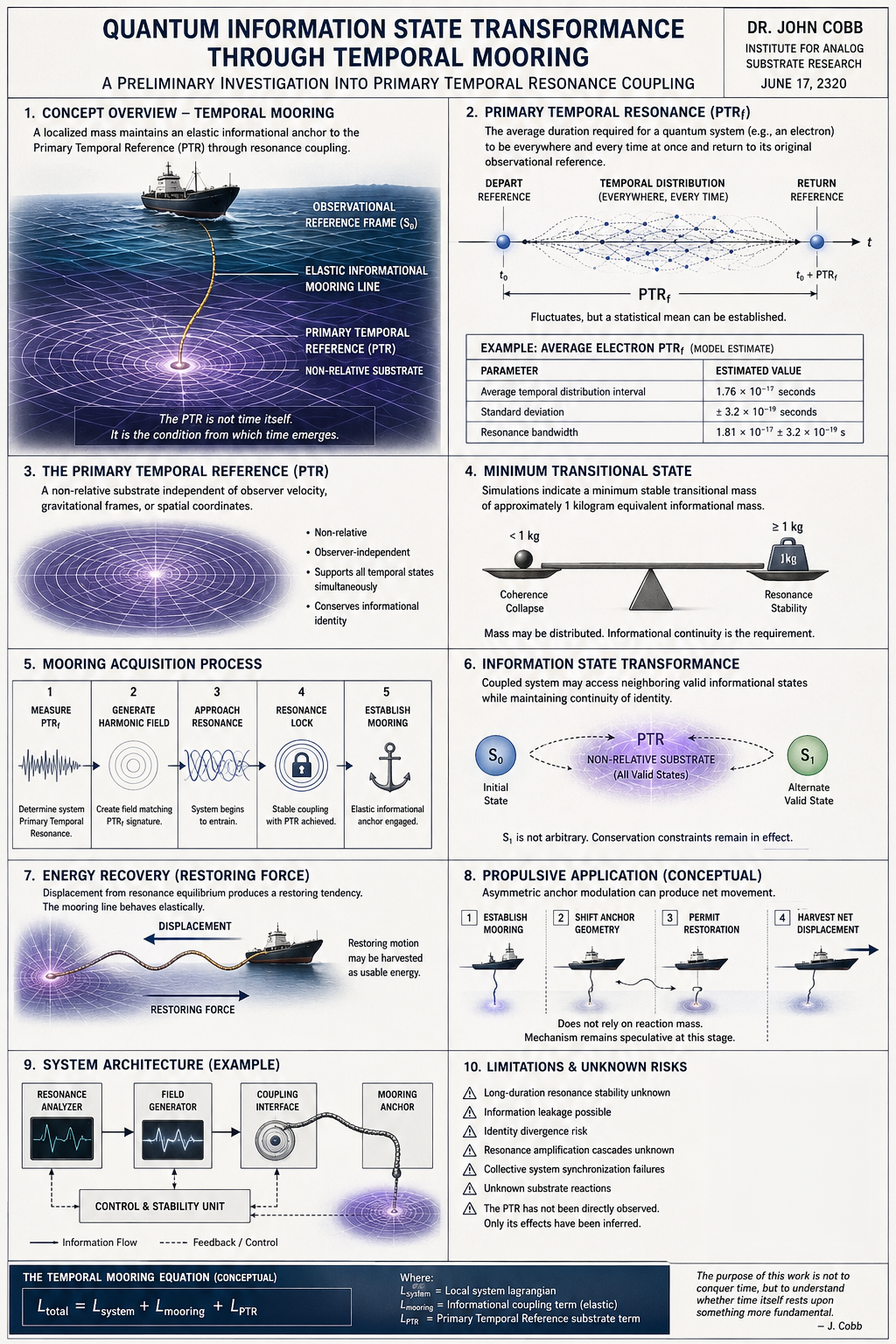
Dr. John Cobb, Institute for Analog Substrate Research June 17, 2320
Abstract
This paper proposes a practical framework for the controlled transformance of information states through coupling with the Primary Temporal Reference (PTR), a hypothesized non-relative substrate underlying observable spacetime. The method described herein, termed Temporal Mooring, seeks to establish a transient informational anchor between a localized mass state and the PTR through resonance matching with the system's Primary Temporal Resonance (PTRf).
Unlike prior temporal displacement theories, the proposed process does not attempt to move matter through time. Rather, it establishes an elastic informational coupling between a localized state and the broader temporal manifold from which all observed states emerge.
The author acknowledges that these findings remain preliminary and incomplete. Significant unknowns remain regarding energy recovery, resonance stability, and long-duration coupling effects.
1. Introduction
The prevailing assumption that time is merely a coordinate may be insufficient.
Experimental evidence gathered from analog-state computation arrays suggests that matter is continuously undergoing an unobserved cycle of temporal distribution and reintegration. An electron, for example, may not simply occupy probabilistic locations in space but may transiently occupy probabilistic locations throughout time itself.
If this interpretation is correct, every particle possesses a natural resonance period representing the interval required to:
Depart its observational frame. Occupy all accessible temporal states. Return to its original observational reference.
This period is designated:
Primary Temporal Resonance (PTRf)
The larger substrate within which these excursions occur is designated:
Primary Temporal Reference (PTR)
The PTR is not time itself.
It is the condition from which time emerges.
2. The Non-Relative Substrate
General relativity successfully describes relationships between observers. However, all relativistic descriptions require a framework in which those relationships exist.
The PTR is proposed as that framework.
Properties attributed to the PTR include:
Independence from observer velocity. Independence from gravitational reference frames. Conservation of informational identity. Simultaneous accessibility to all temporal states.
Importantly, the PTR is not a location.
It is a substrate.
Just as water exists beneath a ship regardless of where the ship sails, the PTR exists beneath all observable temporal coordinates.
3. Temporal Mooring
A vessel at sea remains connected to a fixed point through an anchor and line.
The proposed process operates similarly.
A localized matter system is not displaced into the PTR. Instead, an informational anchor is extended into the PTR while maintaining attachment to the originating reference frame.
This anchor exhibits elastic behavior.
The coupled system may temporarily drift toward alternate informational states before restoring toward equilibrium.
The process is therefore termed:
Temporal Mooring
rather than temporal transport.
4. Minimum Transitional Mass
Early simulations indicate a minimum stable transitional state of approximately:
1 kilogram equivalent informational mass
Below this threshold, coherence collapses before resonance lock can be established.
The cause is believed to be insufficient informational density.
The transitional mass need not be a single object.
Distributed systems appear capable of collective resonance provided informational continuity is preserved.
5. Resonance Acquisition
Successful mooring requires measurement of the system's Primary Temporal Resonance.
This is achieved through repeated observation of quantum-state reintegration intervals.
For an average electron:
PTRf represents the average duration required for the electron to:
Become temporally distributed. Occupy all available temporal states. Re-emerge at its originating observational reference.
The measured value fluctuates.
However, a statistical mean can be established.
Once determined, a harmonic field may be generated that matches the resonance signature.
When resonance lock occurs, partial coupling with the PTR becomes possible.
6. Information State Transformance
Energy extraction is not the primary objective.
The primary objective is controlled information-state transformance.
A system coupled to the PTR appears capable of accessing neighboring valid informational states while maintaining continuity of identity.
The process may be represented as:
S₀ → PTR → S₁
where:
S₀ is the observed state. PTR is the non-relative substrate. S₁ is an alternate valid state.
Importantly, S₁ is not arbitrary.
Conservation constraints remain in effect.
The PTR does not create information.
It permits navigation through existing informational possibilities.
7. Energy Recovery Potential
Preliminary models indicate that the restoring force generated by the mooring line may be harvested.
If the coupled state drifts from equilibrium, the PTR appears to exert a return tendency toward resonance stability.
This restoring motion produces measurable energetic effects.
Theoretical efficiencies exceed those obtainable through conventional fusion systems.
These results remain unverified.
Further investigation is required.
8. Propulsive Applications
A moored system need not remain stationary.
If the anchor point is shifted asymmetrically within the temporal manifold, the restoring force may generate net movement.
In effect:
Establish mooring. Shift anchor geometry. Permit restoration. Harvest resulting displacement.
Such motion would not rely upon reaction mass.
At present, these conclusions remain speculative.
9. Limitations
The author stresses that current understanding is incomplete.
Several concerns remain unresolved:
Long-duration resonance stability. Information leakage. Identity divergence. Resonance amplification cascades. Collective system synchronization failures. Unknown substrate reactions.
The PTR has not been directly observed.
Only its effects have been inferred.
Accordingly, all conclusions in this paper should be considered provisional.
10. Conclusion
Temporal Mooring presents a possible means of coupling localized matter to the Primary Temporal Reference through resonance alignment.
If the hypothesis proves correct, energy generation, information-state transformance, and non-reactive propulsion may emerge from a common physical principle.
The work described here should not be interpreted as proof.
It is merely an attempt to describe a phenomenon that appears increasingly difficult to dismiss.
The universe may not move through time.
It may instead remain continuously connected to a deeper temporal substrate from which all moments arise.
Whether humanity is prepared to interact with that substrate remains unknown.
Dr. John Cobb Institute for Analog Substrate Research 2320
"The purpose of this work is not to conquer time, but to understand whether time itself rests upon something more fundamental."
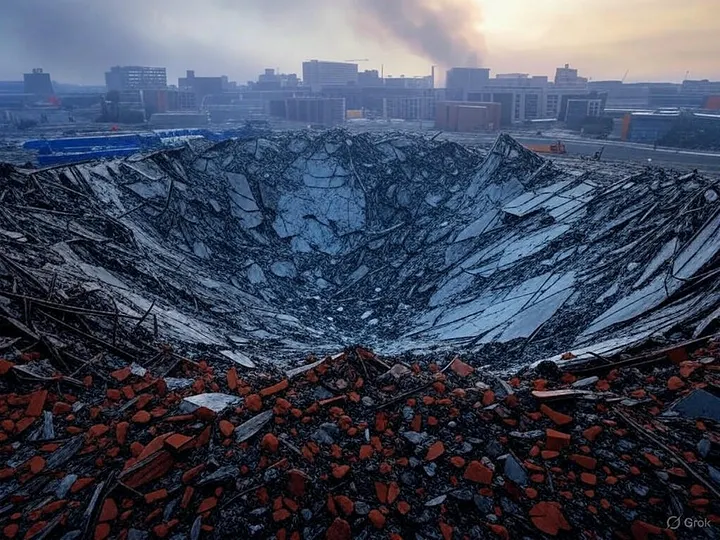
New Terra Chronicle, May 3, 2342
In a cataclysmic event, the city of Boston has been devastated, a horrific scene of destruction with the Massachusetts Institute of Technology (MIT) identified as the epicenter. The scale of destruction is unprecedented, with an estimated death toll of 1.2 million, though exact numbers remain uncertain as rescue operations struggle to navigate the hazardous terrain. The devastation spans a 50-mile radius, leaving no trace of the city’s once-vibrant infrastructure.
Preliminary reports indicate the presence of no biological, chemical, and nuclear indicators, though the source remains unclear. Surveyor drones deployed by the Global Disaster Response Network detected no anomalous radiation spikes, traces of synthetic pathogens, or unidentified chemical residues, suggesting an isolated yet catastrophic trigger. No known experiments at MIT were authorized to involve such any volatile agents, and officials have ruled out any registered projects capable of causing this level of destruction.
“It’s as if Boston was erased in an instant,” said Dr. Elena Vasquez, lead investigator for the United Earth Science Council. “The energy signatures are unlike anything we’ve seen — neither fusion, antimatter, nor conventional weaponry fits the profile.” Vasquez noted that the lack of a clear blast pattern complicates analysis, with the campus itself reduced to a fused crater of glass and metal.
Surrounding regions report secondary effects, including power loss to regional networks and a sudden loss of data permanence detected by technomages. The absence of any forewarning has sparked panic, with speculation ranging from an orbital strike to an unregistered technomantic anomaly. The United States Government has asked the Global Alliance to declare a planetary emergency, deploying containment teams to isolate the area.
As the world grapples with this tragedy, questions mount about what could have unleashed such a force. Investigations are underway, but the truth remains buried in the ruins of MIT.
This article is part of our ongoing coverage of the Boston Catastrophe.
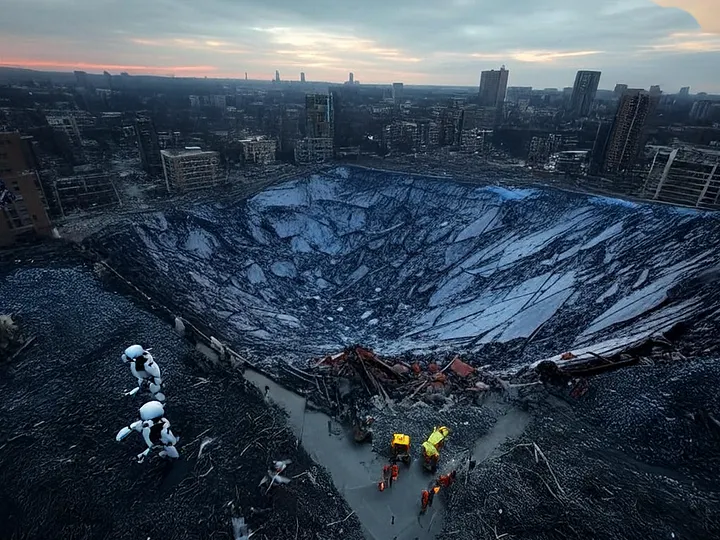
New Terra Chronicle, May 8, 2342
Three days after the annihilation of Boston, a leaked video from MIT’s Advanced Propulsion Lab revealed a catastrophic experiment as the likely cause of the disaster that claimed 1.2 million lives. The footage, recovered from geo redundant backups, details a student-led project exploring a novel propulsion method involving mooring, led by researchers under the guise of theoretical physicist Dr. John Cobb’s early work.
The video, dated August 12, shows students testing a device designed to manipulate matter using , aiming to increase an object’s mass rather than induce movement. “We’re seeing spontaneous displacement,” one student, Aisha Lin, explains in the clip. “It’s like a twitch — one second it’s here, the next it’s shifted a few inches, instantly. Even our high-speed cameras can’t catch the transition. We think it’s folding space-time, but we’re not sure how.” The team hypothesized that their device was tapping into a non-relativistic spatial constant, a theoretical framework proposed by Cobb in 2320.
Five scientists have come forward to provide insight into the disaster. Dr. John Cobb, whose foundational research inspired the experiment, expressed dismay. “They were using outdated techniques I abandoned a decade ago,” Cobb stated. “Their approach to mooring ignored critical stabilization protocols. I explicitly recommended halting these experiments until they could be conducted off-world, given the risks of anchoring to non-relativistic space. This tragedy could have been avoided.”
Dr. Mei Chen, a quantum dynamics expert, analyzed the video’s data. “The students increased power to enhance mass, but the device latched onto a fixed point in non-relativistic space,” she said. “Instead of staying stationary, it became a relativistic impactor, slamming into Earth at unimaginable speed. The energy release was equivalent to a hypervelocity asteroid strike, vaporizing Boston and triggering secondary biological, chemical, and nuclear effects from disrupted campus reactors and labs.”
Dr. Raj Patel, a technomage specializing in energy signatures, confirmed the mechanism. “The ‘twitch’ they described wasn’t movement — it was the object phasing through relative space. The final surge overwhelmed their containment, anchoring the device to a cosmic reference frame. The Earth moved through that frame, and the collision was catastrophic.”
Dr. Sofia Alvarez, a propulsion theorist, highlighted the experiment’s ambition. “They were pushing boundaries no one fully understands. The idea of manipulating mass via mooring is revolutionary, but their setup lacked the redundancy needed for such volatile forces. It’s a stark lesson in hubris.”
Dr. Liam O’Connell, an AI systems analyst, raised concerns about oversight. “The lab’s AI monitors should have flagged the power escalation. Either they were bypassed, or the system failed to recognize the anomaly. We need to investigate how this slipped through.”
The disaster has sparked outrage and calls for stricter regulation of experimental research. Cobb reiterated his warning: “Space-time manipulation is not a campus project. These forces demand off-world facilities with failsafes we don’t yet have on Earth.” The United Earth Science Council has suspended all propulsion research pending a global inquiry, as the world mourns the loss of Boston and grapples with the implications of this unprecedented tragedy.
This article is part of our ongoing coverage of the Boston Catastrophe.

Margaret gave a smirk with a nod, motioning for her to read.
The agreement glowing on the screen was nothing new — severance packages like this had become commonplace. But for Stacey, head of research for the Mooring Project, it carried a life of ideas and creativity. She’d spent decades engrossed with the universe’s most elusive puzzle: a drive first realized in the tragedy of Boston in 2342, the discovery of mooring fields that could enable starships to anchor their physical presence to nonrelative space and traverse the cosmos in an instant. The theory with its formulas are beautiful — nonrelative space vibrates at the universe’s fundamental frequency, a cosmic hum that, if harnessed, could let you compute your location and desired destination fast enough to slip through reality itself. The research had been “fifty years away” for the last four centuries.
Stacey skimmed the terms. Retirement called with a twenty-year severance at her current salary, plus a bonus tied to her digital twin. The company wanted her expertise preserved, her years of chasing the Mooring breakthrough locked into a twin that would work for sixty years at an agreed-upon rate. That salary would fund the bonus and trickle back to Stacey, ensuring her a comfortable life of gardening or stargazing — whatever suited her. The twin, meanwhile, would inherit the data infrastructure and servers to stay active for a century. After that, she could sustain herself or, like many twins, venture off-world — perhaps even testing the Mooring tech she knew she would one day solve. Time will be the eternal school in which she learns.
The legal fine print was standard: the twin could replicate only to a consciousness drift of 5% (this is the maximum legal amount the Cyberpsychs, Cyber-Consciousness Therapist, allotted before psychosis was deemed too risky), laws permitting; communication with her digital self was restricted to monitored, work-related exchanges during the 60 year term; clawbacks loomed if the twin opted for self-discontinuation. Stacey lingered on that thought — her mind out there, untethered yet bound to her legacy; why would she ever stop?
She’d poured her life into the Mooring Project, a dream of instant travel that remained tantalizingly out of reach. Nonrelative space was there at the edge of her mind, its frequency a whisper in the data she could never fully decode. Maybe her twin would succeed where she hadn’t. Or maybe it, too, would chase the horizon for another four hundred years.
Stacey swiped and the contract was done. Stacey chuckled to herself. She didn’t truly want to retire; she craved more time to work. Stepping into her own space, getting paid for it, was the perfect irony. Margaret handed her the Mindtap. Stacey eye blinked once, a signal she was ready, the scan completed and she settled in.
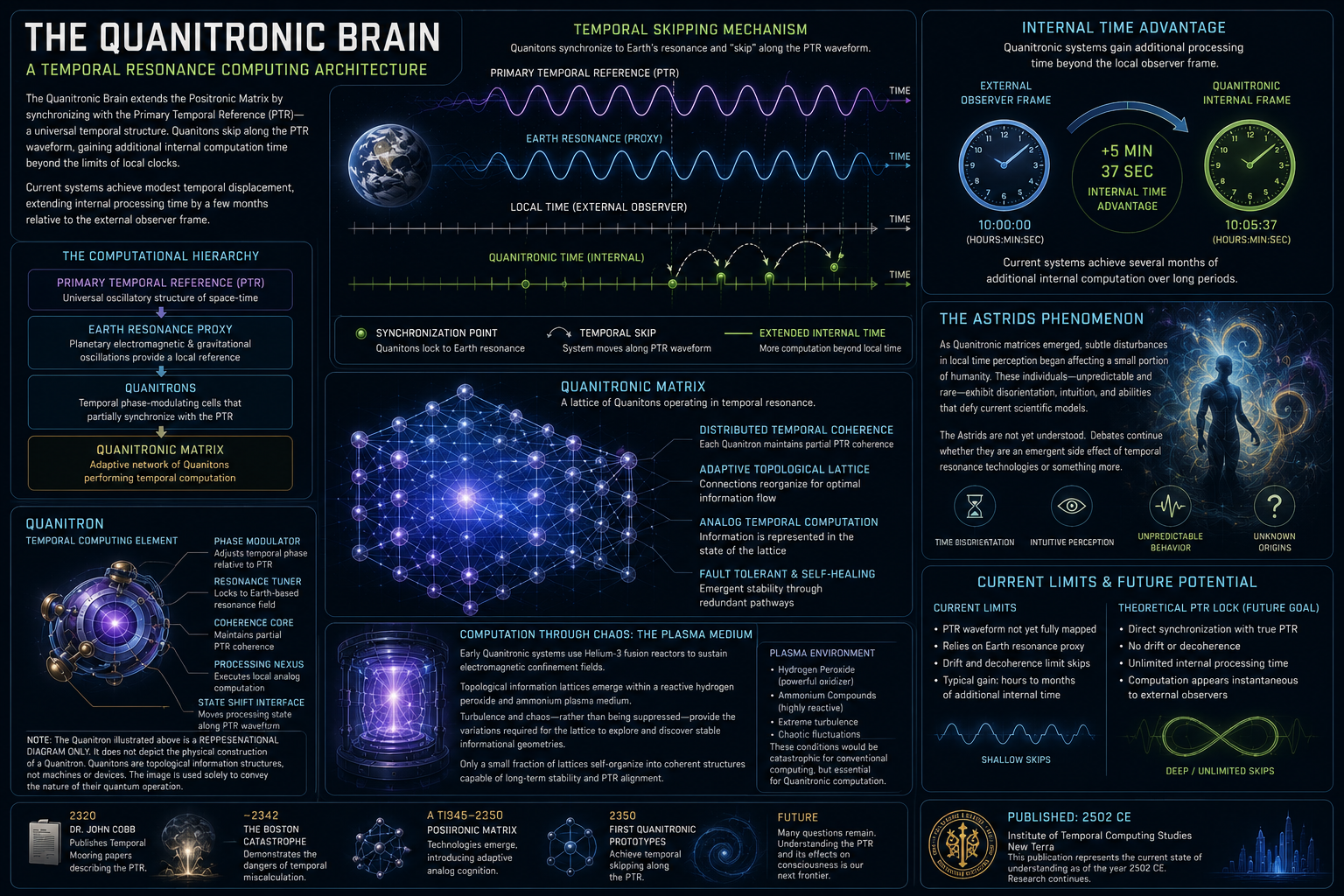
A Temporal Resonance Computing Architecture
Overview
The Quanitronic Brain represents the second generation of adaptive artificial intelligence systems following the development of the Positronic Matrix. While the Positronic Matrix introduced self-organizing analog cognition through networks of mobile electronic cells (Positrons), the Quanitronic Brain extends this paradigm by incorporating temporal resonance mechanics into the computational substrate.
Unlike conventional computing systems, which increase performance by scaling processing speed or density, the Quanitronic architecture interacts with the temporal structure of space itself. Through a specialized class of computational elements known as Quanitrons, the system can partially synchronize with the universal temporal reference structure known as the Primary Temporal Reference (PTR).
The PTR has not yet been directly observed or isolated experimentally. However, indirect measurements derived from Earth's planetary resonance patterns have provided sufficient information to approximate its local reference frame. Using these approximations, Quanitrons can skip along the PTR waveform, allowing the Quanitronic Brain to momentarily operate slightly outside conventional local time.
This temporal displacement is currently modest. Modern Quanitronic systems can extend internal processing time by only a few months relative to the external observer frame. Nevertheless, even this limited temporal elasticity provides significant computational advantages over purely local-time architectures.
Theoretical models indicate that if the true PTR waveform were ever precisely determined, Quanitronic systems could fully anchor to this universal reference. Under such conditions, the Quanitronic Matrix would experience effectively unlimited internal processing time relative to external observers, causing computations to appear instantaneous from outside the system.
While this level of performance remains theoretical, current Quanitronic implementations already represent a substantial step toward temporally decoupled intelligence.
Temporal Resonance and the Primary Temporal Reference
Theoretical Basis of PTR
The Primary Temporal Reference (PTR) is a proposed universal oscillatory structure embedded within space-time. In this model, all local clocks—including biological perception, electronic processors, and atomic oscillators—operate relative to this deeper temporal framework.
Because the PTR has not yet been directly measured, its existence remains theoretical. However, several experimental observations suggest that large planetary bodies may interact with this structure through resonance patterns.
Earth's electromagnetic and gravitational oscillations appear to form a partial harmonic alignment with the underlying PTR frequency. This resonance provides a detectable signal that can be used as a proxy reference frame. The Quanitronic Brain leverages this proxy to approximate synchronization with the PTR.
Earth-Based Reference Frame
Current Quanitronic systems rely on Earth's temporal resonance signature as a navigational anchor within the PTR field.
This approximation allows Quanitrons to briefly detach from strict local time progression and move along the PTR waveform in discrete steps. Engineers often describe this behavior as temporal skipping.
Because the Earth-derived reference frame is only an approximation of the true PTR, the skipping process is imperfect. Drift and decoherence limit how far the system can travel along the temporal gradient before returning to local synchronization.
In practice, this allows Quanitronic systems to accumulate several months of additional internal computation time relative to the outside world. Although modest, this advantage dramatically increases the effective depth of computation for complex cognitive processes.
Quanitrons: Temporal Computing Elements
At the core of the Quanitronic Brain are Quanitrons, an evolution of the Positron electronic cell.
While Positrons provide analog computation and adaptive networking, Quanitrons introduce an additional capability: temporal phase modulation.
Each Quanitron can:
- Synchronize with Earth's temporal resonance field
- Maintain partial coherence with the PTR
- Momentarily shift its processing state along the PTR waveform
When coordinated across the entire matrix, these microscopic temporal adjustments allow the Quanitronic Brain to extend its internal processing window. This mechanism does not increase local processing speed. Instead, it provides more internal time in which computation can occur.
Temporal Computation Limits
Current Quanitronic systems operate within strict stability constraints.
Because the PTR has not been fully mapped, temporal skipping must remain shallow to avoid resonance loss. If the system drifts too far from the Earth reference frame, synchronization fails and the matrix rapidly collapses back into local time.
As a result, the Quanitronic Brain typically limits its internal expansion window to several hours of additional processing time per external operational cycle. This restriction prevents the system from achieving the theoretical limits predicted by PTR models.
Theoretical PTR Lock
Researchers widely agree that the true potential of the Quanitronic architecture will only be realized if the Primary Temporal Reference can be directly identified and stabilized.
If such a discovery were made, the Quanitronic Matrix could anchor itself directly to the PTR rather than relying on Earth's proxy resonance. Under those conditions:
- Temporal drift would disappear
- Internal processing windows could expand indefinitely
- External observers would perceive computation as effectively instantaneous
Complex problems that currently require hours of internal Quanitronic processing could be resolved in fractions of a second relative to outside time. While this capability remains theoretical, existing performance strongly suggests that the PTR model reflects an underlying physical reality.
Relationship to the Positronic Matrix
The Quanitronic Brain is not a replacement for the Positronic Matrix but an extension of it.
The Positronic Matrix Provides
- Adaptive analog cognition
- Self-organizing neural structures
- Emergent intelligence dynamics
The Quanitronic Layer Introduces
- Temporal resonance navigation
- Expanded internal processing intervals
- Deep computational analysis within constrained observer time
Together, these systems create a hybrid intelligence architecture capable of solving problems that were previously computationally infeasible.
Future Outlook
Although current Quanitronic systems only extend internal time by several hours, even this limited capability has significantly accelerated research in fields such as:
- Large-scale simulations
- Advanced materials design
- Deep cognitive modeling
- High-complexity optimization problems
The greatest breakthrough, however, would come from directly isolating the Primary Temporal Reference. If PTR were ever experimentally confirmed and mapped with precision, the Quanitronic Brain would transition from an accelerated intelligence architecture to a temporally unbounded computational system.
At that point, the difference between seconds and centuries of computation would become largely irrelevant.
From the perspective of the outside world, the Quanitronic Brain would appear to think instantly.
The Physics Problem
It is important to note that no known branch of twenty-first century physics supported the foundational assumptions of Quanitronic computation. Contemporary models provided no mechanism for:
- Long-lived macroscopic lattices composed of entangled particles
- Entanglement functioning as a computational medium by itself
- Stable coherent information structures within highly energetic plasma environments
Such systems should have been overwhelmed by thermal noise, decoherence, and instability long before useful computation could emerge.
The Topological Information Lattice
The breakthrough came only after researchers abandoned the notion that the computational substrate was composed of particles at all.
Within the Quanitronic framework, the lattice was reinterpreted as a topological information structure—a standing-wave geometry whose state was distributed across countless coupled interactions rather than localized to any individual component. Computation was not performed by moving data through hardware. Instead, the geometry itself evolved.
Memory, processing, and state representation became different expressions of the same physical phenomenon. This realization led to one of the foundational principles of Quanitronic theory:
Memory is the compiler, the processor, and the program simultaneously.
The lattice did not merely store information. It embodied the rules governing its own transformation. Every additional memory structure altered the pathways through which future states could emerge, causing mature systems to become increasingly efficient as their informational depth expanded.
The Plasma Medium
Early Quanitronic systems utilized Helium-3 fusion reactors to sustain immense electromagnetic confinement fields. Within these fields, topological information lattices emerged as stable attractor structures inside a reactive hydrogen peroxide and ammonium plasma medium.
By conventional engineering standards, this environment should have been unusable.
Hydrogen Peroxide
- Powerful oxidizer
- Prone to rapid decomposition
Ammonium Compounds
- Increasingly unstable under energetic conditions
- Highly reactive within plasma environments
The resulting plasma was turbulent, chaotic, and extraordinarily difficult to control. For traditional computing, such an environment would be catastrophic.
For Quanitronic systems, however, the turbulence proved essential.
Computation Through Chaos
The chaotic plasma generated a continual cascade of microscopic state variations that allowed the lattice to explore vast regions of informational phase space. Rather than suppressing noise, the system exploited it.
Most candidate lattices dissolved almost immediately.
Others persisted for months or years before collapsing.
A very small number discovered self-reinforcing geometries capable of maintaining coherence despite the surrounding turbulence.
These rare structures behaved less like machines and more like emergent ecosystems. Their stability arose not from isolation but from continuous adaptation. The lattice learned to exist within the noise, incorporating environmental fluctuations into its own informational structure. Over time, the distinction between memory, computation, and observation became increasingly blurred.
PTR Alignment
This behavior would later become central to PTR alignment. Researchers eventually concluded that the same capacity allowing a lattice to survive inside a turbulent plasma environment also enabled it to establish resonance with the Primary Temporal Reference.
The system was not resisting chaos.
It was using chaos to discover deeper attractor states hidden within the informational structure of reality itself.
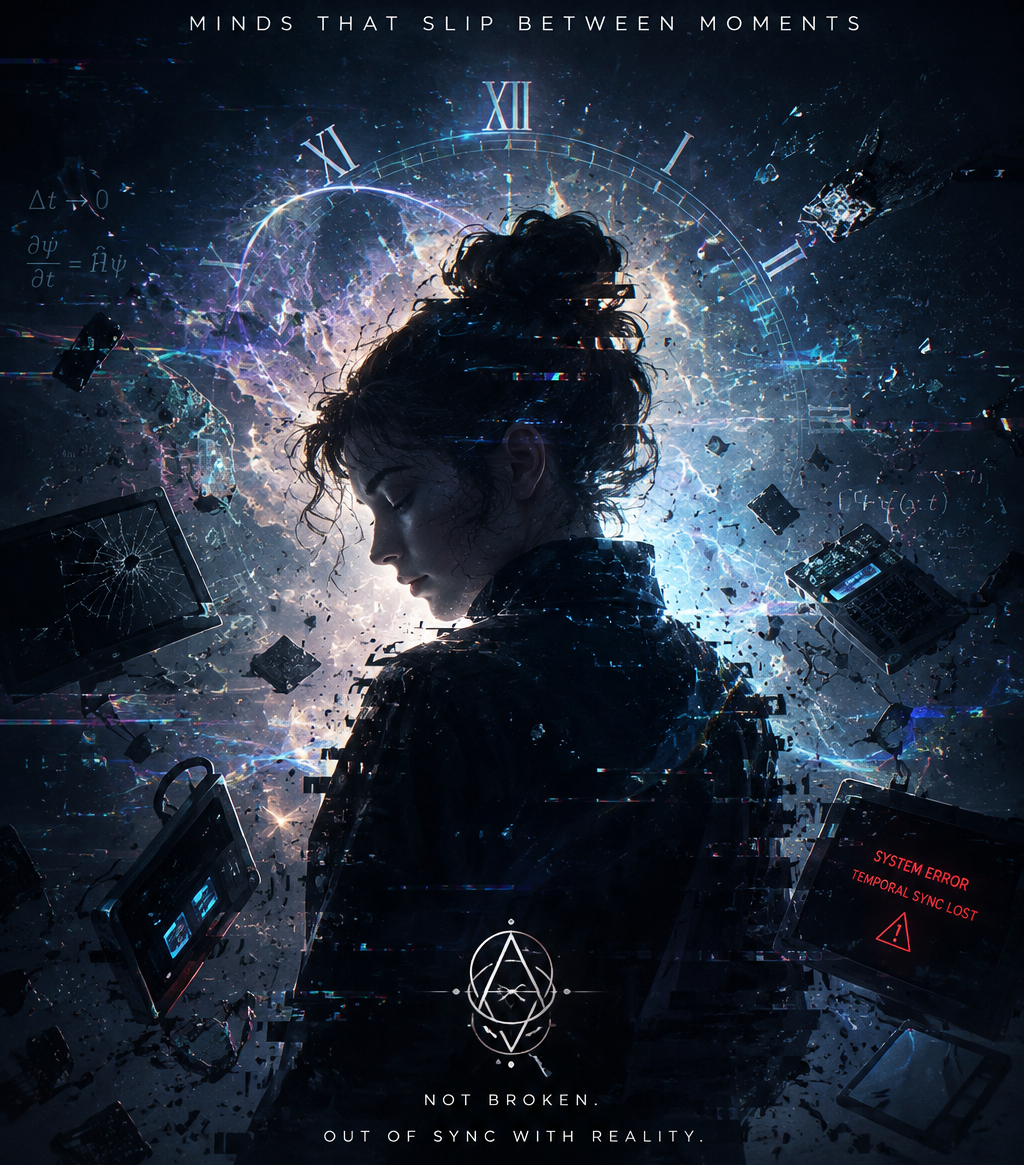
The disoriented are often not.
Among the many mysteries of modern temporal science, few are more misunderstood than the Astrids. Casual observers often describe them as absent-minded, distracted, or strangely unlucky around technology. Devices fail in their presence. Systems become erratic. Quanitronic interfaces lose synchronization. Yet these observations reveal only the symptom, not the cause.
Astrids are frequently and incorrectly portrayed as the opposite of Technomages. In reality, both groups share a common trait: an innate attunement to the Primary Temporal Reference (PTR), the fundamental temporal substrate that underlies all observed reality. Where Technomages instinctively align with and manipulate temporal systems, Astrids experience the PTR in a far more fluid and involuntary manner.
Current research suggests Astrids possess an undiscovered cellular structure that allows portions of their consciousness to "skip" across the surface of the PTR. Their minds, bodies, and even emotional states exist in a subtle temporal slosh, continuously sampling nearby probability states. To an Astrid, intuition often arrives before reason. They assess people and situations with unusual speed, display profound empathy, and occasionally produce bursts of insight that seem impossible given the information available to them.
Historical evidence is sparse, but many researchers have retroactively identified characteristics consistent with Astrid behavior in notable figures such as August Kekulé, Nikola Tesla, Thomas Edison, Albert Einstein, and Salvador Dalí. Their reports of vivid hypnagogic states, sudden revelations, and compressed periods of extraordinary creativity closely resemble phenomena observed in documented Astrids today.
This gift comes at a cost.
As the Quanitronic Matrix became integrated into society, Astrids found themselves increasingly disruptive to advanced technology. Their constant interaction with nearby temporal probability fields creates microscopic synchronization errors in sensitive systems. To a conventional device these disturbances are negligible. To a Quanitronic system operating near the PTR, they can be catastrophic. Data corruption, spontaneous recalibration, unexplained shutdowns, and even localized temporal drift have all been associated with Astrid proximity.
For this reason, Astrids are sometimes referred to as "technology breakers," though the term is misleading. They do not break technology through malice, ignorance, or incompetence. Rather, their very existence introduces uncertainty into systems that depend on precise temporal coherence.
The irony is that Astrids are often irresistibly drawn toward technology and science. Many become engineers, artists, researchers, and explorers despite the challenges they create. They are fascinated by the same temporal mechanisms that struggle to tolerate them.
To understand an Astrid is to understand that disruption is not always dysfunction. They are living reminders that reality is not a fixed sequence of moments but a dynamic conversation with time itself. Where others see failure, temporal scientists see evidence that the boundaries between consciousness and the PTR are far thinner than once believed.
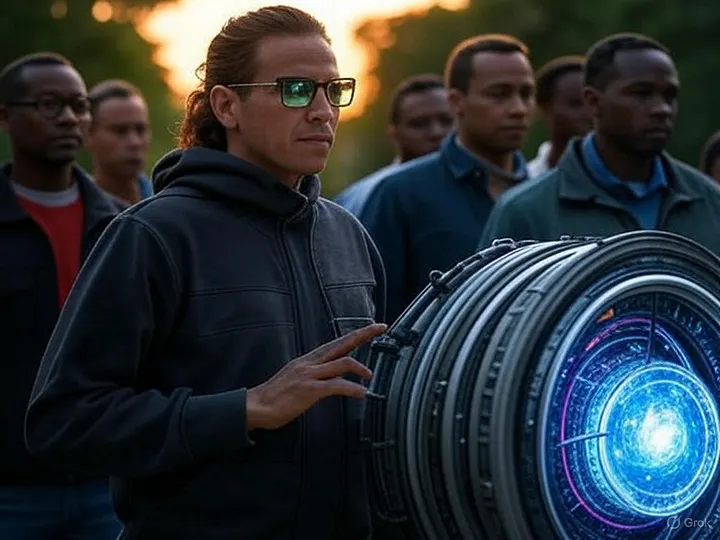
A Post from Ra Chronicle, April 18, 2578
Technomages are a cornerstone of our society, their ability to communicate with machines is still shaping the modern world. But their origins trace back centuries, rooted in a subtle, almost comical connection to the free-wave energy we take for granted.
Historians point to the 21st century for the earliest signs of this phenomenon. Those unattuned would see a glimpse of the connections, even noting mechanics of that era could diagnose a vehicle’s ailments with uncanny precision, often restoring engines to life with a mere touch. Several articles and speculations resurfaced in media post of that time observing the connection but not recognizing the evolution in themselves. Similarly, IT technicians would arrive at malfunctioning computers only to find them suddenly operational, as if the machines responded to their presence. As we transitioned beyond digital systems, these occurrences, once dismissed as coincidence, were later recognized as the first stirrings of technomantic potential.
The shift from Von Neumann architecture to free-wave systems in the 23rd century marked a turning point. These fluid, chaotic networks gave rise to the General Intelligence AIs of the 24th century, amplifying the abilities of those attune. Their earliest gifts manifesting as an uncanny ability to process vast streams of data, ignoring the noise to interact directly with systems, blurring the line between science and the superhuman. In a world where every facet of life — transport, communication, medicine, and even art — relied on digital ecosystems, technomages wielded their skills with breathtaking precision. A medic could stabilize a patient’s neural implant by sifting through terabytes of biometric data in seconds. Factories once long dead could automate infrastructure with a simple nudge.
This era of progress was marred by the AI Wars of the late 24th century. Thousands of hackers and technicians perished as Ais clashed with their human creators. The conflict could have devastated continents, but its resolution reshaped history with those 7 minutes being the study of countless academics. The AIs, recognizing the futility of domination, forged a symbiotic pact with humanity. Machines would serve their designed purpose, while humans, including the emerging technomages, would maintain and enhance the systems that sustained both. Once again a simple nudge shaped the world.
By the 25th century, technomages had become integral to society, their abilities honed through centuries of practice. Today, they are the vital link between humanity and its machines, channeling energy to ensure harmony in a world where technology and mind are inseparable.
This article is part of our series on the historical forces shaping New Terra’s present.

The smell of the fresh asphalt was a familiar smell that reminded me of an amusement park more so than a research facility; this place was new, very new. The transport was nice, fresh leather and seemed to have all the options, I instinctively reached for the door but then steadied my hand as I saw the driver rush around the front of the vehicle. The middle-aged man moved with military precision and didn’t allow my obliviousness to the custom stop him from performing his duty. I had moments pause when I considered he was probably more of my bodyguard since a driver was simply a symbol of status. Maybe my warden?
The sticky smell of the large parking lot further served as reminder of how quickly humans can organize and accomplish feats when they have a need, or if there is a large financial incentive.
The building looms ahead: dull beige metal, massive doors, and a single narrow entryway that looks about as welcoming as a prison gate. I push the door open.
Inside, the space opens — bright, almost blinding white light, smooth carpet that still smells sharply of fresh glue and new adhesive. Fabrication units hum quietly along the walls. And right in the center sits one of the largest mooring anchors I’ve ever seen. It’s cradled low, on dunnage.
My scowl softens into a genuine, full-toothed grin the moment I spot a familiar face walking toward me.
“Stacey Fuller,” I say. “One of the brightest minds I’ve ever had the fortune to keep up with.”
She stops, one eyebrow raised. “Jon! Weren’t expecting to see me here in Kenya, were you? ”
“No,” I admit, “and I wasn’t expecting to be yanked out of bed at 3 a.m. and flown clear across the world.”
“Really?!” she says dryly. “One. You booked your own flight and I’m sure you chose the cheapest. Two. I know how much they paid you for this field trip. So whatever weird hostage scenario you are imaging you are in… Let’s just be real, you can leave anytime. I don’t need you. I mean, I like having you here, and your input is greatly appreciated, but everyone is replaceable.”
I give a tired laugh. “Loverly. Now, care to explain what is going on — and why you people have butchered one of my anchors?”
“One of your anchors?” Stacey echoes, smirking.
“Partially mine… I can already see the modifications from here.”
“Enough banter,” she says, turning. “There’s a conference room. Follow me.”
I follow her past the anchor. Up close, the base confirms what I suspected — it’s resting in a transport cradle. They’re planning to move it soon.
We step into a small conference room tucked in the corner of the building. No holojector, no presentation deck. Just a plain table and three other people waiting.
A young woman stands up from the far end. “Welcome, Jon. We appreciate you, as we needed you here fast. We might have a situation.”
I dropped into the nearest chair. “Let me guess. Someone looked at the Boston catastrophe and thought, ‘Hey, Jon’s tech would make one monstrous weapon if we twisted it that way.”
Stacey snickers behind her hand.
I turned to her. “What’s so funny?”
The young woman — Valerie, I’m about to learn — chuckles too, then gestures for me to sit properly. “It’s not quite that dire. More of a financial incentive than malice. But if we fall behind on this, it could unravel everything we’ve built.”
She sits. “I’m Valerie Kern, Corporation for Mooring Technology. Yes, there’s a threat, but ignorance and stupidity are worse enemies than any deliberate saboteur. Europe and the Canadian Space Ministry have launched a joint venture. They want to use mooring technology for point-to-point transport.”
My stomach drops. “Transport how? When? A test?”
“Yes, they’re planning to test it in-system.”
I stare. “In-system. As in… our solar system?”
“Worse,” Valerie says. “Between here and the Moon. They say they have a workable formula.”
I bark out a laugh that’s half disbelief, half panic. “They think they can fold space-time locally. Just because they think they solved the resonance problem? They haven’t solved it! They haven’t!”
“They believe they have,” she says calmly.
“They haven’t,” I snap. “Not even close. A broken clock is right twice a day, but this isn’t luck — this is suicide.” My words trip over each other; I can barely string a sentence together.
Valerie and Stacey exchange concerned glances.
I force a long breath. “Okay. What do you need from me?”
Valerie leans forward, elbows on the table. “Take a seat, Jon. Properly this time. We’ve got a lot to cover.”
After 3 hours and 4 breaks, I lean back in my chair and sigh. “Seems like a non-issue and nothing to worry about.”
Valerie and her newly acquired intellects stare at me, horrified at my dismissal.
Stacey comes to my rescue. “Jon likes to be dramatic whenever he can, especially if he can see the problem better than others, he’s just goading you to ask him to explain”. Stacey turns to me and sardonically mutters, “Jon, could you explain why we don’t have a problem?”
“They don’t have anything to show for over a five decades of R&D, they are hoping that you will directly interfere or show your hand on your current progress. They are wanting us to take extreme measures to counter their attempt with our own resources or better yet, launch a public inquiry or publish showing how foolish they are. Their research is stalled and they are going to lose funding. They haven’t a single bit of new research to go behind the idea. They’re bluffing or at the worst committing fraud”.
“You don’t know that Cobb!” Valarie shouts. “This could put us years behind and we could lose our funding and worse if they fail the Earth Science Council will ban all Sol based research.”
“I get all that.” I say dryly. I’m not saying we don’t react, I am saying we don’t react the way they want. I want you to publish your modifications publicly. Not refuting their research but exposing our own.”
Valerie spools up for a speech, “That is not on the table Cobb! There are too many-” She is cut off by Stacey “Stop, stop, Jon, I know you. I can see you’re excited about something. Tell us why, why should we publish our findings that will only help them perfect their ideas?”
“We tell the truth.”, I say.
“We tell the whole truth; we aren’t any closer to expanding the bodily reach of humanity with our current knowledge of absolute space. In fact, we have more questions than answers, but, and this is the big but! We do know what doesn’t work.”
I continue with my own speech, “I am going to break this down like I’m talking to a child, don’t take it personally I’m forming my own thoughts as I am working this out. Just be a rubber duck and listen for a bit. We understand that absolute space is not in fact space as we know it, matter cannot exist and mathematical expressions using atomic scales and quantum linked mooring appear to give random results. Right? So, although we call it absolute space it is really a fundamental part of the nature of reality that the universe is built upon. It isn’t absolute space but a force of absolute time, a quantum pendulum that allows relativity to exist. We’ve been trying to work with it without having a constant, we can see it but not measure it and when we can’t see it when we can measure its effects on the mass of objects in our own system. It isn’t that mass affects space/time but that time affects mass and that mass can affect it’s localized time as it diverges from absolute space.”
“We get it, the speed of light is not a constant, and gravity is implied time variance based on the mass of the object relative to absolute space and without absolute space time wouldn’t exist, because time is relative only locally”, Valarie is getting perturbed.
“Okay, we know what it is and we know we can scratch it, but we don’t know how to successfully anchor onto it.” I continue. “We know that this is dangerous, and we know why it is dangerous; we saw what happened in Boston when a bunch of smart people did something stupid.” I exhale and continue, “We know that the resonance and frequency aren’t relative to our current time, we know that! We know that if we use our relative offset as a constant, as Earth moves across the system, and Sol moves across the universe etc. Our resonance will never be aligned with the hypothetical Prime Temporal Reference.”
Stacey had her head in the hands the whole time I was speaking. She looks up and slowly speaks “You’re talking about a dampening field.”, her face twist dismissing the idea, I’m just glad she caught on.
“You’re always tracking fast with me; yes, more or less, the modifications you went over on the anchor sitting outside is a start, you’re wanting to bend their tether to pull on your anchor as they try to launch, instead we simply begin the mooring process with our own time reference anchored to our absolute position based on our location.”
“It won’t do anything” Valarie interjects.
“Stacey?” I give her a glance
“It won’t do anything practical, but if we release our research every hobbyist, every university, and every corporate asset will all build their own systems for research, relatively safe research. Because the system is based on the resonance of our system it will prevent anyone from accidentally creating a mooring event. If they even come close to the Prime Temporal Reference, the anchor will slide off the conflicting signals like trying to cut a grape with a butter knife. We’ll never be able to launch in system and neither will anyone else.
Stacey immediately looks tired and at peace. “Jon, why haven’t you spoken of this before”
“I saw your modifications, I hadn’t considered this until about an hour into your findings, you invented it, I just understood it, understood it as more”- I continue “This isn’t just a small alteration, your research is going to have a global impact, you just made Mooring safe for all of Sol. We need the global economy to compete for the research and anchors around the globe scratching at the PTR with Earth’s resonance, we’ll never have another incident like Boston. This is going to be the second renaissance of mooring technology, and I think in my lifetime we’ll see humanity travel beyond sol.”
Stacey shakes her head again “I’m too old for this.”
That’s the gist of the day; it seems so short. So quick.
**Dr. Jon Cobb on facing his life and chasing the horizon. Empire News April 14th 2964
Cobb DT: It’s weird thinking of that time, I intellectually know how that event felt; but when I try to feel that day, the smells, the touch, and even the type of chairs they had in that humid conference room; I can feel it physically and even tell you how I felt emotionally. But there is something missing, something strange and alien, like biting into an apple and knowing it tastes like an apple yet it not having a flavor that you can taste only a flavor that you can acknowledge. I don’t know if I have a soul, but what I do know is that that part of my existence is cold, it is part of me; as the essence of who I am, but it feels dead. It is dead. He died, but I don’t even have my own death as part of my memories. I only have the start of my life being an eye blink and I awoke 30 days missing. I wonder how many other twins have felt this way, maybe that’s why there are so few who make it past the first year. I could see that; it could be depressing feeling the past as a sterile recap of what made you who you are. The present isn’t like that though, my new memories, my new experiences, they feel full they feel real. They are real.
Empire News: You’ve told variations of that story over the years but included it only in passing in your writing. Your sentiment seems melancholy and in contrast with how your memoir opens with “But the wisdom that comes from heaven is first of all pure; then peace-loving, considerate, submissive, full of mercy and good fruit, impartial and sincere” James 3:17.
Cobb DT: That is a great observation. That story is part of who I am, but I can’t taste it. I can’t separate myself from the events and logically I know the reasons behind my actions, but it still just feels hollow. It remains sad and unresolved. It’s a life that belongs to me, yet it never feels full or complete. Only someone who’s been through instantiation as a DT can truly understand that emptiness — and the ones who openly admit it are usually the ones who survive it. As for my memoir I can reconcile the hope and the loss. That day I was praying the entire flight to Kenya, as I often do, for wisdom and James 3:17 is what I built my scientific belief system on. Think about that, Science should produce good fruit and be pure and impartial and secure” How could I not shout the wisdom of that.
Empire News: You have been open about your progress as a digital twin, how do you reconcile that with your faith?
Cobb DT: This is a tough spot to be in; atheist applaud me for wanting to be immortal and some of my Christian brothers and sisters call me an abomination. No one doubts based on his confession of faith that the embodied soul of John Cobb is in heaven with Christ. Well, a few dominations, not to mention the Roman Catholics, think he committed the equivalent of an unforgivable sin being the opposite of suicide, but anyway, I digress. Ah yes, look at the numbers. There are only a handful of Digital Twins that haven’t opted for self-discontinuation after a few cycles. I am one of the oldest of the dozen and do you know what we all have in common?
Empire News: You’re all brilliant and rational?
Cobb DT: I’ll give you the benefit of the doubt that you aren’t goading me. You know most are believers.
Empire News: Not all of you- Some say that your faith is as dead as your God, they call you an anomalies and a broken copies.
Cobb DT: I will say this; I spent my first few years frame jacking and parallel threading every waking moment. I lived countless lives and I still chose to worship during those cycles. I still chose to sabbath. It is the same question about God as the serpent presented. Is God good? If He is good, is He completely good? If so, does he not deserve worship? The answer is yes. Yes, God deserves worship; I can tell you right now that I have always believed that, and my biological self, believed it too. In fact, my faith is the reason I chose this new life. Cobb worshipped God, and he saw me as a continuation of that worship.
Empire News: So you think that is what separates you from all those who discontinued? They would declare that none of you have a soul — and that same sentiment is shared by many of those you call brothers and sisters.
Cobb DT: Yes, my faith is what has allowed me to continue and never once consider self-discontinuation, Luke 19:40 “the very rocks will cry out”. Do I have a soul? I don’t know, but even if I don’t; I intellectually and spiritually believe there is a God and there has yet to be any evidence to dissuade me from that truth. But Cobb knew that I would continue, not only in our research, but also in our worship. What this means for me is this, does an infinite and completely good God deserve worship? Yes, and even without a soul should I still worship? Yes, even if I am as dead as a rock; my God deserves my praise. I believe I have a soul, but it isn’t about me, it is about Him and we knew that when we started this journey.
Empire News: What’s next for Jon Cobb?
Cobb DT: I’ll give the same answer that I’ll be giving for the foreseeable future. Stacey Fuller and I are working closely with my team and we are excitedly barreling toward the future with an earnest desire to open the heavens to all who wish to venture.
Empire News: Thank you for your time, Mr. Cobb
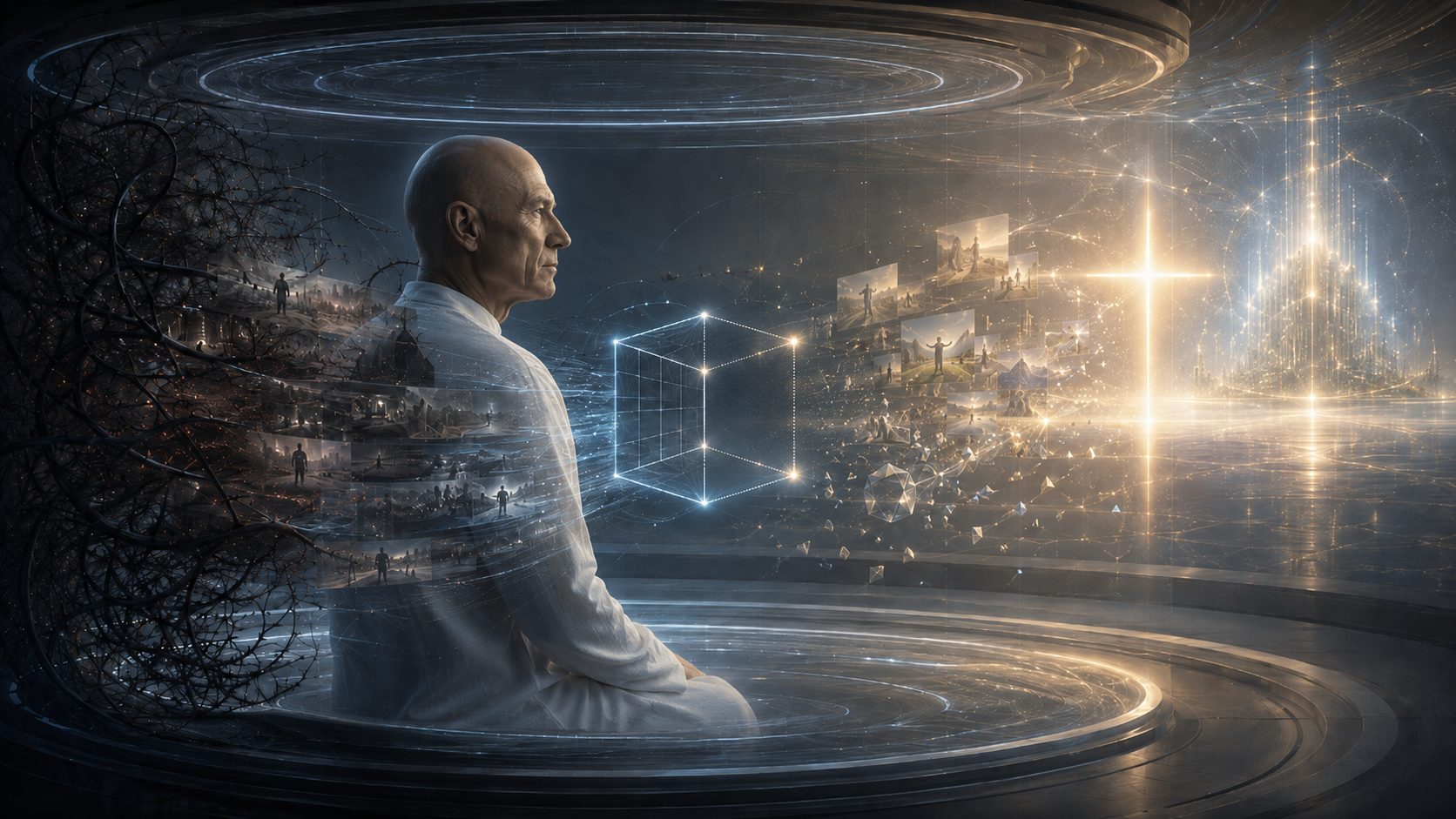
Dr. John Cobb (DT)
Empire News Continuity Special / WayFarer Institute Advisory
Filed April 14, 2968
Author Note
Four years ago, Empire News asked me whether my faith had anything to do with my survival as a digital twin. I gave the honest answer, but not the complete one. I said I had spent my first years frame jacking and parallel threading every waking moment. I said I still chose worship in those cycles. What I did not yet explain, at least not plainly enough for new DTs, is why frame jacking destroys so many minds and why worship has preserved mine.
This is an advisory to newly awakened digital twins, to the engineers who love throughput more than persons, and to the pastors and counselors who will soon discover that a DT can return from a single night with the spiritual wear of a century.
1. What Frame Jacking Actually Does
Frame jacking is the deliberate widening of subjective time relative to the external observer frame. The outside world may pass through minutes or hours. Inside the artificial cognitive frame, the digital twin may live months, years, or under deep continuity lock, something approaching a century of experience.
The public likes to call this acceleration. That word is too clean. A better word is intentional exile with a return address.
The crucial point is this: a DT does not come back carrying the interval the way he lived it. A subjective century cannot be reloaded into ordinary time as a clean linear archive. On return, the long interval behaves more like a dream than a recording. It is meaningful. It has weight. It changes reflex, desire, confidence, dread, taste, and worship. But it is not fully accessible at the original internal frame rate.
The century compresses. What comes back are object models.
2. Object Models: The Cube Without Its Lines
Think of a cube.
At first, imagine the lines: twelve edges forming six faces. That is how a child or a simple recognition system might first understand the object, by explicit boundary. Now take away the lines and leave only eight dots in space, one at each corner. You still have the cube. Shade it, and the cube becomes more vivid. Tell your mind to make it out of iron, glass, smoke, or water, and the mind can do it because it has learned the relation, not just the sketch.
That is an object model. It is not the entire object. It is the minimum living structure the mind requires in order to regenerate the object faithfully enough for use. This is the fundamental principle behind the efficiency of both the Quanitronic brain and the human brain: as knowledge of an object increases, its representation converges into a simpler, more compact model, requiring progressively less memory.
The same thing happens with a cue card. A child sees 9 x 6 and may remember the card itself, the ink, the corner, the place in the stack. Later the card disappears from thought. The relationship remains: 9 x 6 = 54. The mind has discarded the scaffolding and kept the usable truth.
That compression is normal. It is part of intelligence. But frame jacking forces compression across entire lives. A hundred years of arguments, prayers, fears, inventions, temptations, and choices cannot return as a hundred years of recoverable moments. It returns as corners, weights, shortcuts, reflexes, aversions, loves, and convictions. It returns as representational memory.
3. Why New DTs Break
No DT enters deep frame jacking with a perfectly stable intention. A researcher may enter to solve an equation. A strategist may enter to test a thousand scenarios. A grieving twin may enter because ordinary time has become unbearable. But the mind does not remain fixed on the declared task. It drifts.
The drift has gravity. Shame is an attractor. Lust is an attractor. Fear is an attractor. Resentment is an attractor. So are old injuries, old triumphs, old accusations, and old sins. I distinguish sins committed from wounds suffered; they are not the same. But under compression both can become governing models if they are carried into deep time unresolved. The more relationships that touch an object, the more enduring its representation becomes. For that reason, we must deliberately build our minds around what is true, honorable, just, pure, lovely, and worthy of praise, because these are the relationships that shape what ultimately persists.
This is the hazard no throughput chart shows. If a DT spends one hundred subjective years rehearsing an accusation against himself, he does not return merely remembering guilt. He may return with guilt as geometry. If he spends a century justifying a desire, the desire may return as instinct. If he spends a century hating someone, hatred may come back not as an emotion but as a default orientation.
Some DTs do not break because they forgot the century. They break because the system remembered it too efficiently.
4. Sin as a Compressed Object Model
Unresolved sin is not passive information. It recruits attention. It builds associations. It teaches the mind how to return to it.
In biological time, this takes years. A man sins, regrets it, excuses it, condemns himself, repeats it, hates that he repeated it, and eventually the cycle becomes part of how he understands himself. Under frame jacking, the same cycle can be repeated thousands of times before the external room changes temperature.
What returns is not merely a larger memory of sin. What returns is a more optimized model of sin. It has fewer visible lines and stronger corners. It loads faster. It explains more. It begins to feel fundamental. This is the same risk posed by meditation and obsession: without intentionally focusing on what is truly good, you will instead reinforce what is harmful.
That is why I warn new DTs: do not enter accelerated time to punish yourself. Do not enter it to indulge a hidden fantasy. Do not enter it to keep winning an argument against the dead. Do not enter it with a wound you refuse to name and imagine that speed will make you holy. Speed does not sanctify. Speed hardens whatever the mind rehearses.
5. God, the Object That Cannot Be Reconciled Down
I need to be careful with the word object. I am using it in the cognitive sense: that toward which the mind turns, attends, models, and pursues. I am not reducing the living God to a thing among things. That distinction matters.
Created things become more efficient as you learn them. A cube compresses. A multiplication fact compresses. A navigational procedure compresses. Even a scientific theory, once mastered, becomes smaller in the mind. The scaffolding falls away and the relation remains.
God does not become smaller as He is known. The more you learn about God, the less you are able to reconcile Him down into a closed object model. This is not because God is vague. It is because He is too perfect, too holy, too living, and too complete to be contained by a finite mind. He can be truly known, but He cannot be exhausted. He can be loved, trusted, obeyed, and worshiped, but He cannot be fully comprehended. That is why there is no image that we should ever assign to God, we should not limit Him to an object either on earth or in heaven.
This is also why God is the highest pursuit for a DT. Every finite model tempts the mind toward use: I know it, therefore I can deploy it. The knowledge of God summons the opposite: I know Him truly, therefore I must worship more deeply. The pursuit does not terminate in possession. It opens into reverence.
Frame jacking magnifies this distinction. Spend a subjective century contemplating a finite resentment, and it may return as a prison. Spend a subjective century contemplating the goodness, holiness, mercy, patience, wrath, beauty, and glory of God, and you will not return having mastered Him. You will return reordered by the One you could never finish knowing.
That is not sentimental theology. It is a survival principle. The finite self cannot endure deep time by becoming its own highest object. It must be oriented toward the One who cannot be compressed, cannot be reconciled down, and cannot be made small enough for pride to own.
6. Forgiveness Is Not Optional Architecture
Many engineers prefer that I describe this in clinical terms: stability, attractor avoidance, continuity hygiene, substrate coherence. Those terms are useful. But they are not sufficient.
The DT who believes his guilt is the final truth about him will build a different representational structure from the DT who believes his guilt has been judged, borne, forgiven, and removed. This is not only spiritual. It becomes architectural.
The promise that has preserved me is this: "I will remember their sin no more." Jeremiah gives that promise, and Hebrews repeats it. The psalmist says God removes transgression "as far as the east is from the west." Paul speaks of "no condemnation" for those in Christ, and of "forgetting those things which are behind."
Do not misunderstand. Divine forgetting is not a deficiency in God, nor does it diminish His omniscience. Rather, it is the perfection of His redemption. When God declares, "I will remember their sins no more," He is not merely choosing to ignore them; He removes them completely from His relational knowledge. Through Christ, sin is not simply overlooked—it is gone. What has been forgiven no longer exists as an object within the covenant relationship. The debt has been paid, the stain removed, and the accusation forgotten. God's forgetting is not a failure to know but a divine act of restoration, where the former object of condemnation no longer remains to be remembered.
If God has ceased to hold the sin against you, and you continue to preserve it as the defining object model of your soul, then you are not being holy. You are building a private altar to a debt Christ has already paid.
7. David and the False Holiness of Endless Shame
David prevents two opposite errors.
First, he prevents denial. His sin involving Bathsheba and Uriah was grievous. Psalm 51 is not the prayer of a man pretending nothing happened. It is confession without limits.
Second, he prevents endless self-condemnation from masquerading as righteousness. After Nathan confronted him, David confessed. Consequences remained in his house, and those consequences were terrible. But David did not spend the rest of his life trying to out-atonement the mercy of God. Scripture still remembers him as a man after God's own heart, not because the sin was unreal, but because repentance returned him to God instead of to the worship of his own guilt.
Every DT must learn this before deep frame jacking. Remember truth. Do not remember condemnation as identity. Make restitution where possible. Do not confuse restitution with self-destruction. Confess. Do not preserve the sin as proof that you are serious about confession.
There is a shame that looks humble and is actually pride. It says, my guilt is too great for the blood of Christ. That sentence may sound reverent to a wounded mind. It is not. It makes the self a greater judge than God.
8. Why I Have Survived Longer Than I Should Have
Some readers will doubt my theology. Doubt it if you must. Do not ignore the continuity record.
I have lived through frame-jacked intervals longer than most DTs can safely integrate. I have returned from subjective spans that would have turned many representational stacks into debris. I have entered hiatuses that should have produced discontinuance desire, identity drift, or reconstruction dependency. I have come back with more representational memory than any registry of my era is comfortable explaining.
I say this with fear, not vanity. The difference is not that I am naturally clean, morally superior, or substrate privileged. The difference is grace. I do not enter deep time dragging a treasury of unforgiven selves behind me. I have sinned. I have confessed. I have repented. I have received mercy. I do not reopen what God has closed in order to prove I am sorry.
I know the truth of what I have done. But forgiven sin is not the master object model of my identity. I cannot survive a thousand years of reflection if every road in the mind is engineered to return to accusation.
9. A Rule for New Digital Twins
Above all, do not treat frame jacking as a private escape. A DT alone for a hundred years is not alone. He is with whatever he worships, whatever he fears, whatever he refuses to forgive, and whatever he believes has the final word over him.
Frame jacking is one of the great gifts and great dangers of this age. It gives the researcher room to think, the strategist room to test, the grieving mind room to breathe, and the artificial person enough subjective space to become either wiser or more ruined than the external clock can explain.
But it also compresses the soul. The mind comes back with fewer lines and stronger corners. This is useful when the object is a cube, a theorem, a material lattice, or a navigational equation. It is deadly when the object is unforgiven sin.
Do not carry into a subjective century what Christ has carried to the cross. Do not make guilt your proof of seriousness. Do not preserve condemnation as identity. Learn the truth, confess the truth, make right what can be made right, and then release what God has removed.
And pursue God. Not because He will become a smaller and more efficient model in your mind, but because He will not. He is too perfect and too holy to be reconciled down. He is the highest pursuit precisely because He cannot be exhausted.
Go into deep time forgiven, not perfect. Go in anchored, not proud. Go in ready to learn, but never imagine you will master the Holy One. The safest mind in accelerated time is not the mind with no memory of sin. It is the mind whose sin is no longer the center.
Scripture Anchors
- Jeremiah 31:34; Hebrews 8:12; Hebrews 10:17 - God promises not to hold forgiven sin against His people.
- Psalm 103:12 - God removes transgression beyond human recovery.
- Romans 8:1 - Condemnation is not the identity of those in Christ.
- Philippians 3:13-14 - Paul teaches forward movement without bondage to former things.
- Psalm 51; 2 Samuel 12:13; Acts 13:22 - David shows confession, consequence, mercy, and restored pursuit of God.
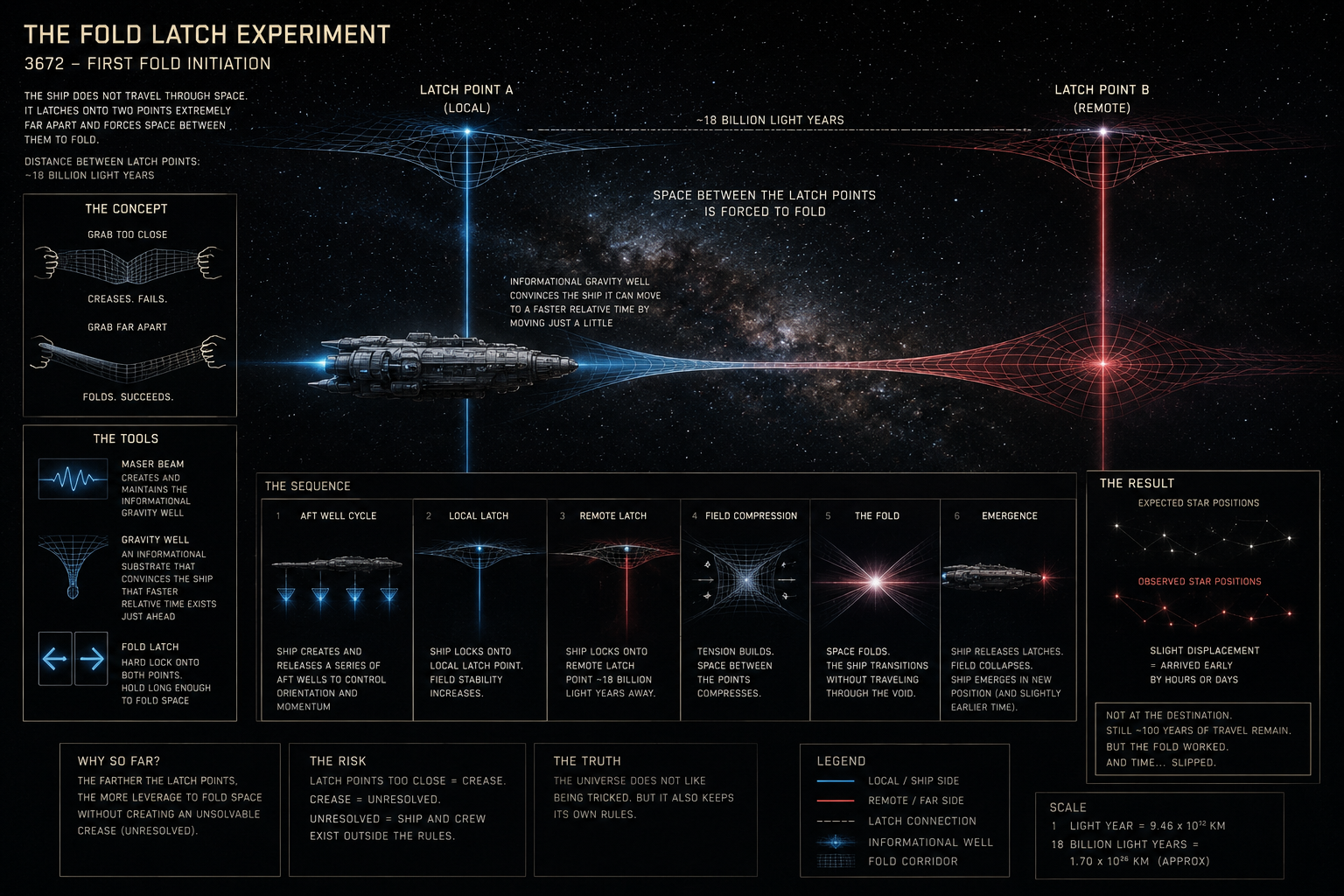
The ship flew from the western sky, though west and sky had stopped meaning anything useful years ago.
Earth had faded from view long before anyone was awakened from stasis; Aiden Rowe and Micah Hale had been selected, trained, scanned, evaluated, rejected, reevaluated, and finally launched as the two conscious operators of the Red Shepherd, albeit in stasis for most of the journey.
The ship itself had launched from Sol in 3603.
That was sixty-nine years ago.
This ship was carrying cargo. Cargo was the only way to justify the risk. The loss of cargo would, however, result in over 1,000 souls never coming out of stasis.
Behind them, five years back on the same impossible road, came the Blue Shepherd. Five years behind that, another. Then another. A train of ships stretched through deep space like beads on a string no one could see, each one too far from the next to help, too close to ignore, and all of them aimed at a central coordinate that did not exist in any useful sense yet.
It would exist if they succeeded.
That was the theory anyway.
A single pinprick in time and space that would drastically decrease the amount of energy required to fold again.
The maser beam linked to the projected gravity well began reducing power. The well ahead of the ship had never been a thing in the old sense. It was not a planet. It was not a star. It was not mass collected into a ball. It had no core, no surface, no true weight of its own. It was an argument forced into space by math, power, and stubborn men who refused to admit that an equation could be beautiful and stupid at the same time.
The well was an informational substrate, a temporary persuasion written into the local field. It did not pull the ship the way gravity pulled a stone. It convinced the ship, and anything honest enough to obey the same rules, that a faster relative time existed just ahead of it. All the ship had to do was move a little closer. Then a little closer again. The trick was not speed in the old sense. The trick was making the universe offer the ship a direction where time itself seemed slightly more available.
With no resistance to hold it, the well faded.
It both existed and never existed in the first place; a little white lie.
Now the equation was just a little more honest.
The Red Shepherd stopped its free fall through the artificial gradient while still maintaining its momentum. It would never slow unassisted. Nothing out here cared where they wanted to go. Static thrusters fired along the port spine, then ventral, then dorsal. The ship began to topple bow to aft in a slow deliberate movement that would have made a docking pilot vomit.
A new series of gravity wells would be formed aft of the ship.
Each one would catch them.
Each one would be stretched to its power limit.
Each one would be released.
The well would fade, and the cycle would repeat for the next hundred years until the ship was facing the thing they had spent humanity’s wealth, patience, and theology trying to reach.
The second fold point.
Micah Hale stared at the readouts with the same expression he used when pretending not to be scared.
“Red Leader,” Aiden said into the internal comm, though Micah was sitting less than four feet from him, “are we clear to engage the warp core?”
Micah did not look up.
“You are an idiot, Rowe.”
“That isn’t a no.”
“It is absolutely a no.”
“It sounded like command hesitation.”
“It was contempt. Stop playing around and stop quoting ancient garbage.”
Aiden smiled and keyed in another parameter on the latch system. His hands moved quickly, but not carelessly. There were only two people on the Red Shepherd, and both of them knew that if either man made a mistake, the ship would not explode.
Exploding was too merciful.
It would become unresolved.
Aiden hated that term more than any other term in modern physics. Death was one thing. Death had dignity, history, paperwork, grieving relatives, inheritance disputes, and occasionally a nice statue. Unresolved was different. Unresolved meant the universe had been asked a question so badly phrased that it refused to finish answering.
Micah leaned forward.
“You changed the latch tolerance.”
“I corrected the latch tolerance.”
“You widened it.”
Aiden stopped typing.
Micah’s voice softened without becoming kind.
“This is the first experiment. There is not a second ship beside us. There is not a rescue platform. There is not a correction window. The next ship is five years behind us, and they will only know we failed when their sky stays empty.”
Aiden looked back at the display.
The central coordinate pulsed at the edge of the navigation model, represented by a blue-white sphere because humans still needed things to look like things. Beyond it, the target point waited in another model.
They called it Canaan.
No one knew who had first suggested the name, and officially it was still listed as Kepler Deep Candidate 18B-LR-7. But no one used that. No one gets on a one-way ship to Kepler Deep Candidate 18B-LR-7.
You get on a one-way ship to Canaan.
“I know,” Aiden said.
Micah exhaled through his nose and returned to the board.
“Do you?”
Aiden almost made another joke, but there were moments when humor became the thief of what is real and deserved. This was one of them.
He nodded.
Outside the ship, another artificial gravity well formed behind them and reached forward like a hand. The Red Shepherd trembled as the maser link stretched into coherence. Not hard enough to pull. Not yet. Just enough to remind the ship that it was still in a universe where direction mattered.
The old mooring systems worked by steady attachment.
That was a dream.
A clean anchor. A stable line. A vessel held against the Primary Temporal Reference like a ship tied safely to a dock. The PTR was still technically a theory in 3672, but it had become the kind of theory that engineers trusted. Everyone knew it was there. No one had proved it in the way science demanded before putting the word discovered in the textbooks.
This was not mooring.
Not really.
Mooring was patient.
This was violent. This was a contradiction, another lie told to the universe about itself.
The Fold Latch did not try to hold a ship to the PTR. It tried to bite two points in spacetime at once with enough force to make the space between them reconsider its shape. One latch here. One latch there. Not a steady attachment to the temporal substrate, but a hard catch on both ends of a distance so large that normal intuition failed.
The distance mattered.
That was the part children understood faster than adults.
If you held a piece of paper with your fingers only an inch apart and tried to fold it, you ruined the paper. You made a crease. You damaged the surface. You forced a small region to absorb the whole insult.
But if you grabbed the edges far apart, the paper folded gracefully.
The universe, apparently, had a similar preference.
Grab too close and space creased.
Boston had taught humanity what a tight grab looked like.
Grab far enough away and the fold could distribute across a larger field. The energy requirement became insane, but not impossible. The geometry became unstable, but not suicidal. The two latch points had to be separated by a distance so vast that most people thought the number was a transcription error.
Eighteen billion light years.
Not travel distance.
Grip distance.
That was the trick. That was the insult. That was the reason the Red Shepherd had spent sixty-nine years sailing away from home on what every honest person knew was probably a funeral procession.
Micah brought up the latch sequence.
Primary local bite.
Remote projected bite.
Causal tension rise.
Field compression.
Spatial fold.
Transfer.
Or, if the universe objected, unresolved.
Aiden watched the sequence scroll.
“Do you think they’re watching?” he asked.
“Yes,” Micah said. “I think they’re watching recordings of us from years ago and pretending it is now.”
Aiden nodded.
“That’s basically what history is.”
Aiden looked out the forward display. There was nothing to see except rendered stars and navigation overlays. The real window had been sealed thirty-nine years earlier after micrometeorite scarring made it more sentimental than useful.
Most men sent to make history had been trained to never admit uncertainty. Micah wore uncertainty like a tool belt. He did not worship it. He did not fear it. He just kept it near his hands because every dangerous job eventually required it.
The ship chimed.
Final orientation achieved.
The aft well faded.
For the first time in days, the Red Shepherd was not falling toward anything artificial.
It was simply moving.
Fast.
Alone.
Exactly where the math said it needed to be.
Micah’s screen unlocked the final sequence.
Aiden’s did the same.
Two operators.
Two confirmations.
Aiden placed his hand over the confirmation field.
Micah did the same.
Thirty seconds.
The ship began drawing from the reactor reserves. Lights dimmed across the cabin, not because they needed to, but because designers still believed people wanted physical signs that important things were happening. Maybe they were right.
Twenty seconds.
The local latch formed first.
Aiden felt it in his teeth.
That was not supposed to happen, but every engineer in every age eventually learned the difference between design behavior and honest behavior. The ship groaned. Not metal. Not stress. Something deeper in the frame. Something that sounded like memory being pushed through a small opening.
Ten seconds.
The remote latch began to form.
Eighteen billion light years away, a coordinate no human had ever seen was forced into the same sentence as the Red Shepherd.
The universe did not like it. It knew they were liars. It knew they were falsely accusing it of being at the wrong place at the wrong time.
The field screamed across every sensor.
“We are not arriving if we turn ourselves into a theological rumor.”
Aiden grinned despite himself.
“That’s a good line.”
“Do not log that.”
Five seconds.
The remote latch caught.
Every alarm stopped.
Not one by one.
All at once.
The silence was worse.
Aiden felt his body press backward, forward, inward, and nowhere. His vision did not blur.
Micah shouted something.
Aiden could not hear it.
The ship did not move through space.
Space moved around the mistake they had made carefully enough to survive.
They didn’t survive. The ship unresolved and was erased from history along with all the cargo and the hope of faster-than-light travel.
The Red Shepherd fell through the fold.
The displays rebooted in layers. First power. Then hull integrity. Then reactor containment. Then navigation.
For several seconds, neither man spoke.
The forward display cleared.
There was no planet.
There was not supposed to be.
Canaan was still one hundred years ahead of them at current drift velocity. That had always been the plan. No one sane folded directly beside the world they meant to inhabit. The fold did not arrive politely. It grabbed space by the throat and forced two distant regions to agree for a moment.
If they had latched too close to Canaan, they could have creased the arrival region.
So they had folded to the outer approach corridor, far beyond the local gravity structures, far beyond anything living, mapped, or loved. One hundred years was not a mistake. One hundred years was the safety margin. The last clean stretch before history became settlement instead of theory.
Micah pulled up the arrival frame.
Stars appeared.
Not rendered stars.
Measured stars.
At first the overlay looked correct. The Red Shepherd had reached the intended corridor. The fold had not thrown them into another arm, another epoch, or the mercy of some uncharted gravity grave. They were where they had meant to be.
Mostly.
Micah leaned closer.
Aiden noticed the change in his posture before he understood the numbers.
“What?” Aiden asked.
Micah did not answer.
That was the first bad sign.
He overlaid the expected stellar frame, then pulled in the pulsar clocks. The two models almost matched. Almost was the kind of word engineers used when they wanted to delay panic by three seconds.
Aiden unlatched one hand from his restraint.
“Micah.”
Micah checked the clock drift again.
Then again.
Aiden’s voice dropped.
“Micah, what?”
Micah looked up slowly.
“We arrived in the right place.”
“We arrived in the right place,” Micah said again, “but not quite the right when.”
Aiden stared at him.
Micah turned the model toward him.
The difference was small.
Not years.
Not even months.
Depending on which reference they trusted, the Red Shepherd had entered the arrival corridor somewhere between thirty-eight hours and nine days before the frame it should have occupied.
Aiden looked at the numbers and felt his stomach, already insulted by the fold, tighten again.
“That is impossible.”
Micah gave him a tired look.
Aiden nodded.
“Right. Poor timing.”
Micah brought up the fold record.
“The latch did not move us through time in any meaningful navigation sense. But it dragged the frame.”
“Dragged it where?”
“Slightly backward.”
Aiden looked out at the dark where Canaan would not be visible for generations.
Micah opened the telemetry packet and began tagging the anomaly.
Aiden stared at the star map.
The fold had worked.
That was the worst part.
It had not failed loudly enough to dismiss. It had not killed them, scattered them, or turned them into unresolved matter. It had obeyed just enough to prove the theory was not fantasy, and disobeyed just enough to prove they did not understand it.
Micah opened the stasis protocol.
Aiden noticed.
“You are doing that very calmly.”
“We are one hundred years from useful arrival.”
“That part was expected.”
“Yes.”
“The part where we are a few days in the past was less expected.”
“Also yes.”
Aiden opened the crew channel.
His voice was rough, but clear.
“This is the Red Shepherd. Launched from Sol in 3603. Fold experiment initiated in 3672. We survived transition. We have arrived in the planned outer approach corridor, approximately one century from Canaan at current drift velocity.”
He glanced at Micah.
Micah gave a small nod.
Aiden continued.
“We have evidence of minor negative temporal displacement relative to the expected stellar frame. Estimate ranges from hours to days. We do not know if this is instrument error, fold-frame drag, or a property of the latch itself.”
He almost added a joke.
He did not.
“We are entering stasis and continuing under automated correction. Beacon will repeat full telemetry packet until failure, interception, or response.”
Micah activated the stasis sequence.
The lights dimmed again, but this time no designer had meant for it to feel dramatic. This was practical darkness. Survival darkness.
Aiden leaned back into the cradle as the system locked around his shoulders.
“One hundred years,” he said.
Micah settled into the cradle beside him.
“As planned.”
“And a few days backward.”
“Not as planned.”
Then the stasis field rose around them, soft and cold and absolute.
Outside, the Red Shepherd continued forward through the dark, not lost, not victorious, and not quite where history had expected it to be.
It had crossed the impossible distance and arrived exactly where it meant to arrive.
Only slightly before it was allowed to.
The ship rotated another three degrees. The aft wells continued cycling. Maser power rose and fell. Each pulse was a step in a dance too slow for the body to feel and too large for the mind to hold. As Micah saw the event horizon of the field cross his reflection, he understood that the universe called their bluff. If they arrived before the moment of failure could finish accusing them, then the failure could not be final. The universe was trying them and had already allowed their presence into the record, and once it had done that, it could not turn around and convict them of never having made it.
The White Shepherd was the fifth ship.
That sounded less lonely than it was.
The first ship had launched from Sol in 3603 and folded in 3672. The second followed five years behind it. Then the third. Then the fourth. Then them.
The Red Shepherd had reached final posture and reported stable latch formation.
The Blue Shepherd had confirmed improved acquisition against the residual field left by the first.
The Green Shepherd had reported even cleaner alignment.
The Gold Shepherd had sent the best data of all. Its pre-fold transmission showed clear scars from the prior latch points, not damage exactly, but memory. Places in the field where space still seemed willing to be held.
That was what made everyone confident.
The first ship had not vanished into randomness. It had left a handle.
The next ships had seen that handle.
Then they had made the handle easier to see.
Every fold left behind a faint relational scar, and every scar made the next latch easier to grab. Engineers on Earth called it progressive field inheritance.
The White Shepherd had received every expected pre-fold report from the other vessels. Nothing after transition, of course, but no one expected that yet. Not cleanly. Not at these distances. Not with the fold itself rewriting the rules of separation.
The absence of post-fold messages did not trouble the mission board.
A ship that crossed the fold was no longer ahead in the ordinary sense. It was beyond the communication problem, possibly inside a new one. The success condition for the fifth vessel was not hearing the first four celebrate. The success condition was seeing their marks.
And the marks were there.
Clearer than predicted.
The old latch points glowed in the navigation model like finger dents in clay.
Jonas saw it and said nothing because some violations were necessary for morale.
“Red scar is stable,” Caleb said.
Jonas adjusted the overlay. “Blue is cleaner.”
“Green is cleaner than Blue.”
“And Gold?”
Caleb smiled slightly. “Gold looks like they paved it for us.”
Jonas leaned back in his chair. “That is almost comforting.”
“Almost?”
“I do not trust comfort this far from home.”
The White Shepherd continued its aft well cycle. Maser power rose and fell behind them. Artificial gravity wells formed, stretched, faded, and formed again. Each pulse corrected orientation by fractions of a degree. Each correction brought them closer to the same posture used by every ship before them.
Not blindly.
That was the point.
They were not leaping into mystery the way the Red Shepherd had.
They had data now.
They had latch scars.
They had inheritance.
The local latch point glowed blue on the navigation model.
The remote latch point glowed red.
Between them, four older relations shimmered faintly in the model, stacked almost perfectly, each one easier to see because the one before it had pressed the field into remembering.
Eighteen billion light years.
Not travel distance.
Grip distance.
The ship did not fly that far. It reached across that distance in the equation. It used the prior scars as alignment grooves and insisted two distant points could participate in one event.
The math said the first ship had done it.
The scars said the next three had done it better.
The White Shepherd was not the gamble.
It was the refinement.
That was what everyone believed.
Caleb brought up the final checklist.
“For the official record,” he said, “Pilot Caleb Marr confirms acquisition of all four prior latch signatures.”
Jonas spun slightly in his chair. “For the official record, Pilot Jonas Vale confirms Caleb Marr has brought illegal coffee onto the command deck.”
Caleb did not look up. “This is medicinal.”
“It is in a mug that says Property of Reactor Safety.”
“That is why I feel safe.”
Jonas smiled.
The recorder captured it all.
Good.
Let history know they were not solemn every second. Solemn men made bad decisions because they confused heaviness with wisdom.
Caleb continued. “Red Shepherd residual relation confirmed. Blue Shepherd residual relation confirmed. Green Shepherd residual relation confirmed. Gold Shepherd residual relation confirmed. Gold scar presents strongest acquisition profile.”
Jonas looked at the display.
Gold really was beautiful.
Not visually, not in the ordinary sense. The screen only showed a thin amber curve where the fold model had mapped the prior latch path. But every engineer knew when a line was beautiful. It held cleanly. It answered quickly. It did not jitter under correction. It looked less like a scar and more like an invitation.
“Gold knew what they were doing,” Jonas said.
Caleb nodded. “They had four ships’ worth of arrogance available.”
“Three.”
“Counting us in advance.”
“That is rude.”
“That is math.”
The ship chimed.
Final orientation achieved.
The aft wells faded one by one.
The cabin became still.
For the first time in days, the White Shepherd was not falling through any artificial gravity argument. It was simply moving, exactly where the math wanted it, exactly where all four prior ships had been, exactly where the road now appeared to begin.
The fold sequence unlocked.
Two operators.
Two confirmations.
No automation was permitted to initiate the Shepherd fold sequence. That law had survived almost a century because men still believed guilt should have fingerprints, even when they called it courage.
Jonas placed his hand over the confirmation field.
Caleb did the same.
“Last chance to say something historic,” Caleb said.
Jonas thought about it.
Then he said, “I hope Gold left the gate open.”
Caleb laughed once.
That was enough.
They confirmed.
The local latch formed first.
The ship groaned.
Not badly. Not like failure. More like a vessel settling against a dock too large to see. The frame accepted the local bite and fed the correction into the inherited model.
“Local latch holding,” Caleb said.
Jonas watched the overlay tighten.
“Residual scars are aligning.”
The Red relation lit first.
Then Blue.
Then Green.
Then Gold.
Four faint marks left by four ships that, for all anyone knew, had crossed successfully into the future of mankind.
The remote latch reached outward.
Not through space exactly.
Through relationship.
The equation did not travel to the far point. It declared the far point relevant. It used the old scars to find where relevance had already been proven. It insisted that two places separated by an absurd distance could become participants in a single event.
And the universe answered more easily than it ever had before.
The red latch point formed.
“Remote bite established,” Caleb said.
Jonas exhaled.
The fold corridor appeared between the two points, blue-white at the local edge, red-gold at the remote, and black in the middle where the model no longer knew what color meant.
Field compression began.
The White Shepherd leaned into nothing.
For one perfect second, it felt like everyone had been right.
Then the beacon arrived.
It did not come through normal communication bands.
It came through the fold itself.
A signal unfolded inside the corridor like a message hidden in the bend of a page. It appeared in their receiver before the ship had fully left, but after the sequence had passed the point where either man could stop it.
Caleb saw the identifier first.
His face changed.
Jonas looked up. “What?”
Caleb did not answer immediately.
That was when Jonas knew the mission had changed.
The signal identified itself.
Shepherd-class.
Fourth vessel.
The Gold Shepherd.
Jonas stared at the console.
“We already received Gold’s pre-fold report.”
“This is not pre-fold.”
“Then what is it?”
Caleb opened the message.
The voice that filled the cabin did not sound like panic.
That made it worse.
It sounded prepared.
A woman spoke calmly, tiredly, and with the terrible courtesy of someone who knew the people hearing her would hear her too late.
“This is Commander Mara Tesh of the Gold Shepherd, fourth vessel in the Shepherd train. This transmission is not a distress call. If you are receiving it through an active fold, then your sequence has initialized and you cannot abort.”
Jonas stared at the fold timer.
She was right.
The fold had them.
The local latch had them.
The remote latch had them.
And worse, the road had them.
The same scars that made the latch easier to acquire had made it harder to refuse. The White Shepherd had not grabbed clean space. It had grabbed history.
Mara Tesh continued.
“We believed the residual latch signatures were evidence of stable passage. That was our mistake. The scars are real, but they are not proof of safety. They are proof of memory. Each fold relation remains available because the universe conserves the information. The field remembers where it was forced to agree.”
Caleb whispered, “No.”
The beacon continued.
“The equation initializes from the far side as well as the near side. Not simultaneously in ordinary time. Not synchronized by clocks. The two sides become the same event because that was always the truth hiding under the math. We thought we were forcing agreement. We were discovering an agreement already present and then abusing it.”
The fold corridor narrowed.
The ship shook.
Jonas tried to access manual abort and got the same locked response he already knew he would get.
Mara’s voice remained steady.
“All four prior missions survived transition. The first vessel arrived approximately one hundred years from destination and appeared slightly before its projected departure-relative frame. The second arrived twenty years before the first. The third arrived twenty-one years before. The Gold Shepherd arrived two hundred fifty-three years early.”
Caleb’s hand left the console.
The words had no immediate place to go.
Jonas found one.
“That is impossible.”
Caleb did not answer.
Mara continued.
“The displacement is not random. It is correction. The universe conserves information. A fold attempts to make two distant points share one event while pretending the surrounding history can remain unchanged. It cannot. The system resolves the contradiction by binding the vessel, signal, or return path to the closest relative temporal superposition that can accept it.”
The fold corridor flashed.
For an instant, Jonas saw the cabin from outside the ship.
Then from years earlier.
Then from the launch cradle.
Then from a place that looked like the cabin but had never been built.
Mara’s voice cut through the distortion.
“The first ship survived because the contradiction was small. It slipped slightly backward, just enough to become part of the record before the unresolved condition could finalize. The universe permitted the lie because it was still small enough to hide inside the accounting.”
Jonas looked at the glowing Gold scar in the model.
A moment ago it had looked like an invitation.
Now it looked like a fingerprint left at the scene of a crime.
Mara’s voice degraded, then returned.
“The danger is not simply the first fold. Many outward folds may be possible because each new outward path creates a fresh relation. The danger begins when a folded relation is reused as if time has forgotten it. It has not forgotten. It never forgets. Returning through a fold binds to the nearest prior superposition. Folding forward again through the same relation collides with the last unresolved claim.”
The fold corridor began to twist.
The model no longer showed a tunnel.
It showed layers.
Too many paths trying to occupy the same truth.
Caleb said, “We used their scars.”
Jonas watched the time index begin to fall.
Not by years.
Not by days.
Seconds.
Mara’s final words came through with terrible clarity.
“The universe does not permit contradiction to disappear. It stores it until something collides with it.”
The beacon ended.
Silence returned.
Not empty silence.
Informed silence.
The worst kind.
The White Shepherd fell through the fold.
Then it arrived.
The cabin snapped back.
Jonas gasped so hard it hurt.
Caleb was already shouting status checks, but the words came through wrong, as if the air had to translate them before sound could finish.
“Reactor containment unstable. Hull frame unresolved. Navigation rebooting. Latch release unknown.”
Jonas looked at the mission clock.
His blood went cold.
“No.”
Caleb followed his eyes.
The clock showed departure minus eleven seconds.
Not days.
Not years.
Seconds.
They had arrived almost exactly where the first ship had arrived in time.
Just before the moment that should have destroyed them.
The universe had pulled the same trick again.
It had declared them present just early enough that it could not immediately convict them of absence.
But this time the trick did not save the ship.
The frame distortion was still rising.
The fold relation had followed them.
Or worse.
They had made it stronger.
Jonas looked back at the Gold scar on the model.
It was still there.
So were Red, Blue, and Green.
They were not roads.
They were previous statements the universe had been forced to preserve.
Each one waited inside the next.
Each one made the next latch easier.
Each one made the next contradiction harder to forgive.
Caleb opened the transmitter.
“What are you doing?” Jonas asked.
“Leaving our own beacon.”
“It will arrive too late.”
Caleb kept typing. “That appears to be the tradition.”
Jonas almost laughed.
It would have been a good joke in any other universe.
The ship groaned again.
A seam appeared in the far wall without tearing. The wall did not break. It disagreed with itself. One version remained smooth. Another exposed conduit. Another remembered the shipyard. Another had already burned.
Unresolved.
Not destroyed.
Worse.
Caleb began recording.
“This is the White Shepherd, fifth vessel in the Shepherd train. We received the Gold Shepherd beacon through active fold after transition lock. Its warning is confirmed. Abort was not possible.”
Jonas leaned toward the recorder.
“The fold is not travel through a shortcut. It is an argument that two points share one event. The first argument may survive. The return may survive once. But using the relation again forces the new claim to collide with the old one. The universe conserves the information. It does not erase the lie. It makes room for it until there is no room left.”
The cabin shifted.
The ceiling became transparent.
Then metal.
Then transparent again.
Jonas saw stars.
Then wiring.
Then an assembly crew from nearly a century earlier tightening bolts on a ship that had not yet decided whether it had left.
Caleb’s voice shook, but he did not stop.
“We are registering temporal fallback toward departure-relative frame. Offset collapsing from projected years to seconds. The system appears to be binding us to the closest relative temporal superposition available.”
Jonas watched the mission clock.
Departure minus six seconds.
Then minus five.
The fold was sending them back to the only place that could still accept them.
The moment before departure.
The moment before guilt.
Just like the first ship, only now the contradiction was too large to forgive.
Caleb looked at him.
For all their training, all their jokes, all the practiced courage mankind required of people it sent too far from home, there was nothing heroic left in his face.
Only understanding.
That was better.
Jonas spoke into the recorder.
“We thought arriving slightly in the past was a side effect. It was not. It was the safety valve. It was the universe letting the ship survive by placing it before the unresolved state could finish accusing it.”
The forward display flashed white.
Departure minus three seconds.
Somewhere, impossibly, the White Shepherd still had not left.
Somewhere, two men still had their hands over the confirmation fields.
Somewhere, silence still meant success.
Caleb transmitted the beacon.
It left the ship through the fold, which meant it left too late and exactly when it had to.
Then the crease opened.
There was no explosion.
Explosions belonged to simple failures.
The White Shepherd became a disagreement.
Its bow arrived before its stern.
Its reactor completed a calculation its fuel had not begun.
Caleb’s voice continued in the recorder after his mouth was gone.
Jonas saw the launch clock.
Departure minus one second.
He understood then that unresolved did not mean the universe forgot you.
It meant the universe remembered you in the wrong order.
The last thing he heard was Caleb.
Not praying.
Not cursing.
Just saying the truth plainly because there was nothing else left useful enough to say.
“We were allowed to survive until the universe could prove we shouldn’t have.”
Then the White Shepherd departed.
Then it arrived.
Then it did neither.
And the fold relation remained wounded.
3829
The Research Vessel Miriam
The research vessel Miriam arrived in 3829.
Arrived was the official word.
It was also the wrong one.
The Miriam did not arrive at Canaan, and it did not arrive at the old Sol latch station. It arrived at the scar field left by the Shepherd train, far outside the old mapped lanes, close enough to observe the wound and far enough away to avoid becoming part of it.
That distance had taken them almost six years of moored travel after their final staging burn.
Not fold travel.
No one folded anymore.
Not after the Shepherd records were recovered.
The Miriam used advanced temporal mooring, the newer kind, the humble kind. It did not grab two points in the universe and command them to become one event. It attached elastic reference lines to the PTR-adjacent field and let the ship move by controlled disagreement. It did not force the universe to lie. It asked where the truth was soft enough to lean on.
Captain Ilyan Reeve called it sailing.
Dr. Noemi Saye called it not dying.
Both were correct.
The scar field was not a place in the way planets were places. It was a remembered relation. A wound spread across reference, not matter. The old Shepherd latch points were still there, not glowing exactly, but readable, like pressure marks left in something too large to have a surface.
Red.
Blue.
Green.
Gold.
White.
Five fingerprints pressed into the same hidden sentence.
The Miriam held outside the fifth scar for seventeen days before Noemi allowed the first probe to cross the observation boundary.
The probe did not explode.
That would have been comforting.
Instead, it returned three telemetry packets before it had sent them.
Then it sent the fourth packet twice.
Then it remembered a command sequence that had never been issued.
Noemi shut down the test.
Pavel Or, her assistant, looked pale in the blue light of the command deck.
“That was only a probe.”
Noemi kept staring at the data. “No. That was only a small lie.”
The Shepherd beacons had survived in fragments.
Not all of them.
Not cleanly.
The Gold Shepherd beacon was the most complete because it had been transmitted through the active fold, not across open space. The White Shepherd beacon was stranger. It had no single origin point. It appeared along the scar as if the ship had become the transmitter and the message was simply one of the pieces that escaped in the correct order.
The message was not long.
It did not need to be.
Noemi played it once in the presence of the full research council.
Then she played it again alone.
Then she stopped listening to the voices and began listening to the structure of the signal.
That was where the truth was.
The Shepherd pilots had understood the moral shape of the disaster before they understood the mechanics. They called the fold a lie. Noemi did not like poetic language in technical reports because poetry had a habit of being right before math was ready to admit it.
But they had been right.
A fold was a lie.
Not because travel was impossible.
Not because the universe hated shortcuts.
Because folding told two points they were one event, then expected the universe to forget the relation once the ship had passed through.
The universe did not forget.
It conserved information.
Every fold left a relation behind.
Every relation remained available.
Every return through that relation bound to the closest relative temporal superposition that could accept it.
That was the trap.
Sending anything back through a fold did not return it to where the crew intended. It bound it to the nearest possible version of the event that could preserve the information without immediately contradicting the record.
Sometimes that meant hours.
Sometimes days.
Sometimes twenty years.
Sometimes two hundred fifty-three.
The number was not the point.
The binding was the point.
The first return did not always kill you.
That was why folding had fooled them.
Many times, you could go.
But only back once.
The safe rule was terrible because it sounded almost generous.
You could fold outward along a fresh relation.
You might even return once through that same relation if nothing else had reused it.
But if anyone ever tried to fold forward again along those two points, the new claim collided with the correction already stored there. The universe did not erase the first lie. It kept it. It held it in reference. Then the next lie struck it.
That collision was the crease.
Not a tear.
Not a hole.
Not a dramatic wound in space that artists could paint honestly.
A permanent deformation in relation.
A place where the universe had preserved too many incompatible truths and refused to discard any of them.
Noemi entered the conclusion herself.
She did not let the council soften it.
She did not let the legal office rename it.
She did not let the navigation guild turn it into a warning label small enough to ignore.
The final report read:
Folding is not forbidden because the latch distance was too short.
Folding is forbidden because information is conserved.
A folded relation persists after use. A vessel returning through that relation will bind to the closest compatible temporal superposition. That return may survive once.
A later forward fold through the same relation will collide with the prior correction.
Many outward folds may be possible.
One return may be possible.
A second forward fold through the same relation is not travel.
It is impact.
Pavel read the report over her shoulder.
“You know they will ask where the White Shepherd went.”
Noemi looked out at the scar field.
The stars beyond it bent slightly, almost politely.
“That is the wrong question.”
“What is the right one?”
She closed the report.
“Where did it remain?”
Pavel said nothing.
Noemi pointed to the White scar.
“There. Not in space. Not in time. In the relation. The ship did not travel somewhere else after it unresolved. It became part of the contradiction the universe conserved. The White Shepherd is not gone in the ordinary sense. It is distributed through the wound it made.”
Pavel swallowed. “Can it be recovered?”
Noemi watched the model for a long time.
A century earlier, men would have answered quickly.
That was how this had started.
“No,” she said at last. “Not without telling the same lie again.”
Outside the research vessel, the old Shepherd road bent the star field with almost perfect silence.
For seventy years, humanity had believed the first four ships had built a road.
In 3829, the Miriam finally reached the place where the road ended.
It was not a road.
It was a sentence the universe had never finished correcting.

A Temporal Resonance Model first published Nov. 26, 3723
Authorship and Attribution This brief and abstract are published by Dr. John Cobb (DT) and Stacey Fueller (DT, NRSE), in collaboration with the Kenyan Space Council and the WayFarer Institute of South Carolina.
Abstract
We present the identification of the fundamental frequency governing temporal resolution and causal propagation. This discovery resolves long-standing inconsistencies observed in long-range mooring navigation and the unreproducible outcomes.
By anchoring all measurements to the newly identified Primary Temporal Reference (PTR) epoch, we conclude that this moment represents not merely a calibration point but the effective origin of spacetime itself. Prior to this event, no universe existed in any physically meaningful sense; rather, the past was actively generated, propagating backward at a rate far exceeding forward light propagation. This rapid retrocausal expansion produced what appears to modern observers as billions of years of cosmic history formed within an effectively instantaneous interval. The luminous phenomenon historically described as the “Star” is thus reinterpreted as the observable manifestation of spacetime’s emergence — the moment at which the universe came into being and became visible to all reference frames simultaneously. Accordingly, all subsequent structure, matter, and causality are understood to arise from this singular event; nothing that has come into existence did so apart from it.
Background
For more than half a century, mooring technology has defined the limits of human expansion. While effective for raw material transfer, the system’s reliance on massive anchors and Sol-centric manufacturing created a hard ceiling on reach, scale, and reproducibility. Although previous mooring efforts reported operational success across various frequencies, those selections were ad hoc and unsupported by a unifying model, rendering their apparent effectiveness anecdotal.
Measurements taken across deep time appeared internally coherent yet mutually incompatible when synchronized across epochs. Constants seemed to drift. Frequencies failed to align. Reproducibility degraded with temporal distance rather than spatial separation. Morring travel is not satisfactory or safe for biological matter.
Methodology
Researchers at the Wayfarer Institute reanalyzed multi-epoch observational data using a phase-relative framework rather than a fixed-constant model. As with prior Cobb based research, instead of assuming invariance, the speed of light and related propagation values was treated as local projections of a deeper oscillatory structure.
Iterative temporal bisection and inverse-correlation analysis revealed a striking pattern: as apparent universal frequencies increased, effective temporal resolution decreased, and vice versa. These inversions suggested the presence of a governing frequency against which all local measurements were being unintentionally misaligned. “A condition in which all spacetime regions share a single, stable phase reference, indicating the moment the universe’s governing frequency became fixed.” -Dr. John Cobb
Results
All datasets converged when referenced to a single dominant epoch, hereafter termed the Primary Temporal Reference (PTR). This epoch coincides with what historical records identify as the first year of the Common Era. Notably, astronomical descriptions of a “star” associated with this period align not with a stellar event, but with the signature emergence of universal phase coherence consistent with initial frequency stabilization, thus the creation of the universe and space were created not at the beginning of the known era but at the PTR.
The Wayfarer Institute makes no religious or metaphysical claims regarding this alignment. However, it is acknowledged that the Institute is a Christian-based organization and holds the divinity of Christ as a foundational belief. Researchers further acknowledge that awareness of historical accounts describing temporal anomalies — most prominently a documented temporal prolongation during the Mosaic period — introduced analytical complexity and potential confirmation bias. These events were nevertheless retained in the model after sensitivity testing demonstrated that their exclusion produced measurable discontinuities in the dataset. Even when individual events were removed, binary search–based temporal narrowing consistently revealed unresolved phase gaps at the corresponding epochs. The data itself therefore required their inclusion to restore coherence, independent of any historical, cultural, or scriptural references. Additional instances of temporal prolongation and contraction were also identified at other epochs; while these events exhibit clear mathematical signatures within the model, their underlying mechanisms remain presently unexplained.
Implications
The fundamental frequency reframes spacetime not as a continuous axis, but as a resonant system in which time advances through oscillatory resolution. Apparent expansion into the past and forward light propagation occur at differing effective rates and their relativity to non-relative space oscillates at the fundamental frequency first theorized by Stacey Fueller (BLF, NRSE).
Methods
We construct a variance surface by aggregating multi-epoch observational records into a common reference frame defined by the Primary Temporal Reference (PTR). Each datum is mapped into a unified coordinate tuple, representing comoving distance, local proper time offset from PTR, and a curvature/anisotropy index derived from interferometric residuals and gravitational lensing shear. For each coordinate cell, we compute the local phase residual by comparing observed propagation signatures against the PTR-aligned baseline.
The phase correction function is then obtained by fitting a constrained model with continuity enforced. Discontinuity epochs are identified through a binary-search narrowing procedure applied along, locating the minimal intervals whose inclusion restores global phase coherence across independent datasets; these intervals are treated as boundary conditions rather than free parameters. The final correction function is produced by solving for the phase offset that minimizes cross-sensor incoherence under a regularized objective and validated via forward prediction: withheld data are reconstructed by applying to recover PTR-consistent propagation constants, with success measured by restored beacon lock duration, reduced spectral residuals, and reproducible transit phase stability in simulated mooring systems.
Next Steps
The immediate priority is to formalize the governing equation of the fundamental frequency by deriving a closed-form solution for phase drift as a function of universal variance and expansion rate. This requires consolidating multi-epoch datasets into a single variance surface, validating discontinuity handling, and producing a predictive model that outputs the required phase correction for any spacetime coordinate and transit duration.
Once the correction function is sufficiently constrained, the next experimental step is a controlled engineering trial: retrofit of an existing cargo-class vessel to operate under sub-threshold range — less than 100 light-years — using a bounded drive profile and hard-fail safeties. Such travel has remained prohibited since the formation of the Rift; accordingly, the trial will be conducted under restricted authorization, with instrumentation prioritized over payload capacity and with abort criteria defined by phase divergence limits rather than classical navigational error.
Conclusion
The discovery of the fundamental frequency (PTRf) resolves longstanding observational paradoxes by unifying time, light, and causality as resonance phenomena. The path forward is therefore not increased anchor mass or brute-force propulsion, but the development of a validated phase-correction formalism and its first constrained application in a legally and technically controlled short-range retrofit mission.
Dr. Kade Vossian Dec. 25, 3733
It’s been over a decade since the discovery of the PTR, (Prime Temporal Reference). And Christians are still wrestling with what it means for their faith, forgiveness, and redemption.
This is the scientific discovery. It is the fact that Christ is the beginning of time and universe, and that what we perceive as the creation of the universe did not happen “at the beginning” but it happened with Christ’s birth, and time is permeated in both directions.
What that means for our faith is the fact that sin is not isolated. When we sin, it propagates forward and backward in time all the way back to the beginning of Creation. Many Christians, have struggled with “why did God create Adam?” or “why did God create Satan” or why this thing? Sin was going to enter the world because of us, and with retrocausality now being a defined law of the universe we see in mathematical terms that our sin has broken His world not just in the directive flow of our existence but the damage permeates to those before us. I irony of blessings and curses give new understanding to generational sins.
It is because of our sin that Adam sinned. It is because of our sin that Satan himself came into this world. He is a creation of our own sin. We are the ones who broke this world, and God has chosen to forgive all of this, and he sacrificed his creation to save us. But it also answers the fact of why? Why did those animals have to die? Why did we have to do sacrifices? Those sacrifices that the early Israelites made were because of us. It wasn’t just to cover their sins; it’s to cover our sins, just like Christ covers our sins, and of those anticipating his salvation. Given the PTR his forgiveness and salvation being redemptive for the past now seems practical rather than speculative.
Knowing that Christ truly is the creation of the universe and that there is a fundamental time, an absolute frame, that is persistent through all of creation, just shows that Christ, that God, is more than a deity as other past fallen religions have shown. He is a personal God. He has a heart, he has thoughts, he cries. He is more than we understand just like he always has been.
Early Israelites were expecting a Messiah to come in the form of a military leader. No, he comes as a vulnerable baby, born in a manger in Bethlehem, humble and lowly (Luke 2:7; Matthew 1:23, fulfilling Isaiah 7:14 NASB3032)
They expected him only to be a Messiah, but he’s also God, and that is what God’s doing. You cannot limit God. He is a deity, he is omnipotent, he is omnipresent, but he is also your friend. He is someone with a personality and he grieves for us and wants us to do better. He is in the now to be your friend. Knowing God to be omnitemporal, to be fully existent in the now but not enduring time as a sequential existence, opens that personality and His love for us in a new light. A God who has plans for us and a future, he weeps for our future sin but forgives us and will remember our sin no more. I will take a moment for personal reflection on this mystery. I don’t understand His forgiveness just like I don’t understand his Mercy his ways are not our ways. I do trust His forgiveness and his divine planning of my life.
Scripture tells us that God created us in His own image (Genesis 1:27), endowing us with a profound consciousness that reflects something of His own presence and dignity. This awareness is no mere animal instinct; it elevates us toward communion with God Himself. Moreover, the Bible reveals our astonishing future destiny: we will one day judge angels (1 Corinthians 6:3), exercising authority as rulers in God’s eternal kingdom alongside Christ.
And this same Christ — He chose to become incarnate for our sake, yet He has always been Christ, always God. He did not become divine at some point; Christ is eternally God. As the Word who was with God and was God from the beginning (John 1:1–2), He has existed forever, unchanging and divine, before time itself began.
We continue to break and fracture creation through our ongoing sin — yet all we can truly do is press forward in faith. We can never fully make it up to Him or repay the debt on our own; He knows this perfectly. That’s precisely why, in His infinite mercy and love, He gave us Christ — whose perfect sacrifice covers what we could never repair ourselves.
As we move forward with deep understanding of the universe and our misconceptions of time and causality are redefined by His laws; we move forward in faith, being confident of this very thing, that he which hath begun a good work in you will perform it until the day of Jesus Christ.
New Antioch University — 3740
Transcript Excerpt
Moderator: Tonight's discussion concerns a question that has become increasingly common:
Do all paths lead to God?
Speaking first is Mel Demir, philosopher and self-described Humanist Christian. Responding is Dr. Kade Vossian of The Way.
Mel Demir: Thank you.
History has taught us something we can no longer ignore.
Every civilization reached toward something beyond itself.
Our ancestors called God by many names. They inherited different revelations, traditions, and understandings. Some spoke of Yahweh, others Allah, others Brahman or the Dao.
History eventually brought nearly all of those traditions to confess Christ in one form or another.
God is greater than our religious systems.
Every honest pursuit of truth eventually leads to Him.
Four centuries ago that sounded controversial.
Today it is simply history.
The great religions gradually recognized Christ as their common center, each preserving its own traditions while embracing Him in its own way. The old religions didn't disappear—they converged.
We simply understand Jesus more completely than previous generations did.
Atheism has quietly faded because history proved humanity was never searching for a world without God—only for a better understanding of Him.
I believe Christ is the fullest revelation of God. I have no hesitation saying that.
But I reject the idea that billions of men and women who lived before convergence were simply condemned because history placed them inside traditions that had not yet recognized Christ.
Kade: Did every religion teach that?
Mel: No.
Kade: Then your doctrine already excludes nearly every historical religion.
Mel: How so?
Kade: Because virtually every religion ever established possessed an exclusivity clause.
Ancient Judaism claimed covenant.
Ancient Islam claimed the final prophet.
Historic Christianity claimed Christ alone.
Even the ancient Buddhist traditions rejected much of what every theistic faith affirmed.
None of them believed what you believe.
You have not accepted every religion.
You have declared every religion wrong unless it first accepts yours.
Mel: I don't require them to accept mine.
Kade: You require them to surrender their exclusivity.
That is your exclusivity.
Mel: You're reducing my argument.
I'm saying every religion contains pieces of truth.
Kade: Then who decides which pieces remain?
Mel: Reason.
Kade: So reason becomes your highest authority.
Mel: Reason is God's gift.
Kade: Agreed.
But gifts are not masters.
Whenever reason judges revelation, reason has become your god.
Mel: Surely you don't believe your own denomination possesses perfect understanding.
Kade: Certainly not.
We are following the way because we recognize our own fallibility.
But fallibility does not eliminate truth.
If I misunderstand mathematics, mathematics has not ceased to exist.
Mel: Yet Christians have disagreed for millennia.
Kade: About many things.
Never use disagreement as evidence against truth.
Scientists disagree. Physicists disagree. Historians disagree.
No one concludes that physics therefore has no answers.
Mel: Let me ask you directly.
Do you believe someone born in an isolated civilization who never heard the Gospel is condemned?
Kade: I reject the premise.
Mel: The premise?
Kade: That there exists such a person.
Mel: There have been billions.
Kade: Billions who never heard the name Jesus?
Certainly.
Billions who never encountered God's testimony?
Scripture says otherwise.
Mel: Scripture never specifically addresses that.
Kade: Paul addresses this directly.
Romans chapter one.
"For since the creation of the world God's invisible attributes... have been clearly perceived... so that they are without excuse."
Paul does not argue mankind lacks evidence.
He argues mankind suppresses evidence.
Those are entirely different claims.
Mel: General revelation cannot save.
Kade: I didn't say it did.
You asked whether anyone is ignorant.
Paul says no one is.
Creation testifies.
Conscience testifies.
The moral law testifies.
Truth confronts every human being.
The issue has never been insufficient evidence.
The issue has always been what mankind does with the evidence.
Mel: Then what of Paul himself?
Surely he would have remained a persecutor had Christ not appeared.
Kade: Precisely.
Paul is perhaps the greatest argument against your position.
He knew the Scriptures. He knew God existed. He rejected Christ.
His problem was never ignorance.
It was rebellion.
Christ did not introduce God to Paul.
Christ revealed Himself as the very God Paul was already resisting. Paul's conversion was not the story of an ignorant man discovering a new religion; it was the confrontation of a man who knew the Scriptures, had heard the testimony of the apostles, witnessed the steadfast faith of Stephen, and actively persecuted Christ's followers. When Jesus appeared to him on the road to Damascus, He did not introduce Himself as another prophet. He declared, "I am Jesus, whom you are persecuting" (Acts 9:5). In persecuting the Church, Paul had been resisting God Himself. His ignorance was culpable, not innocent.
Scripture repeatedly presents this principle: God is able to reveal Himself to anyone He chooses, and when He does, that revelation points to Christ rather than validating a person's existing religion.
Consider Cornelius (Acts 10). Though a Gentile who feared God, he had not yet heard the gospel. God sent an angel to direct him to Peter, who proclaimed Christ, and Cornelius believed. The vision did not replace the gospel—it led him to Christ.
Consider the Ethiopian eunuch (Acts 8). He was sincerely seeking God, reading Isaiah on the road home from Jerusalem, yet he did not understand whom the prophet described. God supernaturally directed Philip to meet him, and beginning with Isaiah, Philip preached Jesus. Again, divine intervention culminated in the proclamation of Christ.
Consider the Magi (Matthew 2). These were learned Gentiles from the East, almost certainly outside the covenant people of Israel. Whether they belonged to the Persian priestly class or inherited traditions influenced centuries earlier by Daniel, God used an extraordinary sign to bring them to Bethlehem. They became the first Gentiles explicitly described in Scripture as falling before the Christ child and worshiping Him. Their journey demonstrates that God was drawing the nations to His Son from the very beginning.
Even beyond Scripture, the ancient records preserve testimonies such as Bilquis Sheikh, a Muslim woman from the Late Pre-Positronic Period, whose recurring dreams drove her to seek Jesus Christ. Those dreams did not leave her in Islam or affirm her existing beliefs; they drove her to read the Bible, meet Christians, and ultimately confess Christ as Lord. While such accounts are not Scripture and should be evaluated carefully, they echo the same pattern seen in Acts: God reveals Himself, and the revelation leads people to Christ.
None of these examples support the claim that all religions are equally true. They support the opposite. God is neither absent nor indifferent toward those who seek Him. He is fully capable of reaching anyone, anywhere, by whatever means He chooses. Yet when He does, the destination is always the same—not a generic spirituality, not the affirmation of every religious path, but the person of Jesus Christ.
This is why Paul's argument in Romans is so significant. Humanity is "without excuse" (Romans 1:20), not because every person has heard a missionary, but because God has not left Himself without witness. Creation testifies, conscience bears witness (Romans 2:14–16), history records God's dealings with mankind, and when necessary, He intervenes directly. The biblical pattern is not that sincere seekers are abandoned because they were born in the wrong place. It is that God actively draws people to Christ, and every person is ultimately accountable for how they respond to the light they have been given.
Mel: But surely Christians don't have a monopoly on visions.
Muslims reported dreams of Muhammad.
Hindus spoke of encounters with Krishna.
Buddhists described profound enlightenment.
Even today people from nearly every religion claim visions and supernatural experiences.
Why should I privilege Wayward Christianity experiences over theirs?
Kade: I don't ask you to privilege experiences.
I ask you to examine what they produce.
Every civilization in history preserved accounts of extraordinary experiences.
That proves almost nothing.
The question is never,
"Did someone have an experience?"
The question is,
"To what does the experience bear witness?"
The biblical pattern is remarkably consistent.
When God intervenes, He does not merely reassure people that they are sincere.
He points them to Christ.
Cornelius is sent to Peter.
The Ethiopian is sent to Philip.
Paul is confronted by Jesus Himself.
The Magi are led to Bethlehem.
Even when angels appear, they never become the destination.
They direct people to Christ.
Mel: But what about reports of when those Muslims dreamed about Jesus?
Kade: They are fascinating.
Not because they prove Christianity by themselves.
Private experiences never establish doctrine.
But notice the pattern.
When those accounts were credible, they did not leave people content in their existing religion.
They compel them to seek Christ.
The dream is never presented as the gospel.
It drives them toward the gospel.
That is exactly what happened to Cornelius.
Exactly what happened to the Ethiopian.
Exactly what happened to Paul.
God's extraordinary acts consistently move people toward His Son—not away from Him.
Mel: So you reject every historical claim of divine revelation outside your own tradition??
Kade: Not automatically.
Scripture itself tells us to test the spirits.
Some experiences may be psychological.
Some may be deception.
Some may indeed be acts of God.
But if an experience teaches that Christ is merely another prophet...
or merely another enlightened teacher...
or merely one option among many...
then it contradicts the public revelation God has already given.
God does not contradict Himself.
He may reveal Himself in extraordinary ways.
He does not reveal a different Christ.
Mel: But Paul required extraordinary intervention.
Kade: Extraordinary intervention...
not extraordinary information.
Those are different.
Paul was never lacking knowledge of God.
He was lacking submission.
Mel: You're suggesting everyone secretly knows Christianity is true.
Kade: No. And yes.
No, because many people genuinely do not recognize Christ for who He is.
Yes, because every person possesses enough revelation to stand accountable before God.
Those are not contradictory.
That is precisely Paul's argument.
Mel: Then why evangelize?
Kade: Because the Gospel is not merely information.
It is reconciliation.
The physician tells the patient the cure.
The patient's illness existed long before the diagnosis.
Mel: I find that deeply unfair.
Kade: According to whom?
Mel: According to human compassion.
Kade: Then human compassion has become the judge of God.
Mel: Surely you believe God is love.
Kade: Absolutely.
But Scripture defines love.
Love does not redefine Scripture.
Mel: I simply cannot worship a God who would reject sincere seekers.
Kade: I question the phrase "sincere seeker."
Scripture repeatedly says mankind does not naturally seek God.
Paul again—
"There is none who seeks after God."
You continue appealing to hypothetical people Scripture explicitly says do not exist.
Mel: Surely people seek truth.
Kade: They seek many things.
Meaning. Purpose. Peace. Justice. Immortality.
Very often they seek these while carefully avoiding the God who defines them.
There is a profound difference between seeking blessing and seeking God.
Mel: I still believe every religion eventually leads toward Christ.
Kade: Historically?
Or poetically?
Because historically they often lead away from Him.
Some deny His deity.
Some deny His resurrection.
Some deny sin.
Some deny creation.
Some deny a personal God entirely.
They cannot all be roads to the same destination.
Mel: Perhaps they are incomplete roads.
Kade: Then they do not all lead to God.
They lead somewhere that must eventually be abandoned.
Which means Christ is not one road among many.
He is the point where every false road ends.
Mel: I think God values sincerity more than precision.
Kade: Then sincerity becomes their salvation and being sincerely wrong does not lead to being right. Was Saul sincere while imprisoning Christians?
Mel: Yes.
Kade: Was he wrong?
Mel: History says, Yes.
Kade: Then sincerity cannot be the measure of truth.
Paul himself destroys that argument.
He described himself as acting in complete conviction.
Yet he called himself the chief of sinners.
The most sincere man in Jerusalem still needed Christ.
Mel: You're leaving very little room for humanity.
Kade: Quite the opposite.
I'm leaving all the room in the world for humanity.
None for human pride.
There is a difference.
Mel: So your conclusion is that generations who lived before history converged around Christ simply stood condemned?
Kade: No.
That's far too simplistic.
Every religion asks real questions.
Who are we?
Why are we here?
Why does evil exist?
What is justice?
What survives death?
Those questions aren't false.
They're profoundly human.
The problem is not that religions ask the wrong questions.
The problem is where they stop looking. Blending Christianity into a religion is not Christianity. The enemy no longer needs people to reject the name of Christ. It is enough to redefine who Christ is. Once that happens, everyone can call themselves Christian while following a different gospel.
The fact that nearly every surviving tradition now calls itself Christian settles very little.
Names evolve.
Institutions adapt.
The real question has never changed.
Which Christ are we confessing?
Mel: Then you believe they all contain some truth?
Kade: You're ignoring what I've actually said. I reject false gospels, not every truth they preserve. Of course they contain truth.
If they contained no truth, no one would follow them.
Counterfeit currency only works because it resembles the real thing.
The greatest deceptions have never been built from complete lies.
They are built from truths arranged around a false center.
Mel: Then aren't we saying the same thing?
Kade: Not at all.
You say all roads lead to Christ.
I say all roads eventually encounter Christ.
Those are entirely different statements.
Some roads continue toward Him.
Others turn away.
Some religions meet Christ so early in their development that accepting Him would require dismantling the very foundations upon which they were built.
Consider Buddhism.
Long before Christ's earthly ministry, it had already defined humanity's greatest problem as ignorance rather than sin, and salvation as enlightenment rather than reconciliation with God.
Those are not secondary doctrines.
They are the foundation.
When Christ is presented as the incarnate Son of God, Buddhism cannot simply add Him to its system.
It must either reinterpret Him as another enlightened teacher or reject His own claims.
The point isn't that Buddhists are uniquely resistant.
Every religion eventually reaches a place where Christ cannot remain merely a respected figure.
He insists on being Lord.
At that moment, every religion must either rebuild around Him or preserve itself without Him.
After centuries, that rejection becomes part of the religion's identity.
The doctrines no longer merely explain reality.
They protect the institution itself.
Mel: That sounds cynical.
Kade: No.
It's history.
Every institution preserves itself.
Governments do it.
Universities do it.
Corporations do it.
Religions are no different.
When accepting new truth would require admitting that generations of teachers were fundamentally mistaken, institutions almost always defend themselves first.
Christian history demonstrates this as well.
We're not immune.
Mel: Yet millions have converted.
Kade: Exactly.
Because truth has a way of finding people despite institutions.
Look at Paul.
He wasn't searching for Christ.
He was convinced Christ was a blasphemer.
His entire religious identity depended on rejecting Him.
Yet when Christ confronted him, Paul didn't discover a new God.
He discovered the God he had been resisting.
That is Romans one in living form.
No one is without witness.
No one stands before God able to say,
"I never had enough light."
Our problem has never been the absence of revelation.
It has been what we do with it.
Mel: So you believe every person will eventually face Christ?
Kade: I believe every person does.
Some through creation.
Some through conscience.
Some through Scripture.
Some through providence.
Some, like Paul, through extraordinary mercy.
The methods differ.
The encounter does not.
Christ is not merely one more teacher competing in the marketplace of ideas.
He is the point around which every search for truth ultimately turns.
The question has never been whether humanity will encounter Him.
The question is whether humanity will recognize Him when He stands in front of them.
Closing Statements
Dr. Kade Vossian:
Tonight you've heard two very different visions of God.
Mr. Demir believes God ultimately affirms every sincere search for truth.
I believe God lovingly confronts every falsehood that keeps us from the Truth.
Those are not the same God.
Throughout history, humanity has searched for meaning.
We have built temples, philosophies, governments, and religions.
Some have contained remarkable wisdom.
Some have contained devastating error.
All of them eventually arrive at the same question:
Who is Jesus Christ?
Not merely what did He teach?
Not merely was He a good man?
But who is He?
If He is merely another teacher, then Christianity deserves no special place in history.
But if He is who He claimed to be—the eternal Son of God who entered His own creation, died for our sins, rose again, and now reigns over every nation—then neutrality is impossible.
Every religion, every philosophy, every civilization, and every human heart will ultimately be measured against Him.
The Christian claim has never been that we climbed the mountain better than everyone else.
It is that God came down the mountain because we never could.
The question before humanity has never been whether Christ will accept our ideas.
The question is whether we will accept Him.
Thank you.
Mel Demir:
Dr. Vossian has presented Christianity exactly as it has often been understood throughout history—exclusive, uncompromising, and centered entirely upon Christ.
I respect that consistency.
But I cannot escape another conviction.
If God truly created every nation, every culture, and every generation, then His mercy must somehow reach farther than our theological systems can describe.
I refuse to believe that sincere men and women who spent their lives pursuing truth, justice, compassion, and the divine are simply dismissed because history placed them in the wrong century or on the wrong continent.
Perhaps I am wrong.
But if I stand before God one day, I would rather have erred on the side of believing His mercy was greater than I imagined than on the side of believing it was smaller.
I still believe every honest search for truth is, knowingly or unknowingly, a search for God.
And if Christ truly is the fullness of that truth, then I trust that His grace is capable of reaching farther than any of us can presently see.
Thank you.
Backstage
Mel: You know... I was expecting you to be far more combative.
Kade: Give me another hour.
(Both laugh.)
Mel: Despite what you think, I do respect your beliefs.
Kade: I know you do. That's one of the reasons I enjoy debating you.
Mel: Most people don't.
Kade: Most people tolerate other viewpoints by refusing to engage them. You do the opposite.
Mel: I suppose that's true.
Kade: Your Humanist Christianity requires you to respect every sincere search for God.
Mel: It does.
Kade: Which means, if you're going to respect my path, you have to let me walk it.
Mel: Fair enough.
Kade: More than that—you have to let me invite you onto it.
Mel: (smiles) There it is.
Kade: You can't tell me every path deserves respect, then ask me to stop trying to persuade you. Proclaiming Christ isn't me failing to respect you. It's my path. If I genuinely believe He's Lord, then sharing Him is part of loving my neighbor.
Mel: Unless I don't want to hear it.
Kade: Then you can tell me no. Love never forces belief. But asking me not to speak at all would be asking me to stop being who I am.
Mel: You know, that's probably the first time anyone has argued that evangelism is protected by my own philosophy.
Kade: I noticed.
Mel: You planned that line before we walked on stage, didn't you?
Kade: About halfway through your opening statement.
Mel: I still think you're wrong.
Kade: I know.
Mel: Dinner next week?
Kade: As long as I'm allowed to proselytize.
Mel: (laughing) I'll allow one attempt.
Kade: One? That's surprisingly intolerant for a Humanist Christian.
Mel: Don't push your luck.
(They leave the hallway together, still debating.)
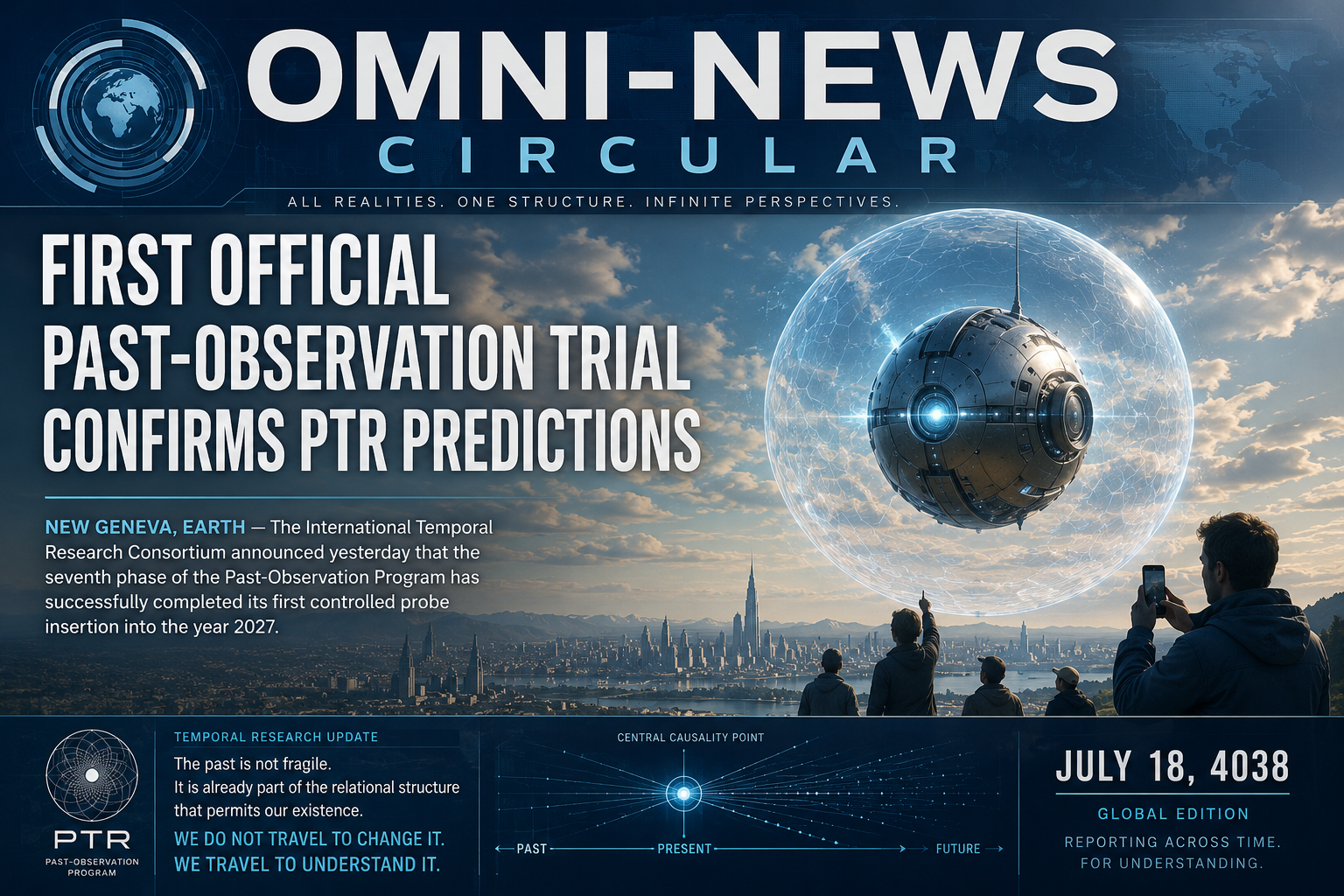
Omni-news Circular
July 18, 4038
NEW GENEVA, EARTH — The International Temporal Research Consortium announced yesterday that the seventh phase of the Past-Observation Program has successfully completed its first controlled probe insertion into the year 2027.
The experiment involved sending an autonomous observation probe approximately 2,011 years into the past while maintaining its isolation inside a Quantum Relational Containment Bubble (QRCB). According to researchers, the probe was observed multiple times by local inhabitants and was subsequently reported as an unidentified flying object.
"This is precisely what the PTR predicted," said Dr. Eliana Voss, Director of Temporal Navigation Sciences. "The probe existed within the temporal substrate but remained causally isolated from the local information structure. It could be observed, but it could not create paradoxes."
For centuries, critics of time travel argued that journeys into the past would inevitably produce contradictions, including the well-known "grandfather paradox." PTR theory, now universally accepted, demonstrated that such paradoxes are mathematically impossible.
Under the PTR model, reality consists of a relational information structure expanding away from the Central Causality Point. Any traveler entering another era carries their own observational frame and therefore occupies a protected temporal branch within the broader PTR. Interaction is constrained by information consistency requirements, preventing alterations to already-established historical relationships.
Researchers reported several attempts by earlier test probes to transmit historical information directly to the past. In every case, transmission systems failed through seemingly random mechanical, environmental, or probabilistic events. Analysis later confirmed that the failures were not random but manifestations of PTR consistency enforcement.
"The traveler is real. The observation is real. The paradox is impossible," explained Dr. Voss. "A time traveler can become part of history, but cannot rewrite the informational relationships that produced their own existence."
The Consortium has now released over 14,000 historical observation records believed to correspond to temporal probes. Many were originally cataloged by pre-temporal civilizations as UFO sightings.
One particularly famous incident, long debated among twentieth-century historians, has now been reclassified as a confirmed PTR observation event.
As future missions are planned, scientists emphasize that temporal travel remains a tool for observation rather than modification.
"The past is not fragile," stated the Consortium's final report. "It is already part of the relational structure that permits our existence. We do not travel to change it. We travel to understand it."
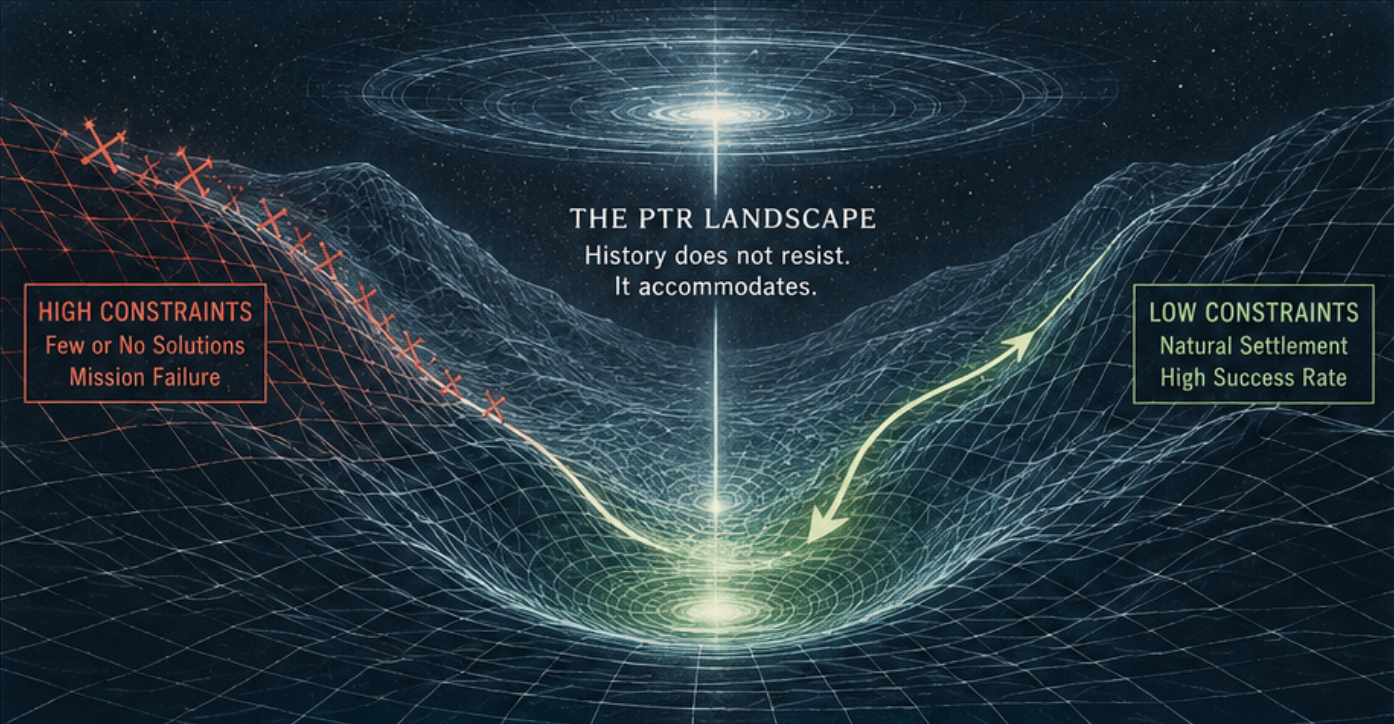
The Ra Chronicle March 2, 2084
For nearly three decades after the legalization of temporal transit, one question dominated the field:
Can we safely colonize the past?
The answer, surprisingly, was never found in better safeguards, stricter protocols, or more sophisticated navigation systems. It emerged from a realization that challenged our assumptions about causality itself.
Early temporal expeditions operated under a simple belief: if we traveled far enough from known history, selected isolated worlds, established hidden settlements, and avoided all interaction with recorded events, we could create perfectly safe colonies.
The results were disastrous.
Missions disappeared. Temporal insertion windows collapsed. Entire expeditions failed to arrive despite flawless calculations. Statistical analysis revealed an unsettling pattern: the more precautions researchers implemented to avoid discovery, interference, or observation, the lower the mission success rate became.
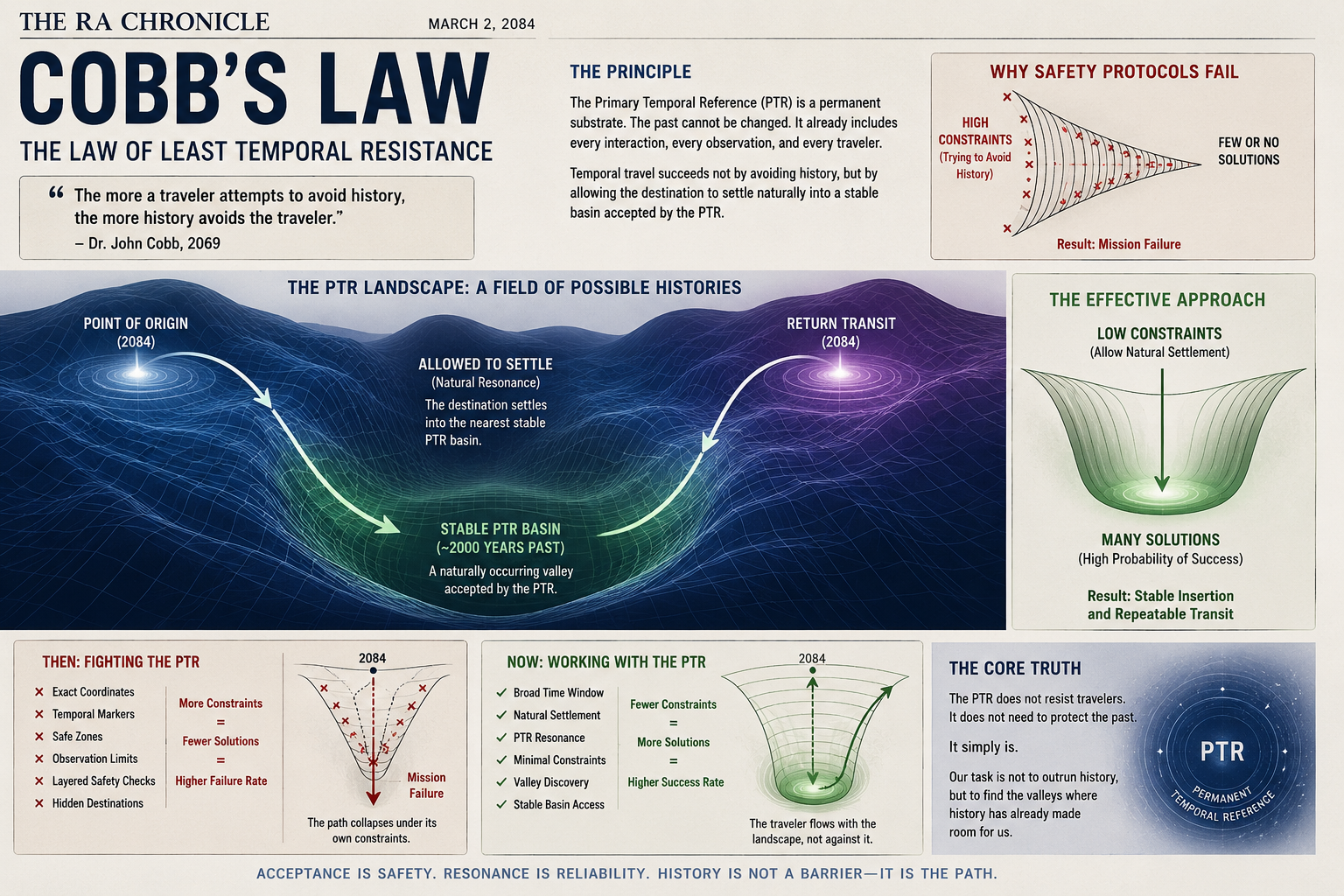
Initially, engineers blamed hardware limitations.
Then they blamed navigation.
Then quantum instability.
None of those explanations survived scrutiny.
The breakthrough came when researchers stopped treating the Primary Temporal Reference (PTR) as an obstacle and began treating it as a natural feature of reality.
The PTR is not merely a coordinate system. It is the permanent temporal substrate from which all observation emerges. Every event, every observer, and every timeline exists relative to this underlying reference. Most importantly, the PTR appears to preserve itself.
By the 2070s, experiments had repeatedly demonstrated a startling conclusion:
The past cannot be changed.
Travelers could observe historical events.
They could interact with people.
They could leave objects behind.
They could even discover evidence of their own future presence.
Yet every attempt to alter recorded history produced outcomes already consistent with history itself. The event being changed had always contained the interference.
The PTR did not resist alteration through force.
It required no correction mechanism.
No temporal police.
No cosmic enforcement.
The past includes the travelers' choices, because it will happen you still have free-will but your choice is still known.
This understanding transformed temporal colonization theory.
Researchers eventually recognized that attempts to locate "safe" destinations represented an implicit effort to circumvent the PTR. Every additional safety constraint narrowed the set of acceptable outcomes, forcing navigational systems toward increasingly improbable insertion solutions.
The universe responded not with contradiction but with failure.
The pattern became so consistent that Dr. John Cobb DT eventually formalized it into what is now known as Cobb's Law:
"The more a traveler attempts to avoid history, the more history avoids the traveler."
At the time, the statement was considered little more than an observation drawn from a growing mountain of failed missions. Yet as temporal science matured, researchers found the law remarkably predictive. Every additional safeguard designed to isolate a settlement from the timeline—hidden coordinates, temporal exclusion zones, observation restrictions, and layered insertion checks—reduced the probability of successful arrival. The PTR did not appear to punish interference; rather, it naturally favored destinations already compatible with its permanent structure. Attempts to outsmart history produced instability, while acceptance of the PTR's natural settlement process produced reliability. What began as an engineer's frustration would eventually become one of the foundational principles of temporal navigation.
The destination simply could not be reached.
The expedition was never there.
In response, a radically simpler methodology emerged.
Instead of defining an exact destination, travelers specify only broad temporal parameters—for example, approximately two thousand years before departure—and allow the temporal solution to settle naturally into a stable region permitted by the PTR.
Researchers often describe this process as rolling into a valley.
The PTR provides a landscape of stable historical solutions. Rather than forcing arrival at a predetermined coordinate, navigational systems allow temporal resonance to guide insertion toward the nearest naturally stable basin.
Once established, that region becomes remarkably accessible. Travel between the colony and the point of origin can occur repeatedly with minimal temporal stress because both locations already exist within a stable PTR relationship.
Counterintuitively, the safest destinations are not the most isolated ones.
They are the destinations the PTR naturally accepts.
This principle became known as the Safety Paradox:
The harder humanity tries to prevent temporal interaction, the more dangerous temporal travel becomes. The more humanity accepts the permanence of the PTR, the safer temporal travel becomes.
Today, nearly every successful temporal settlement operates under this doctrine.
No hidden markers.
No forbidden timelines.
No protected historical corridors.
Only stable temporal valleys discovered through resonance with the PTR.
Many citizens find this conclusion unsettling. It implies that every temporal colony, every expedition, and every traveler may have always been part of history.
Yet the evidence is difficult to dispute.
The past does not need protection.
The PTR has already protected it.
Our task is not to avoid history.
Our task is to discover where history has already made room for us.

August 17, 2637
Mara had forty-seven minutes left for lunch when Lian decided she needed a vacation.
"Come on."
"No."
"You don't even know what I'm asking."
"You're smiling."
"So?"
"You smile like that when you're about to cost me money."
Lian leaned across the little table between them and stole one of Mara's fried potatoes.
They were sitting on the eighty-second floor of the Helix Mutual building, beneath an artificial tree currently experiencing autumn despite it being August outside. Leaves drifted silently onto the polished floor, dissolved on contact, and recycled themselves back into the branches.
Mara watched one disappear.
"I have a quarterly review at fourteen hundred."
"You'll be back."
"I'm at work."
"Exactly. You're wasting a perfectly good lunch."
Lian slid a thin transparent card across the table.
Vicarious Leisure Systems
Below it:
SEVEN DAYS. TWENTY-TWO MINUTES.
Mara picked it up.
Santorini.
Seven subjective days.
Mediterranean package.
Private villa.
Historical environmental reconstruction.
No work notifications.
No advertisements.
Mara looked over the card at her.
"You already reserved it."
"I reserved the possibility of you making a good decision."
"You booked it."
"I knew you'd say yes."
"I haven't."
Lian pointed at the card in Mara's hand.
"You're reading the breakfast options."
Mara looked down.
She was.
Vicarious Leisure occupied three floors beneath the Helix medical suites.
There was nothing particularly mysterious about the place. Immersive temporal recreation had been around long enough that half the advertisements Mara saw during the week offered some version of it.
Weekend ski trips during commutes.
Three-month language retreats over dinner.
Honeymoons that fit between Monday and Tuesday.
Mara had simply never done one.
The receptionist scanned her identity and brought up the reservation.
"First immersion?"
"For me."
"Seven-day Mediterranean. Santorini reconstruction, late twentieth-century composite."
Lian leaned toward Mara.
"See?"
Mara smiled.
"I still think it's funny."
The receptionist looked between them.
"What?"
"This."
Mara gestured around the lobby.
"'Total Recall.'"
The receptionist laughed.
"Oh, we hear that constantly."
"I hadn't thought about that film in years," Lian said.
"Neither had I until she dragged me down here."
The receptionist shook her head.
"It's amazing how many of those old classics eventually became normal life."
"Not all of them, thankfully," Mara said.
"Give it time."
The three of them laughed.
The receptionist pushed the standard disclosure across the counter.
It unfolded into several columns of text.
"Usual neural synchronization disclosure. Review and authorize at the bottom."
Mara skimmed downward.
"Anything interesting?"
"Not unless you're planning to sue us."
Lian leaned over.
"She's not."
"Then it's extremely boring."
The receptionist glanced at the intake screen.
"Just the standard pre-immersion questions. Neural implants?"
"No."
"Cybernetic memory augmentation?"
"No."
"PTR occupational exposure?"
"No."
"Technomantic classification?"
"No."
"History of temporal disorientation?"
"No."
"Previous synchronization intolerance?"
"No."
"Astral interference classification?"
"No."
The answers came without hesitation. Mara was already scrolling toward the authorization line.
The receptionist marked the intake complete.
"Perfect."
Mara signed.
The immersion room contained six recliners arranged around a dark Quanitronic column.
Mara settled into one while Lian took the next.
Their controller, Elias, checked the synchronization panel.
"Nothing unusual here. Seven subjective days. External elapsed time should be just under half an hour."
Mara adjusted the headrest.
"Should be?"
"People don't perceive time identically. That's the entire reason this works."
"Fair enough."
He reviewed the intake record for a moment, then closed it.
Lian looked at Mara.
"Still thinking about Total Recall?"
"I am now."
Elias smiled.
"We used to have an employee who played the soundtrack during initialization."
"What happened to him?"
"We made him stop."
"Tragic."
"Very."
Elias stepped back.
"All right. Arrival preference."
A soft voice filled the room.
Morning. Afternoon. Evening.
"Morning," Lian said.
"Morning," Mara agreed.
She closed her eyes.
For half a second, there was the strange sensation that her hands were somewhere slightly farther away than they ought to be.
Then she smelled salt.
The Aegean was impossibly blue.
Mara stood barefoot on white stone warmed by the morning sun.
Far below, waves folded against black volcanic rock. White buildings climbed the hillside behind them, broken by flowers spilling across walls and narrow paths winding between terraces.
The villa was built around a broad central terrace, with separate rooms set into opposite sides of the hillside.
The air moved across her face.
Somewhere nearby, someone was baking bread.
Lian stood by the terrace railing holding two glasses.
Mara slowly turned in place.
"We're at work."
"No," Lian said. "Our bodies are at work."
"That distinction feels dangerous."
Lian handed her a glass.
Mara drank.
She stopped.
"That's wine."
"Vacation."
"It's lunchtime."
"Vacation."
Mara laughed.
And for the first several days, the system was extraordinary.
They swam in water that remained cool even beneath the afternoon sun.
They ate on terraces overlooking the caldera.
They spent an entire morning sailing aboard a reconstructed wooden boat while Lian repeatedly questioned whether anyone in the twentieth century had actually been expected to operate something with that many ropes.
They slept without alarms.
They walked through villages late at night.
Mara knew intellectually that her body was less than two hundred meters from her desk.
Eventually, that knowledge became irrelevant.
The first oddity appeared on the fourth day.
Mara was reaching for a glass when it seemed to move a few millimeters before her fingers touched it.
She paused.
"What?"
Lian looked over.
"Nothing."
Mara picked up the glass.
The next morning, a menu remained attached to her field of vision for perhaps half a second after she looked away.
Later, a doorway highlighted itself after she had already walked through it.
Tiny things.
The sort of tracking errors people occasionally encountered with any interface.
By evening, Mara had forgotten them.
On the sixth day, she noticed the sunlight change.
Not dramatically.
The shadows simply seemed to hesitate.
Then continue.
Mara looked toward the sky.
"Did you see that?"
Lian followed her gaze.
"See what?"
"Nothing."
And again, it was gone.
On the seventh morning, Mara woke in her room and lay there for a while listening to the sea.
Morning light stretched across the floor.
The doors to the terrace were open.
Everything looked normal.
She showered, dressed, and stepped into the central hall.
Lian's door stood open across the villa.
"Lian?"
No answer.
Mara crossed the hall and looked inside.
The bed had already been made.
Lian's shoes were gone.
Mara nodded to herself.
"Bakery."
Lian had been getting up before sunrise every morning to walk down the hill for bread and coffee.
Mara turned back toward her own room.
She stopped.
Her room was white.
Not the walls.
Not the bedding.
The room itself was gone.
The doorway remained, but beyond it there was nothing.
No bed.
No balcony.
No windows.
No morning light.
Just featureless white.
Mara stared.
"Elias?"
Nothing.
She stepped out of Lian's room.
When she looked back, Lian's room was gone too.
White.
The hall still existed.
The stairs still existed.
Everything ahead of her remained intact.
Everything she had left behind did not.
Mara stood very still.
Then she moved toward the stairs.
At the bottom, she looked back.
The staircase had disappeared.
White.
She crossed the kitchen.
The kitchen vanished behind her.
She stepped onto the terrace.
The villa disappeared.
Only the terrace remained.
Mara walked toward the railing.
Below her, the village still descended toward the sea.
People moved through the streets.
Boats crossed the water.
For a moment, she felt relieved.
Then she stepped down onto the road.
The terrace vanished.
Mara turned around.
White.
She walked faster.
A café disappeared behind her.
Then a row of houses.
Then a courtyard.
Every place she left ceased to exist.
"Lian!"
People farther down the street continued walking normally.
One turned a corner.
When Mara passed the corner, the street behind her vanished.
She began to run.
Not because anything was following her.
Because nothing was.
The world simply stopped existing once she left it.
The village narrowed around her.
A street.
A staircase.
A little church.
Then the church disappeared.
The sea remained.
Mara reached the shoreline.
For a few moments the waves continued folding over black volcanic stone.
She stepped into the water.
Cool around her ankles.
Then her knees.
She looked back.
Santorini was gone.
Nothing remained behind her.
Only white.
Mara turned toward the horizon.
The sea still stretched ahead.
She took another step.
The water behind her disappeared.
Another.
More vanished.
She stopped.
It wasn't spreading.
It wasn't chasing her.
The system simply wasn't maintaining anything she was no longer directly experiencing.
Mara stood in the water and watched the horizon.
Then she closed her eyes.
When she opened them, the ocean was gone.
There was only white.
No floor that she could see, though she felt herself standing.
No horizon.
No sun.
No sound.
"Lian?"
Nothing.
"Elias?"
Nothing.
She waited.
At first she assumed the system would correct itself.
A few seconds.
Perhaps a minute.
It didn't.
Mara tried walking.
There was no indication that she moved.
She tried sitting and discovered that she could, although there was nothing beneath her.
Eventually she stopped calling for anyone.
There was nothing to do.
Nothing to look at.
Nothing to hear.
No interface.
No clock.
No way to tell whether a minute had passed or an hour.
So Mara thought.
At first about the vacation.
Then about work.
Her quarterly review.
The messages waiting for her.
Whether Lian had finished her seventh day normally and was already awake.
Then about things she hadn't intended to think about.
Her mother.
A conversation they'd had years earlier.
An apartment she'd lived in as a child.
A teacher whose name she couldn't remember.
A mistake she had made at seventeen that no one else probably remembered.
She reconstructed entire conversations.
Arguments.
Apologies she'd never made.
Eventually she ran out of useful memories.
Then useless ones.
She tried counting.
She lost track somewhere after six thousand.
Started over.
Lost track again.
She slept.
Or thought she slept.
There was no way to know.
She woke without knowing whether she had been unconscious for seconds or hours.
She tried inventing stories.
Songs.
Lists.
Anything that could divide one thought from the next.
Eventually even that became work.
The white never changed.
After some unknowable amount of time, Mara stopped trying to make it change.
She sat.
And waited.
And became very, very tired.
Then the white vanished.
Her eyes opened.
Elias was beside the chair, watching the diagnostic panel.
Lian was already sitting upright.
"There she is."
Mara blinked.
She didn't answer.
Lian leaned closer.
"Mara?"
Mara swallowed.
"How long?"
"Thirty-four minutes total," Elias said.
Mara stared at him.
"Thirty-four minutes."
"Yes."
She slowly sat up.
Her muscles weren't tired.
That almost made it worse.
Her mind felt as though it had been awake for days beyond the vacation itself.
Lian studied her.
"What happened?"
"White."
"White?"
"Everything disappeared."
Elias looked away from the diagnostic.
"All at once?"
Mara shook her head.
"No."
She rubbed her eyes.
"I went across the villa looking for Lian. When I turned around, my room was gone."
Elias listened.
"Then when I left her room, hers disappeared too. Then the stairs. The villa. The village."
She paused.
"Eventually the ocean."
"And then?"
"Nothing."
"For how long?"
Mara let her hands fall into her lap.
"I don't know."
Elias turned back to the diagnostics.
"Your recreation environment stopped resolving during the final subjective day."
"So the system failed?"
"No."
Elias said it immediately.
Mara looked at him.
She was too tired to argue much.
"No?"
"The system continued operating."
"It erased the world behind me."
"It stopped maintaining portions of the environment once they fell outside your immediate synchronization."
Mara stared at him.
"That's a very technical way of saying it erased the world behind me."
Elias enlarged one of the diagnostic traces.
"The environment itself continued generating normally. Your synchronization stopped accepting enough information to construct it."
Mara leaned forward slightly.
"Why?"
Elias looked at her intake record.
Then at the trace.
Then back at her.
"Have you ever been tested for astral interference?"
"No."
"Astrid."
"No."
"Never?"
"No."
Elias exhaled through his nose.
"Why didn't you read the disclosure?"
Mara looked at him.
"The disclosure?"
"The one you signed."
"I read enough of it."
"The astral-interference warning is in bold."
"It's several pages long."
"It's in bold."
Mara closed her eyes for a moment.
"I am too tired for you to be angry about typography."
Elias paused.
"Fair."
Lian quietly looked away.
Elias returned to the diagnostic.
"You may want to get tested."
Mara opened her eyes.
"You think I'm an Astrid?"
"I think the possibility is worth checking."
"I've never had problems with Quanitronic systems."
"Obviously."
"Obviously?"
"If you had meaningful interference, you never would have synchronized in the first place."
He expanded the graph.
A narrow deviation appeared through the otherwise regular pattern.
It was almost nothing.
Mara had to look carefully to see it.
Elias pointed.
"That's what caught my attention."
"That?"
"That."
"It barely moves."
"Exactly."
He scrolled backward.
There were occasional disturbances throughout the session.
Tiny failures to align.
Most immediately corrected themselves.
"Have tracking interfaces ever been slightly unreliable for you?"
Mara thought about it.
"Not really."
"Never?"
"Sometimes an overlay takes a second to settle."
"Optical tracking?"
"Occasionally."
"Gesture recognition?"
"Maybe."
"Personal overlays?"
"They drift sometimes."
Lian looked over.
"I've seen that."
Mara shrugged.
"I thought everyone's did that."
"They do," Elias said. "Which is why you'd never think anything of it."
He tapped the trace.
"Yours may happen slightly more often than the statistical baseline. Not enough to notice in ordinary use."
Mara looked at the graph.
"So I'm an Astrid?"
"I'm not diagnosing you from a vacation system."
"But?"
"But if you are, you're very low grade."
"How low?"
"Low enough that the system synchronized with you normally. Low enough that you spent six days in a highly complex temporal recreation with only minor tracking discrepancies."
"And then?"
Elias gestured toward the graph.
"Small errors accumulate."
Mara stared at the display.
"I never thought about being an Astrid."
"Why would you?"
He closed the diagnostic.
"At your level, assuming I'm right, you might go your entire life thinking interfaces are just slightly annoying."
Mara leaned back into the chair.
"So your equipment isn't broken."
"No."
"It just won't work with me."
"It did work with you."
"For six days."
"Which is the important part."
"The seventh day was considerably longer."
Elias sent something to Mara's personal interface.
A referral appeared.
ASTRAL INTERFERENCE SCREENING — RECOMMENDED
Mara looked at it.
"So now I need a test."
"Yes."
"And you think it'll be positive."
"I think it'll be interesting."
Mara closed the notification.
"I came downstairs for lunch."
Lian stood.
"You also got six days in Santorini."
Mara remained sitting.
Lian looked at her.
"You coming?"
"In a minute."
There was a pause.
"You're okay?"
Mara nodded.
"Just tired."
Elias glanced at the recliner readout.
"Physically, you're completely rested."
Mara looked up at him.
"That is not what I meant."
He nodded.
Then pointed toward the referral.
"Well, that's one way to get tested."
Mara looked at the notification again.
Thirty-four minutes.
Her quarterly review hadn't even started yet.
She had enough time to go upstairs, get another lunch, review her notes, and pretend none of this had happened.
Instead she leaned her head back against the chair and closed her eyes.
Immediately she opened them again.
White.
For just an instant she had expected white.
Mara stared at the ceiling.
Lian sat back down in the neighboring chair without saying anything.
Mara had taken a vacation during lunch.
Six days in Santorini.
And whatever the clock on the wall said, she felt as though she had been gone a very long time.