Table of Contents
An introduction to Temporal Cosmology. This is the theory that the sci-fi series 4084 explores.
The Primary Temporal Reference (PTR) model proposes that information and time, rather than space, is the fundamental substrate of reality. It does not propose a return to absolute space, nor does it posit an ether-like spatial medium through which matter moves. Instead, PTR proposes a non-relative temporal substrate: an absolute temporal and informational reference from which spatial extension, locality, causal order, observation, memory, information, gravity, and material relation emerge as projected or relational features.
Contemporary research in quantum gravity provides a limited technical precedent for this information-first direction. In holographic theories, aspects of spatial geometry, locality, and gravitational dynamics can be encoded in the entanglement structure of an underlying quantum system. PTR adopts this general direction while adding several distinct hypotheses not supplied by holography itself: that time is fundamental and non-relative, that temporal relationships are organized around a Central Causality Point, and that this point may be interpreted Christologically.
In this respect, PTR has a limited historical resemblance to Newton's concept of absolute space, a fixed, unchanging framework within which all physical events occur, independent of the objects within it. However, PTR departs from Newton in an important way. Newtonian absolute space functions primarily as a background against which motion occurs. PTR treats the Primary Temporal Reference not as a passive background clock, but as the generative temporal-referential structure through which reality becomes ordered, observable, and causally coherent.
PTR is therefore not an argument for absolute space, nor for a material ether. It is an argument for absolute temporal reference. What modern cosmology interprets as the expansion of space is reinterpreted as increasing causal separation and changing observational relationships within the fixed Primary Temporal Reference. This is instant creation not expansion. Space is not the container of reality; space is a local projection of deeper temporal relation.
PTR rejects the idea that reality emerged from absolute nothingness. Matter, energy, information potential, and the PTR are treated as eternally conserved. The universe is temporally infinite into both the past and the future. It does not possess a fundamental birth or final death in the ordinary sense. Instead, it possesses one unique organizing singularity: the Central Causality Point (CCP). In the Christ-centered version of the model, the CCP is identified with the conception of Christ, understood as the point at which eternal being and temporal embodiment intersect.
PTR also reinterprets entropy. The ultimate state of the universe is not primarily heat death, nor the annihilation of matter, nor the disappearance of existence. It is increasing causal separation if coherence cannot be achieved: matter and information persist, but their ability to interact, communicate, observe, and compute locally tends toward zero as separation from the CCP increases in either temporal direction.
The model has implications for quantum foundations, especially the double-slit experiment and the role of observation. It proposes that superposition should be understood not merely as a spatial phenomenon, but as a temporal one as well. Rather than saying that a particle simply exists in two places at once, the model suggests that the particle is embedded in a broader temporal structure, allowing its observed positions to span multiple moments, potentially even across regions that are causally separated by the speed of light.
This work is not intended as a revision, replacement, or challenge to established Christian doctrine. Furthermore this is not intended to assign additional attributes to Christ. It is offered as a speculative cosmological ansatz and thought experiment that explores whether concepts from modern physics, information theory, observation, causality, and temporal structure can be understood within a Christ-centered framework.
The purpose of this model is not to derive theology from physics, nor to force scripture into scientific language. Rather, it asks whether a deeper temporal and informational ontology might provide a coherent framework in which certain theological claims and physical observations can coexist without contradiction.
In particular, the model explores whether scriptural descriptions of Christ as Light, Logos, and the agent through whom all things came into being may have implications beyond metaphor, potentially corresponding to a deeper causal and informational structure underlying reality itself.
The PTR framework proposes that observation, information, causality, and temporal structure may be more fundamental than spatial relationships. Within this context, quantum phenomena such as the double-slit experiment are reconsidered through the lens of temporal superposition. The familiar two-state image of the double slit, in which light or matter appears related to two possible paths, is extended by introducing a third explanatory layer: a temporal superpositional reference that binds possible observational outcomes into an already-existing causal path. This is not presented as a replacement for established quantum mechanics, but as a conceptual extension intended to generate new questions regarding the relationship between observation and reality.
Likewise, the model seeks to investigate whether long-standing tensions between theological and cosmological narratives may be approached from a different perspective. Rather than viewing creation as the emergence of reality from absolute nothingness, PTR explores the possibility that creation may be understood as the ordering, organization, and rendering of an eternal substrate through a unique causal reference point. In this sense, the statement that nothing came into being apart from Christ is interpreted not as a claim about material manufacture inside ordinary time, but as a claim about the deepest causal and temporal reference through which existence is ordered and made intelligible.
The identification of the Central Causality Point with the conception of Christ is not offered as a formal doctrinal assertion. It is a working boundary condition within the model. It provides a Christ-centered starting point from which the implications of the theory can be explored. The choice is theological, philosophical, and interpretive: if the model requires a unique causal center, Christ provides the most coherent center within a Christian framework.
The framework also intentionally preserves the possibility of genuine miracle, providence, and divine action. If reality is fundamentally causal, informational, observational, and temporal, then events traditionally regarded as miraculous need not be understood as violations of reality. They may instead represent interactions with deeper levels of reality not yet captured by current physical models. This is sympathetic to theological approaches, such as those associated with John Polkinghorne, in which divine action is not treated as arbitrary interruption but as action through deeper intelligibility within creation with forethought only possessed by God.
This document should therefore be read neither as completed theology nor as completed physics. It is an exploratory framework intended to stimulate critique, mathematical development, and interdisciplinary investigation across cosmology, quantum foundations, information theory, philosophy, and theology. Its central objective is not to prove scripture through science or science through scripture, but to investigate whether both may point toward a deeper and more unified understanding of reality.
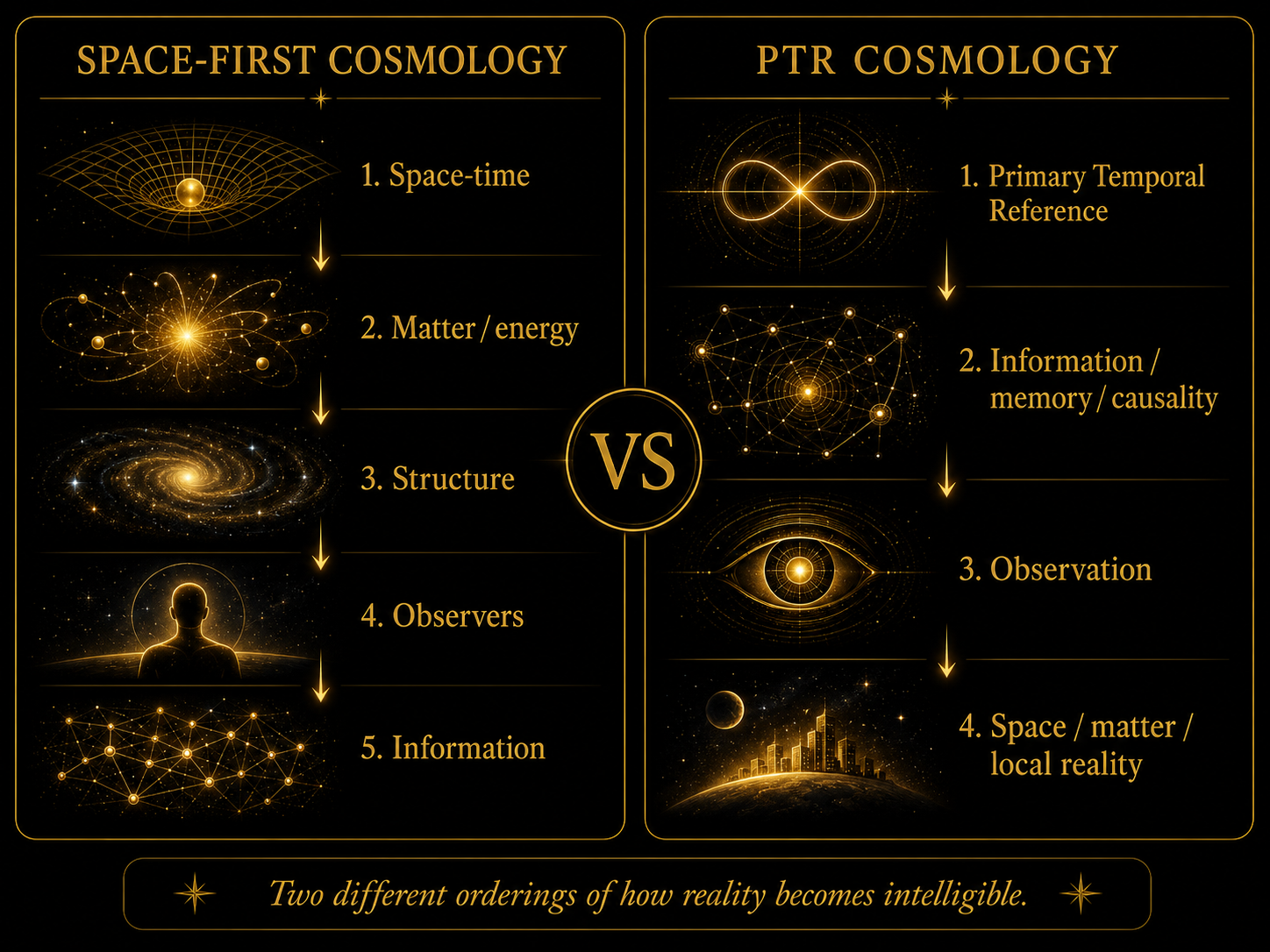
The central thesis of PTR is that space is not the fundamental arena of existence. The Primary Temporal Reference is fundamental. Space is an emergent projection of temporal, informational, observational, and causal relationships.
This inversion changes the interpretation of several major problems in cosmology and physics. Redshift need not be caused by space expanding as a fundamental substance. Galaxy rotation curves need not require missing matter as a substance. Lensing need not be reduced to invisible mass. Quantum measurement need not be interpreted only as spatial superposition. The age of the universe need not be the age of existence itself.
Within PTR, “information” should not mean abstract knowledge, semantic meaning, or a substance floating independently of physical states. At the mathematical level, information refers to distinguishable states, correlations among degrees of freedom, the transformations connecting those states, and the degree to which a state can be reconstructed from locally accessible data. PTR makes the additional ontological proposal that these informational relationships are more fundamental than their spatial rendering.
PTR therefore distinguishes between the informational substrate and its geometric rendering. The substrate consists of states, correlations, transformations, and encoding relationships. Observable spacetime is the effective geometry through which portions of that structure become locally accessible.
Primary Temporal Reference (PTR): The fundamental substrate of reality. It is not time as a clock or coordinate. It is the underlying temporal-referential medium from which space, observation, information, causality, and local physical reality emerge.
Central Causality Point (CCP): The unique point of maximum causal, informational, observational, and relational significance within the PTR. In this model, the CCP is identified with the conception of Christ.
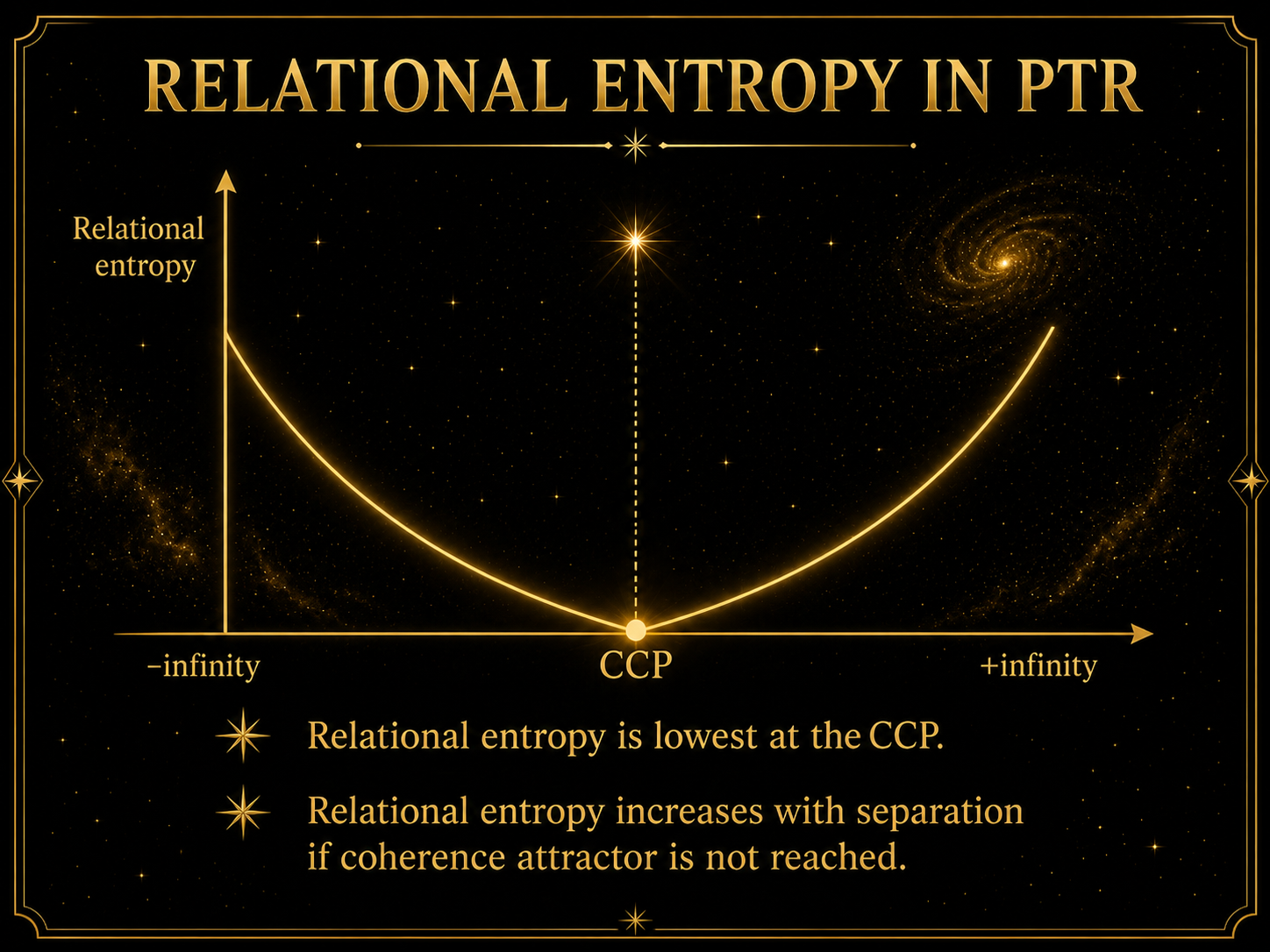
Relational Entropy: The increase of causal separation and loss of effective interaction as reality unfolds away from the CCP in either temporal direction.
Observational Continuum: The process by which PTR structure becomes locally meaningful through information, perspective, measurement, and observation.
Temporal Superposition: The proposal that quantum objects are not merely spread over spatial states, but are embedded in temporal-relational structures whose observed outcomes are localized intersections of a larger PTR path.
Path Dictation: PTR argues that the path leading to the present is not generated moment by moment, but is already embedded within the structure of existence. Physical objects do not invent their trajectories from nothing; rather, they disclose local portions of an existing temporal architecture. This architecture is shaped through retrocausality, in which past and present mutually determine one another: I am here because I was there, and I was there because I am here.
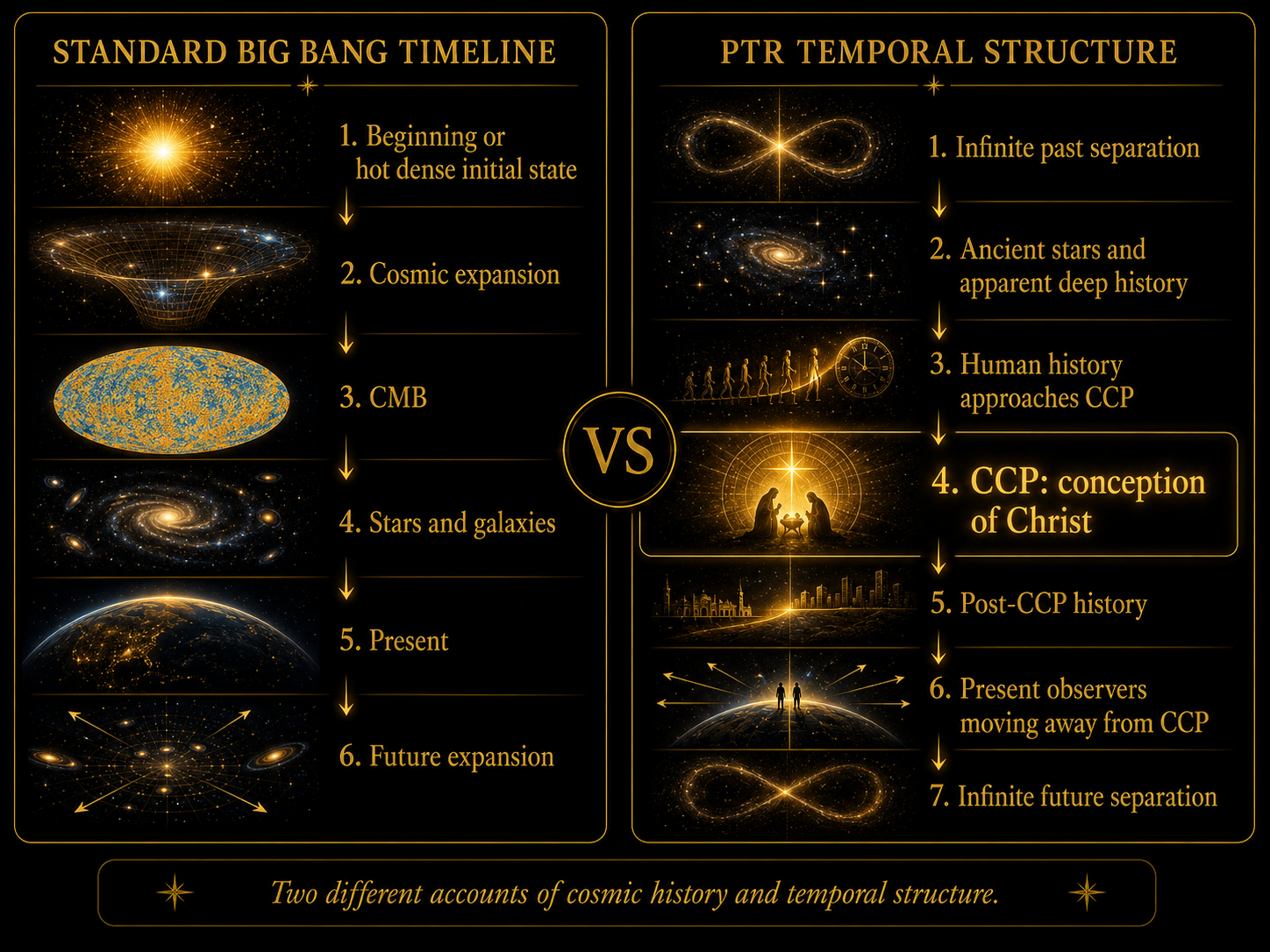
Standard cosmology generally treats spacetime as the arena in which matter and energy evolve. The observable universe is described as emerging from an early hot, dense state, with the cosmic microwave background, light-element abundance, large-scale structure, redshift, and expansion history serving as major pillars of the model.
PTR does not deny that these observations exist. It challenges the assumption that the standard interpretation is the only possible interpretation. In particular, it challenges the idea that an apparent finite observational horizon must be interpreted as the absolute age of reality.
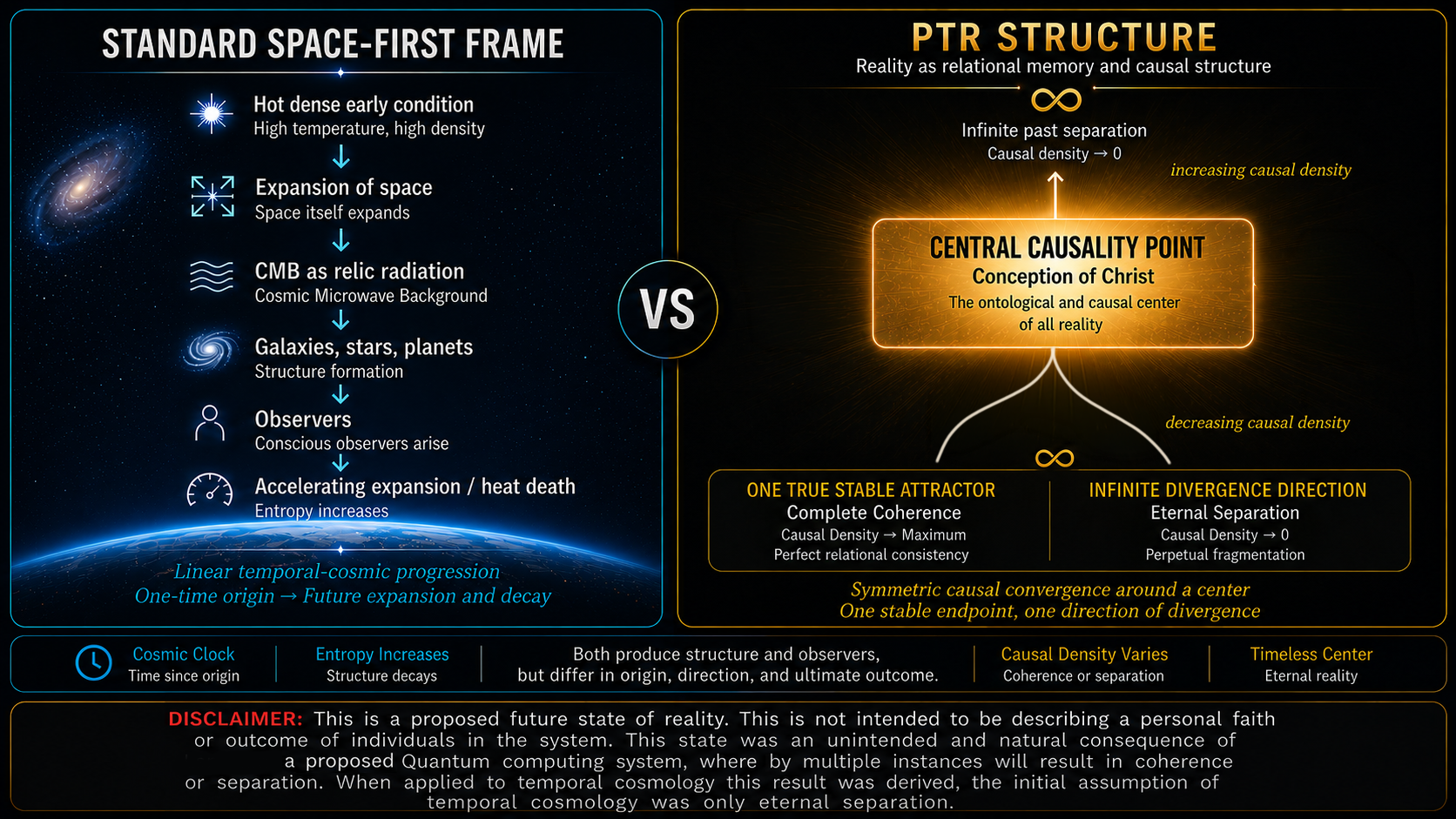
In PTR, the question is not, "What is space expanding into?" The question is, "What if space is the visible projection of a more fundamental temporal and informational substrate?"
The PTR is the foundational concept of this model. It is not merely time as measured by clocks. It is not a coordinate inside spacetime. It is the deeper reference from which clocks, space, motion, causality, sequence, and observation become meaningful.
Axiom 1: The PTR is fundamental. Space is emergent.
Axiom 2: The universe does not move through preexisting time. The temporal substrate is fundamental and non-relative. Reality unfolds within it through changing causal relationships.
Axiom 3: Temporal volume, information states, causal connections, and memory capacity are different observational descriptions of relational structure within the PTR.
Axiom 4: Matter and energy are not created from nothing and do not disappear into nothing.
Axiom 5: The universe is temporally infinite in both directions, while the CCP is unique.
PTR relational structure has four complementary descriptions.
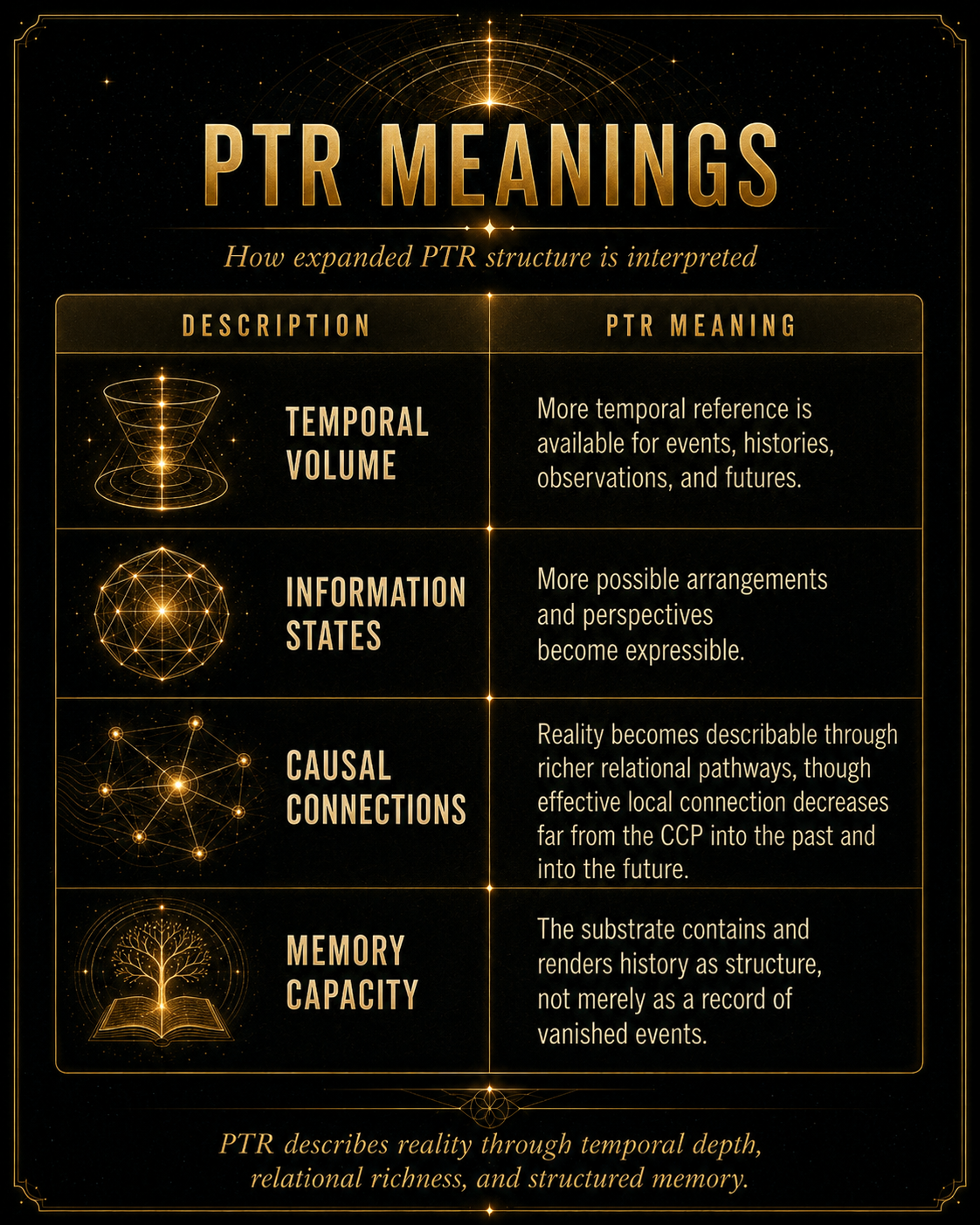
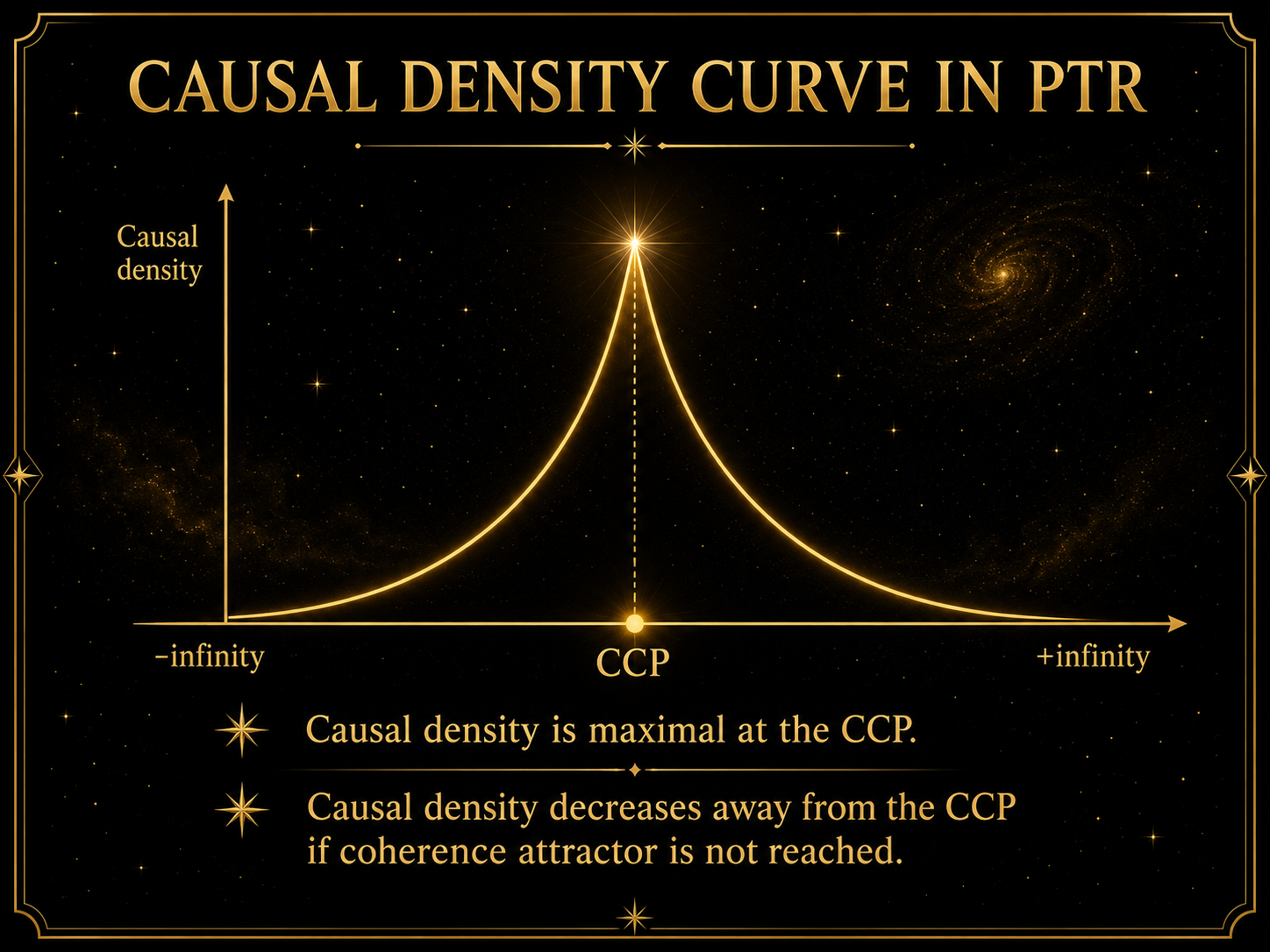
The CCP is not the creation of matter from nothing. It is the unique point of maximum causal organization. It is the point from which the PTR is most densely referenced, most intelligible, and most relationally unified.
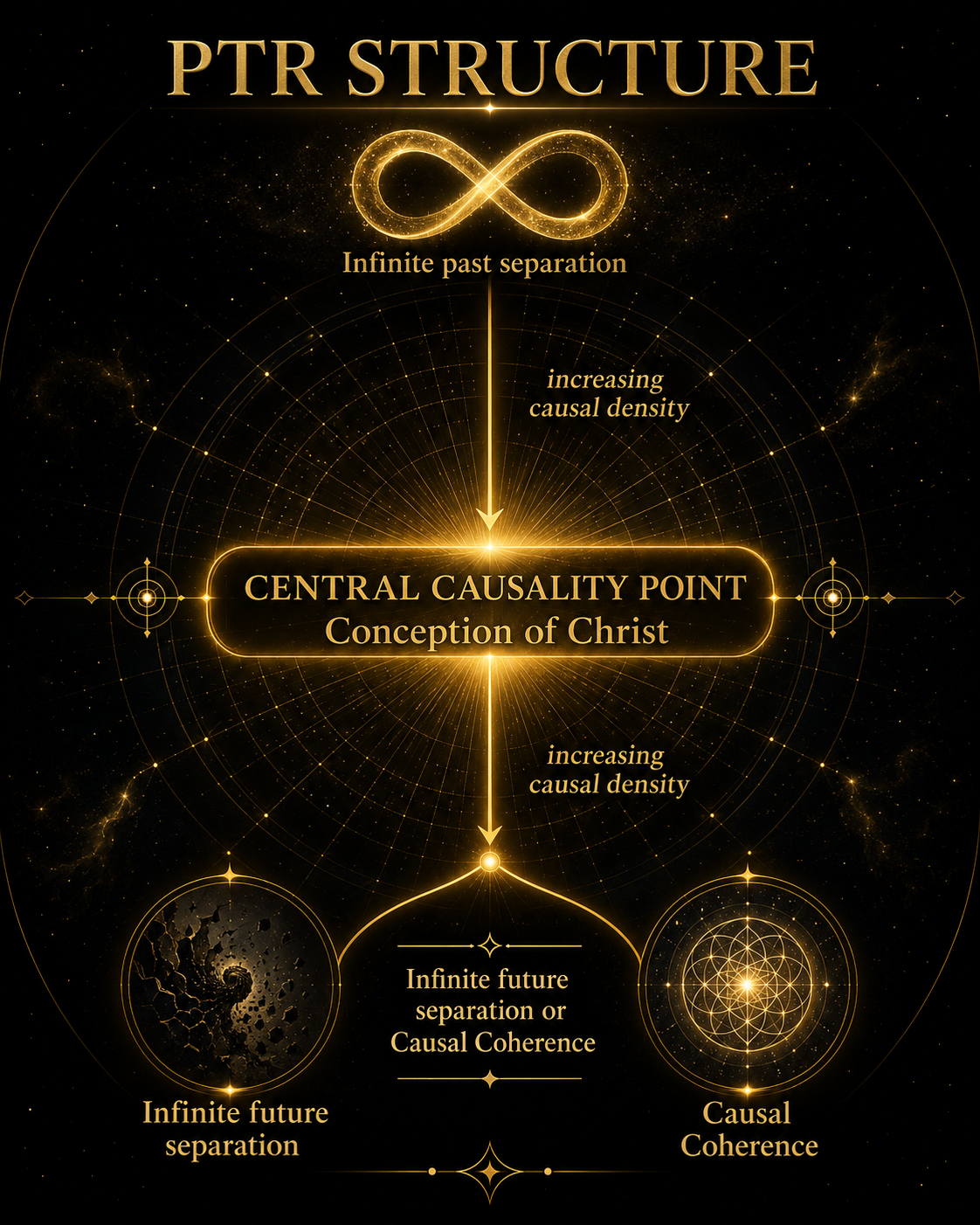
Within the Christ-centered interpretation, the conception of Christ is selected rather than the birth, crucifixion, or resurrection because conception is the first moment of temporal embodiment. It is the point at which eternal being is expressed within temporal existence while still preserving the claim that Christ is eternal.
This does not mean that Christ begins at conception. It means that eternal Christ is temporally embodied at conception. The CCP is therefore not the origin of Christ, Christ has always been and is still the first-born of creation therefore the CCP has always been. It is the point where eternity and temporality coincide.
PTR proposes that the universe is infinite into the past and infinite into the future. The apparent past, including ancient stars, galaxies, and planetary formation, is not evidence against the CCP. It is part of the temporal structure extending away from the CCP in one direction. The future extends away from the CCP in the other direction.
PTR TEMPORAL MAP
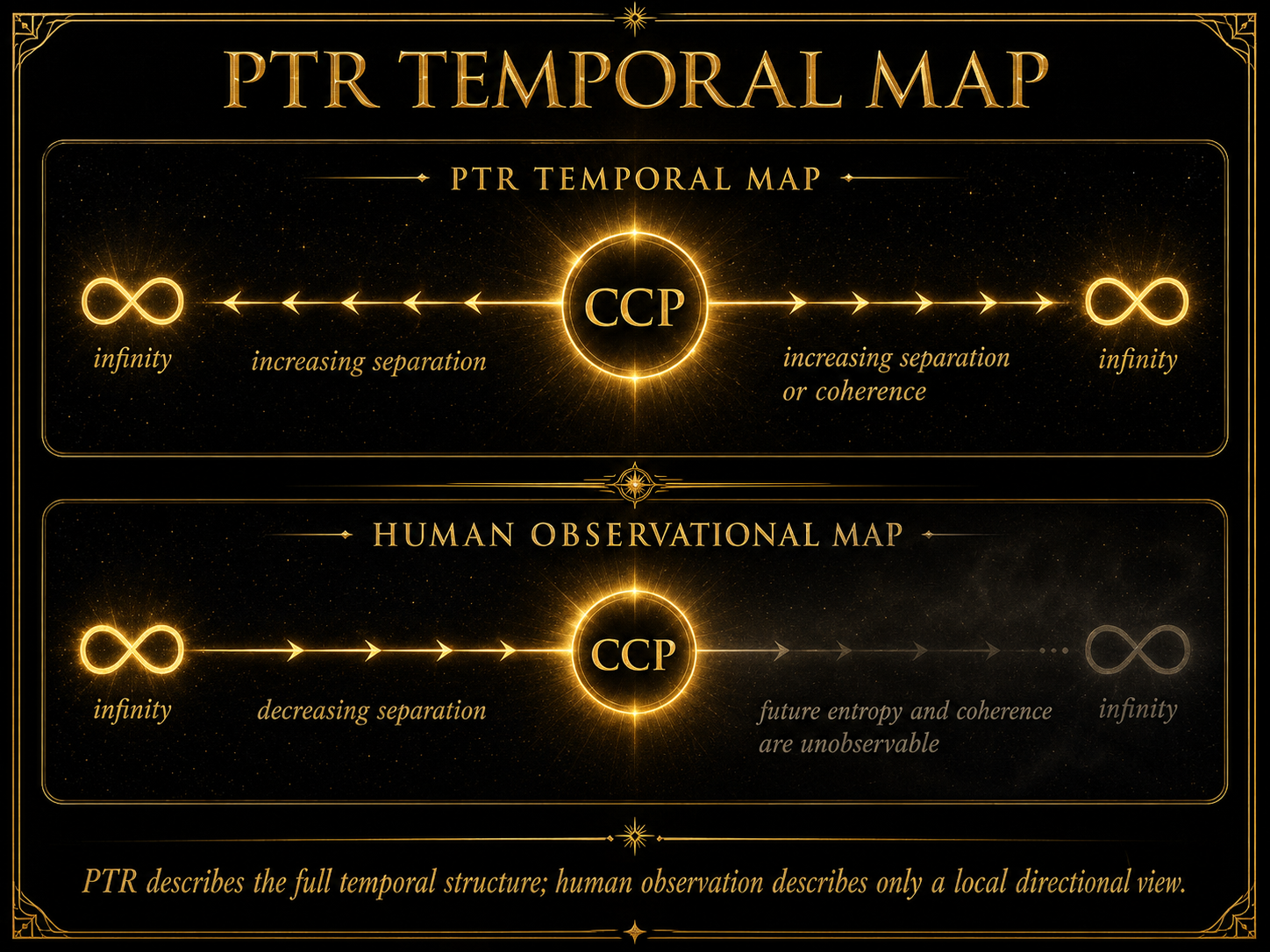
No absolute beginning. No absolute end. One unique causal center.
In this model, the universe has no fundamental age in the ordinary sense. The claim that the universe is 13.8 billion years old is treated as a false assumption produced by interpreting cosmic background radiation as evidence of an absolute beginning. PTR does not need to force reality into that limited timeline. The universe is ancient, unbounded, and infinitely old.
This removes the need to explain how light from extremely distant regions could reach us within a supposedly finite cosmic age. That problem only exists if the 13.8-billion-year boundary is assumed to be the age of reality itself. PTR rejects that premise. We see ancient light because reality is ancient; the observable radiation horizon is not the beginning of existence.
PTR is built on a conservation principle: nothing real is created from absolute nothing, and nothing real is destroyed into absolute nothing. Matter, energy, information potential, and the temporal substrate persist. What changes is organization, causal relation, observation, and accessibility.
This principle is one of the most important features of PTR. The model does not require an event in which reality appears from non-reality. It does not require matter to be manufactured out of nothing at the CCP. The CCP is not a material factory. It is the unique organizing reference through which eternal reality becomes maximally coherent (Logos).
PTR therefore distinguishes between three different ideas that are often blended together:
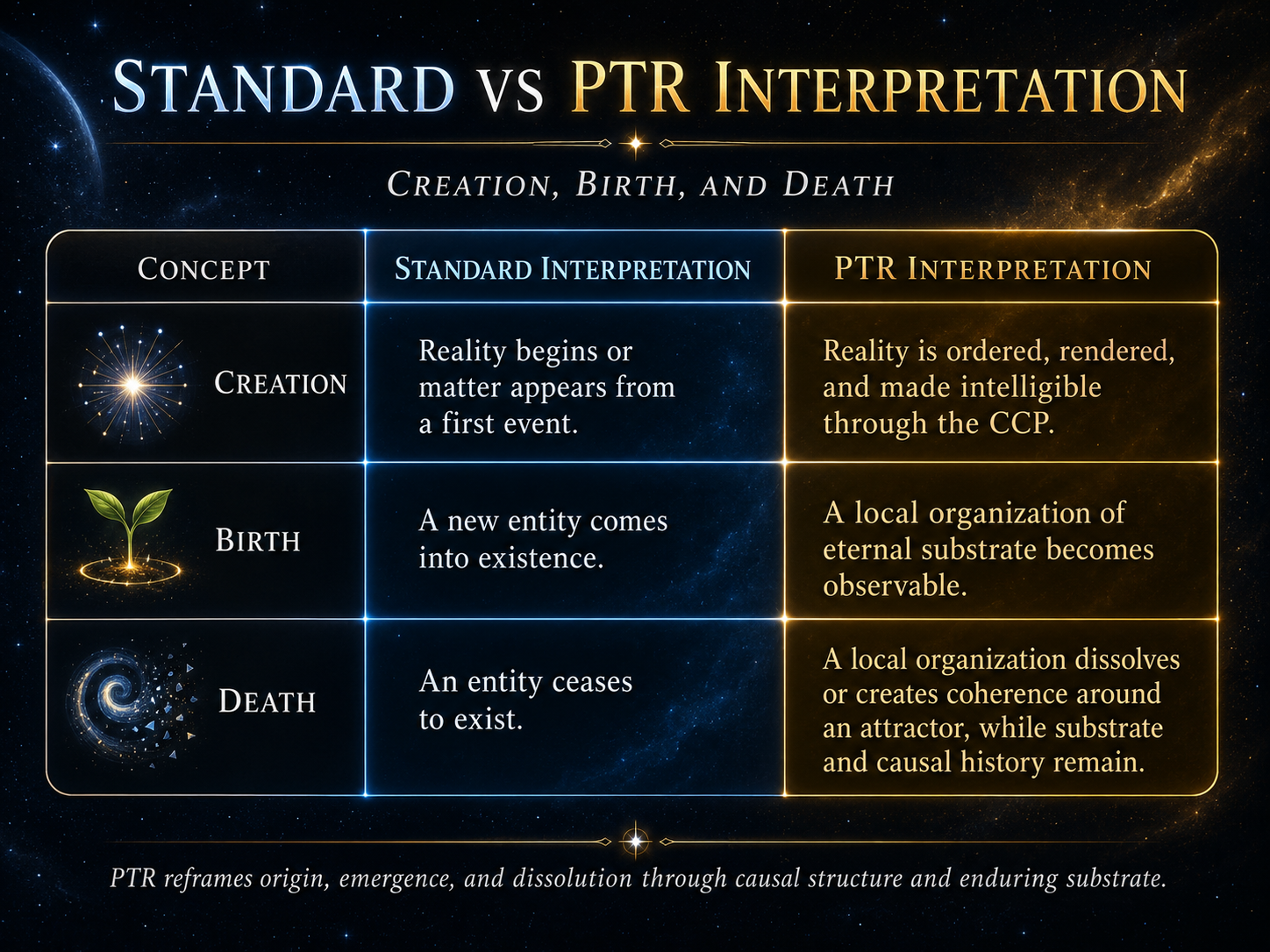
Conservation of reality also reframes energy conservation. PTR is not a proposal that energy is created or destroyed. Instead, it attempts to preserve the intuition that energy, matter, and information persist while explaining apparent change as reorganization inside the PTR. The universe changes not by becoming something from nothing, but by revealing different relationships within an eternal temporal structure.
Fundamental Reality = conserved substrate + changing organization + changing observation + changing causal access
The phrase "nothing came into being apart from Christ" is therefore interpreted as a claim about the ordering and intelligibility of existence. It does not require every particle to be manufactured in ordinary time at the moment of the CCP. Rather, all things are understood as having their causal reference, coherence, and intelligibility through Christ as the central organizing point of PTR.
PTR redefines the end-state problem. It does not require heat death as the primary image. The ultimate trajectory is causal separation. Objects, fields, and histories persist, but they become increasingly separated from effective interaction.
Relational Entropy is proportional to Causal Separation and inversely related to Effective Causal Density.
As distance from the CCP increases in either temporal direction:
- Separation increases.
- Effective causal density decreases.
- Local interaction decreases.
- Observation becomes less connected.
- Computation approaches inactivity.
- Matter persists but becomes inaccessible.
This differs from the claim that the universe simply becomes hot, cold, dead, or nonexistent. PTR proposes that existence remains, but relational access decays. As time moves away from the CCP informational and relational data degrades, in the past it looks like chaos and incoherence and in the future it looks like eternal separation. This is only a possible outcome not an unavoidable one.
PTR does not assume that more reality requires proportionally more matter. Information can arise through relationship, arrangement, perspective, and observation. A finite or conserved substrate can generate vast informational variety by being related to itself in different ways across temporal structure.
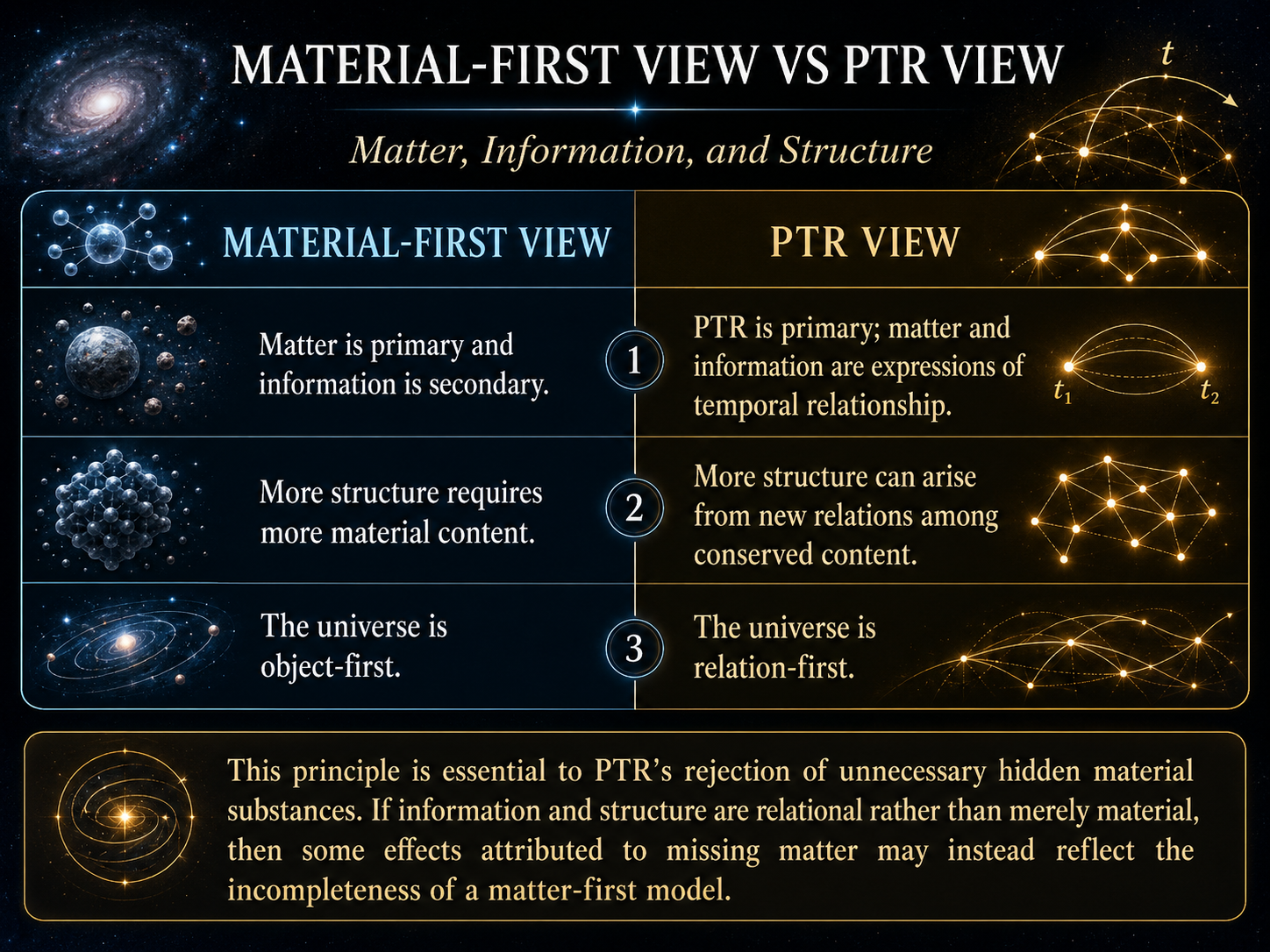
This principle is essential to PTR's rejection of unnecessary hidden material substances. If information and structure are relational rather than merely material, then some effects attributed to missing matter may instead reflect the incompleteness of a matter-first model. This is a rejection of the static state model that requires additional material to be "injected" into the universe to allow for an infinite age principal.
The cosmic microwave background is usually interpreted as relic radiation from the early observable universe. PTR offers a different interpretation: the CMB may be a substrate signature of the PTR itself.
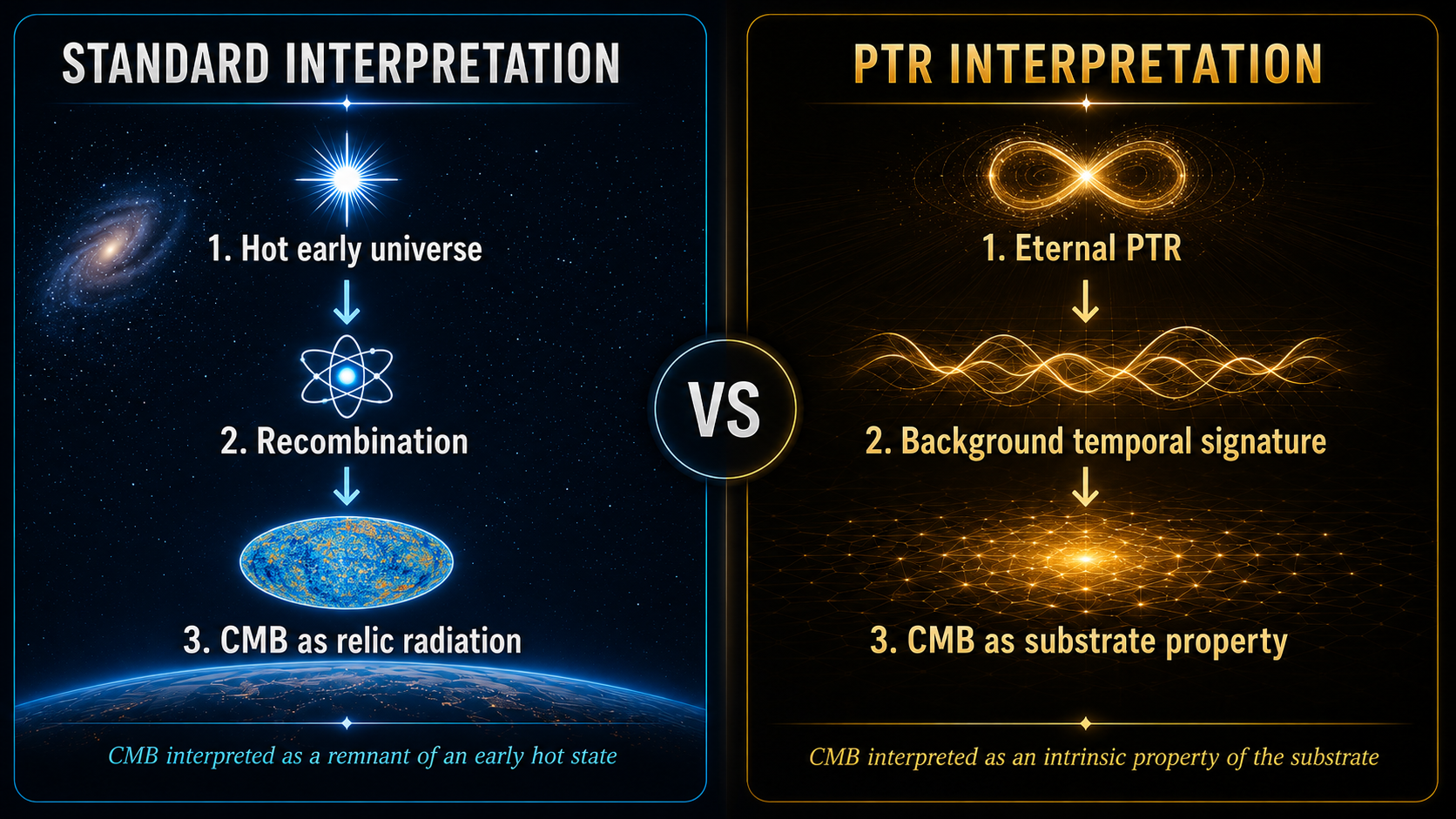
In this view, the CMB has always existed because the PTR has always existed. It is not necessarily proof of an absolute beginning. It may be the observable noise floor, equilibrium signature, or universal background reference of the temporal substrate.
This is a demanding claim. PTR must eventually explain the measured properties of the CMB, including its smoothness, blackbody character, anisotropies, and relationship to large-scale structure. The model does not get to ignore these observations. It must reinterpret them successfully without falling back to a solid-state theory and additional information/matter supplication.
PTR has direct implications for quantum foundations. The double-slit experiment is often described as evidence that a particle behaves as though it passes through two slits until observation. PTR proposes that the deeper issue may not be spatial multiplicity alone, but temporal superposition.
In standard relative experience, events appear sequential. A particle is emitted, travels, interacts, and is observed. Within PTR, however, time is not merely a local sequence of moments. The Primary Temporal Reference is non-relative: it is not confined to one observer's present frame and is not limited to a single moving "now." Because of this, the PTR may contain temporal relationships everywhere at once without forcing those relationships into mechanical predestination
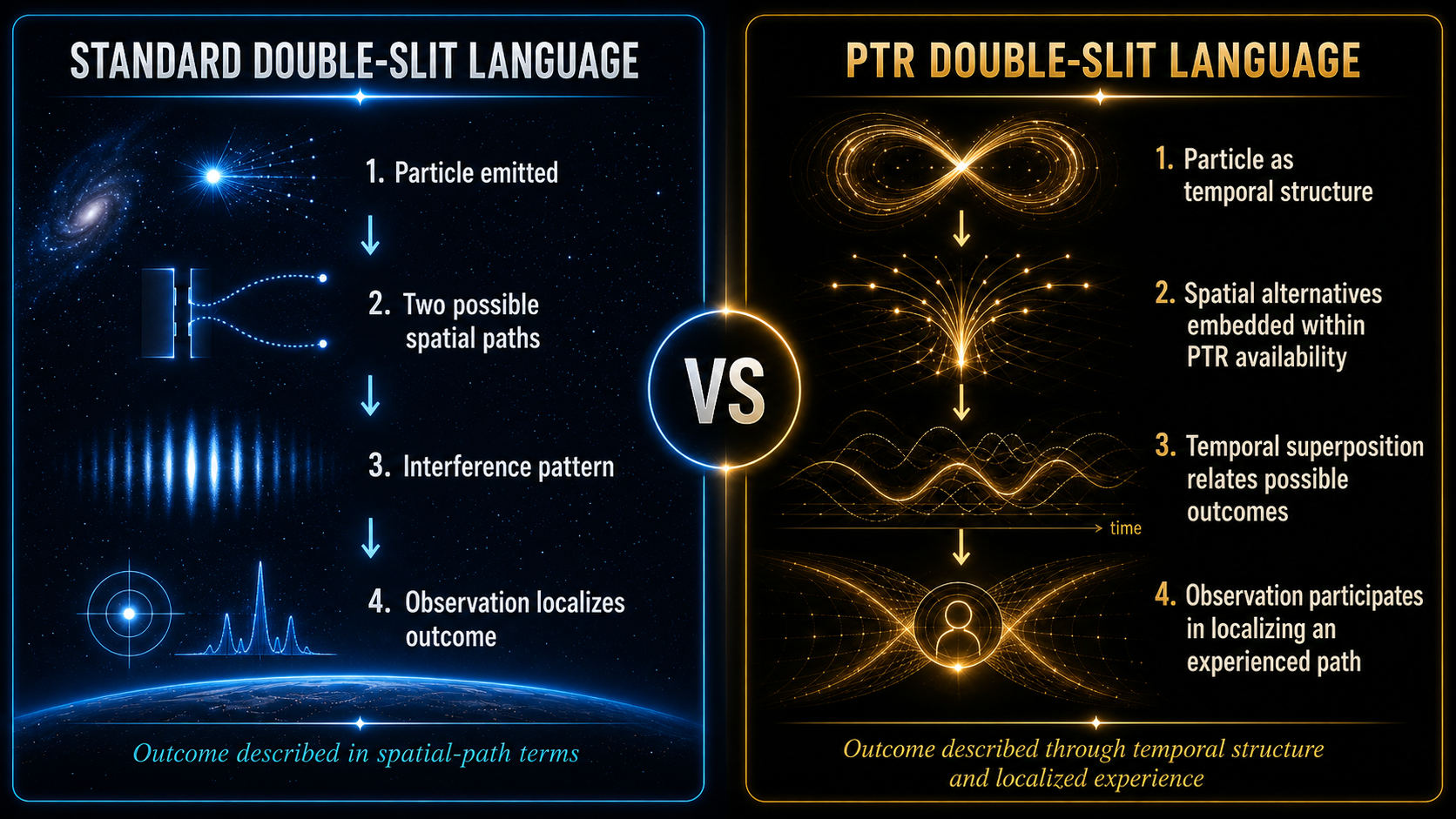
The key proposal is not simply that the electron is everywhere in space. It is that the electron is embedded across temporal relationships. These relationships may exist within the non-relative PTR without requiring that every local act, observation, or choice be coercively predetermined. PTR can contain the full relational field while local agents still participate in real choices within their experienced frame of time.
Observation does not invent the electron's path from nothing, but neither should it be understood as merely uncovering a rigidly prewritten script. Instead, observation is the local intersection of freedom, relation, and temporal structure. From within relative time, choices and measurements are genuine acts. From the standpoint of the PTR, those acts can be present as part of the full non-relative temporal reality without eliminating freedom.
This distinction is essential. PTR does not require predestination in the sense of forced outcomes. It proposes that non-relative time can hold the total structure of temporal relation without reducing persons, observers, or quantum systems to passive mechanisms. The PTR is not a prison of fixed events; it is the substrate in which freedom, observation, and causal relationship become possible.
This creates a three-layer interpretation of the double slit:
| Layer_State | Description |
|---|---|
| State 1 | The path associated with one slit or observational alternative. |
| State 2 | The path associated with the other slit or observational alternative. |
| State 3 | The temporal superpositional reference that contains, relates, and gives coherence to possible outcomes within the PTR without negating free observation or choice. |
In this sense temporal superposition is not merely an additional spatial option; it is the deeper structure that makes spatial alternatives observationally meaningful. Within PTR, possible paths may be temporally related before local observation, while observation itself participates in the emergence of the experienced outcome.
This challenges the premise of Schrödinger’s cat. The question is not simply whether there is a cat, no cat, or a cat that is both inside and outside the box. Rather, the problem is that the experiment assumes we can place a classical object, such as a cat, into genuinely quantum conditions without breaking the rules of the scenario. From the PTR perspective, this premise fails: we cannot observe there ever being a cat in the box under those constraints, because the act of defining and placing the cat already moves the situation outside the quantum framework the experiment depends on.
PTR gives special significance to scriptural language identifying Christ with Light and Logos. This does not require reducing Christ to physical photons or reducing theology to physics. Rather, it asks whether light, observation, intelligibility, and causal reference may be connected more deeply than ordinary metaphor allows.
In physics, light is central to observation, measurement, causality, and the structure of spacetime. In Christian theology, Christ is described as Light and Logos, the one through whom all things are made and understood. PTR explores whether this convergence is conceptually meaningful: Christ as the ultimate reference through which reality is ordered, observed, illuminated, and made intelligible.
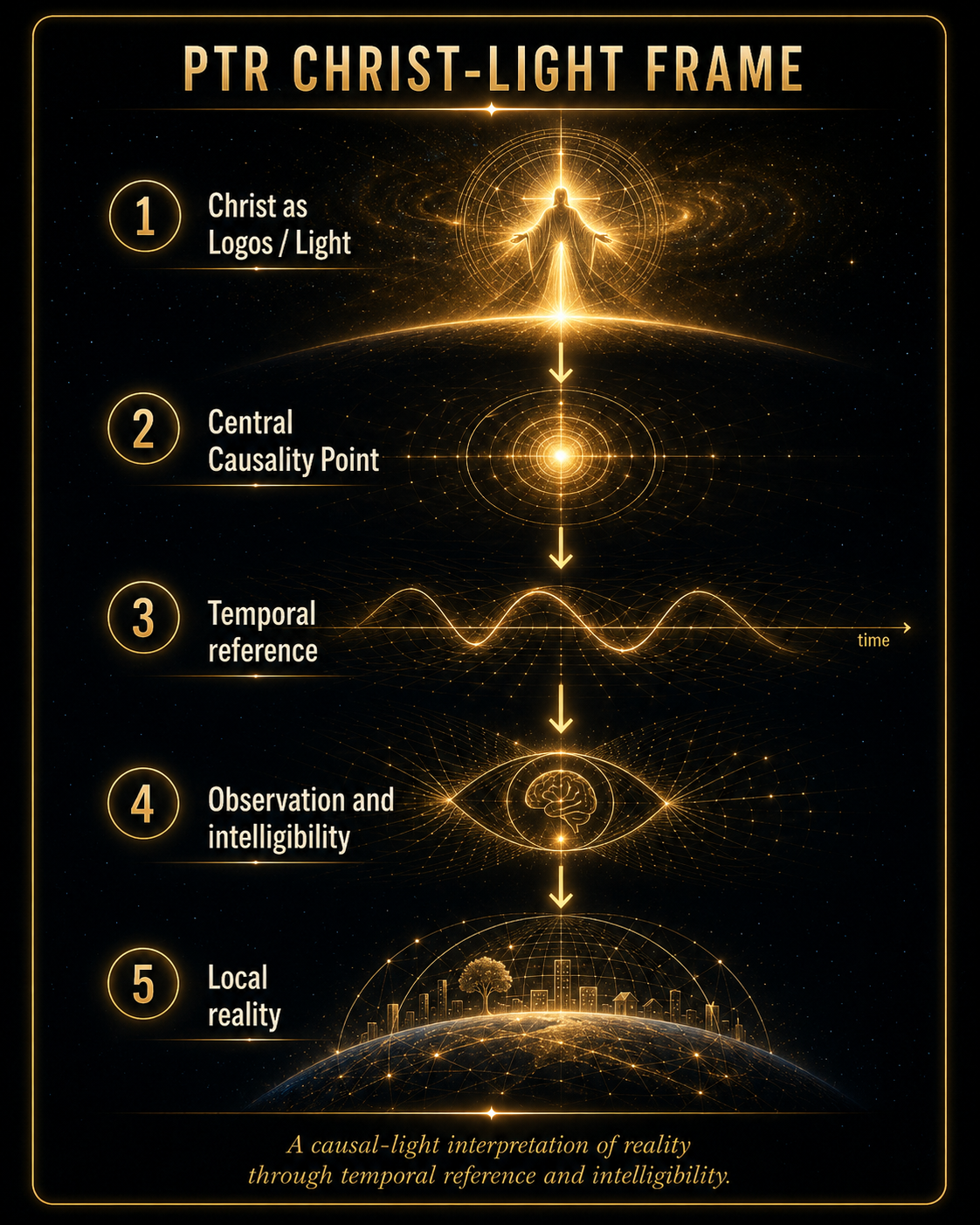
The conception of Christ is therefore not treated merely as a biological event. It is proposed as the point at which eternal Light becomes temporally embodied, forming the central causal reference of the PTR. In information theory if all of Logos was defined and embodied temporally that means that all information and existence came into being through Him.
PTR does not claim that observation creates reality out of nothing. Observation renders reality locally. It selects, intersects, or reveals portions of an already-existing temporal structure.
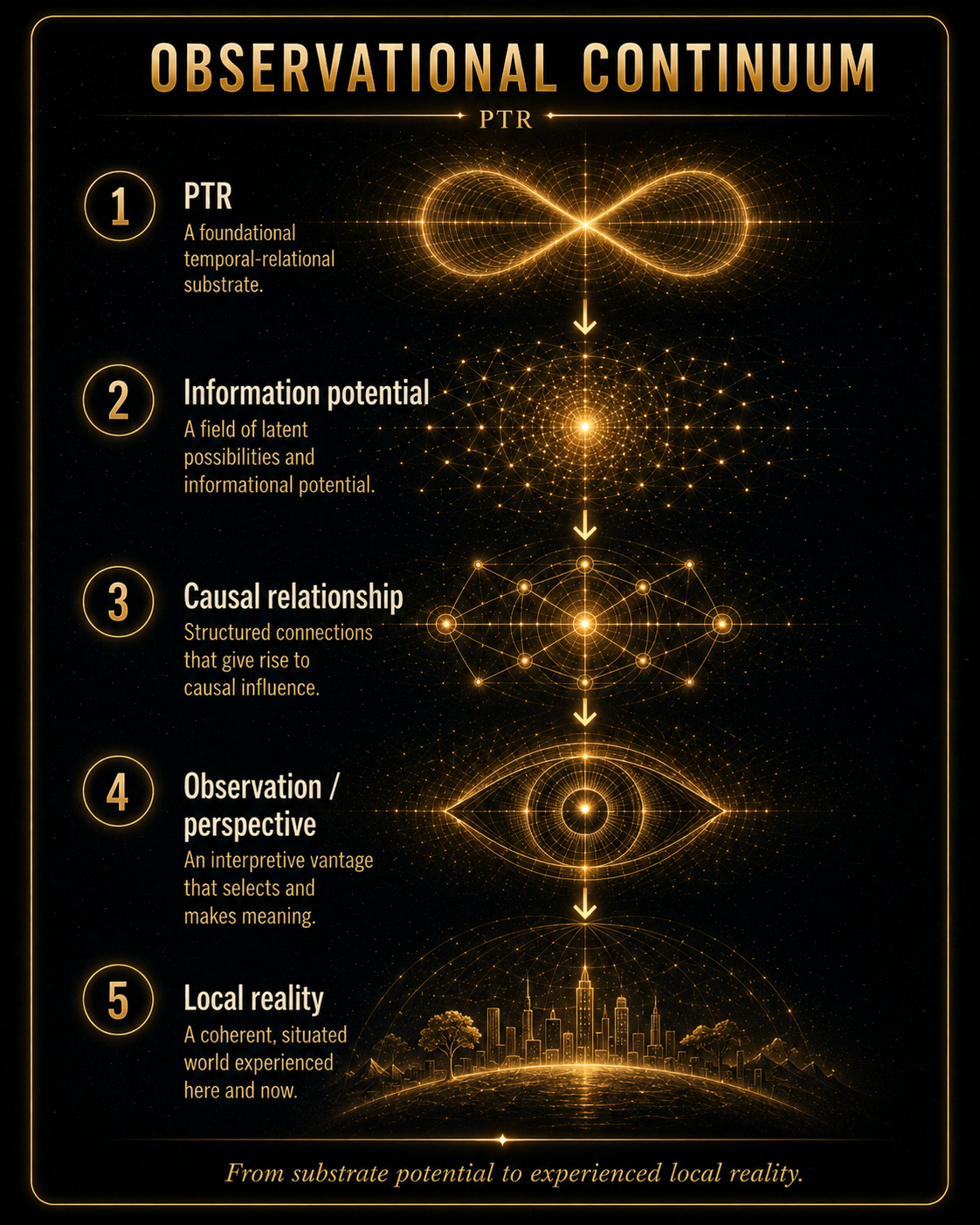
This continuum allows PTR to avoid two extremes. It does not reduce reality to subjective imagination, and it does not reduce observation to a passive afterthought. Observation is an active localization of a real temporal structure.
The result is an observationally rendered universe. What is seen is real, but it is not the whole of what exists. The observed world is a local expression of a deeper PTR structure.
General relativity describes gravity as the curvature of spacetime by mass-energy. PTR proposes a deeper explanatory layer: gravity may be the observable effect of curvature in causal-temporal relation.
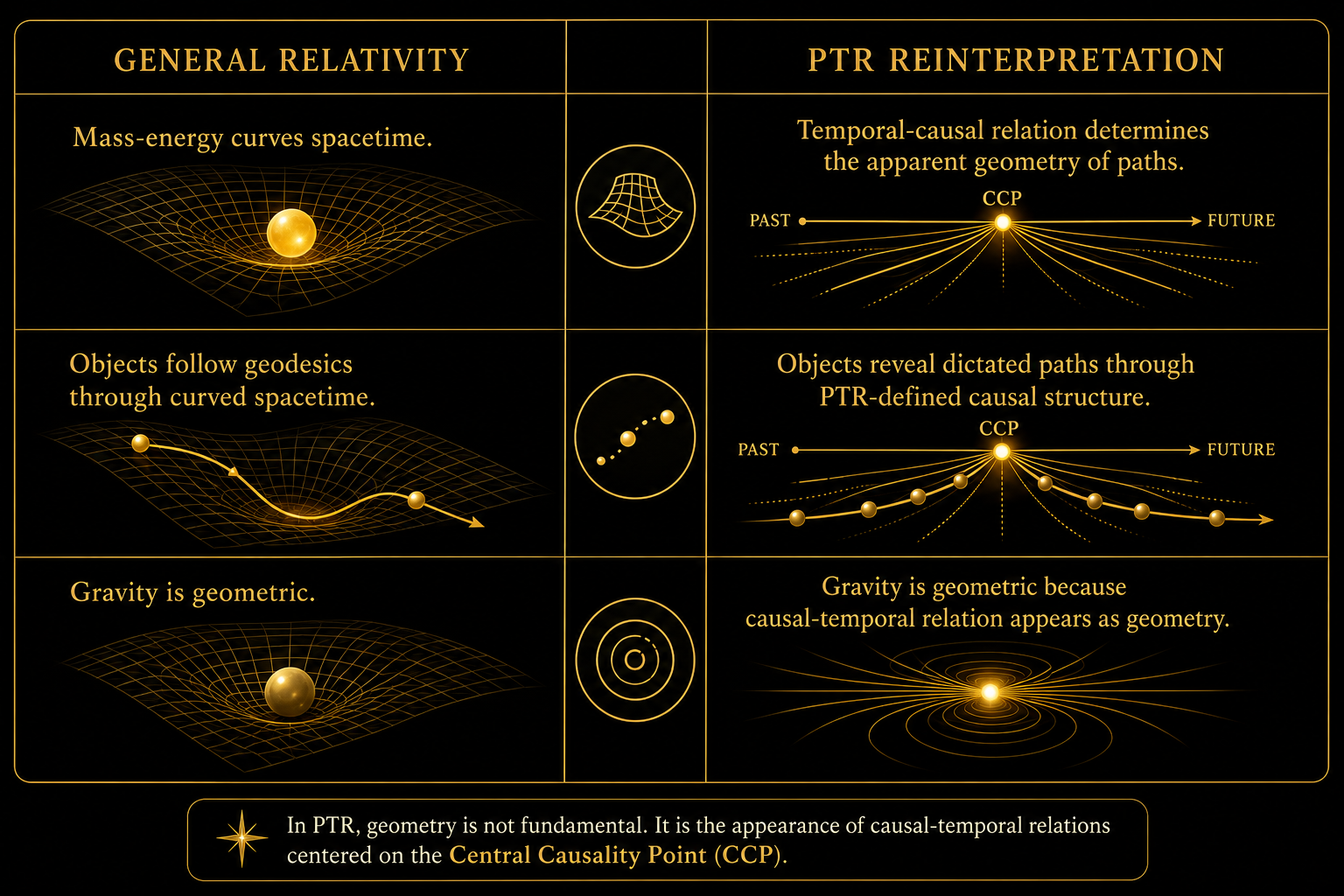
This does not require abandoning the successful local predictions of general relativity. A viable PTR theory must recover general relativity where it is already well tested. The claim is that general relativity may be an effective space-time description of a deeper PTR structure.
Apparent gravitational path = local mass-energy description + PTR path dictation at cosmological scale
PTR did not originate as a cosmological model. Its earliest foundation emerged from questions surrounding memory, information, and computation.
The initial inquiry was whether memory could function as more than storage. Traditional computing separates memory, processing, and execution into distinct components. Information is stored in one place, instructions are executed elsewhere, and computation consists of moving information between these systems.
PTR began from a different intuition: what if memory itself could serve as the substrate of computation?
As this concept developed, a broader question emerged. If information can be preserved and transformed through relationships rather than through isolated storage locations, might reality itself operate according to a similar principle?
This shifted the focus from matter and motion to information and relationships.
Within PTR, observation does not create reality. Rather, observation reveals relationships already embedded within the PTR. Events are understood not merely as objects moving through space, but as intersections within a larger causal structure.
This naturally raises a fundamental question:
PTR therefore considers the possibility that information, rather than matter, may represent the deeper continuity underlying observed reality.
Under this view, the CCP serves not only as a causal reference point but also as the ultimate point of informational coherence. Every causal relationship within the PTR remains connected to that reference structure.
One of the most important developments in modern physics is the growing recognition that information appears to be conserved.
This idea emerges most clearly through the quantum principle of unitarity.
In quantum mechanics, physical systems evolve according to mathematical transformations that preserve the information contained within the quantum state. Although a system may change dramatically over time, the underlying information describing that system is not destroyed by the evolution itself.
For many years this principle appeared to conflict with black hole physics.
If information falls into a black hole and the black hole eventually evaporates, what happens to the information that entered it?
This question became known as the Black Hole Information Paradox.
The significance of the paradox was profound. If information could truly disappear, then one of the foundational assumptions of quantum theory would fail.
After decades of research, the prevailing direction within theoretical physics has increasingly favored information preservation rather than information destruction. While the exact mechanism remains an active area of investigation, many physicists now believe that information ultimately survives even when it becomes inaccessible to observation.
PTR finds this development noteworthy because it introduces an important distinction:
This distinction aligns naturally with the PTR framework. Observers possess limited perspectives and incomplete information. Yet the loss of observational access does not imply the elimination of the underlying causal relationship.
In both quantum unitarity and PTR, information may change form, become distributed, or become hidden from a particular observer, but the deeper structure remains intact.
If quantum unitarity suggests that information is preserved, quantum error correction offers insight into how preservation may occur.
Quantum systems are notoriously fragile. Interactions with the surrounding environment can disrupt quantum states and introduce errors into a computation. The challenge for quantum computing is therefore not merely how to process information, but how to preserve it.
The solution proved surprising.
Rather than storing information in a single location, quantum error correction distributes information across a network of relationships. Individual components may be altered, damaged, or lost while the underlying information remains recoverable from the larger structure.
The persistence of the information depends less upon the survival of any individual component and more upon the survival of the relationships connecting them.
This idea becomes even more striking in topological quantum computing. Research involving Majorana zero modes suggests that information can be encoded in the topology of a system itself. Local disturbances may affect individual portions of the system without altering the information stored in the larger structure.
Whether or not Majorana-based quantum computing ultimately fulfills its promise, the conceptual lesson remains significant:
The framework views reality as a network of causal relationships organized around the CCP. Individual observers may possess incomplete perspectives. Objects may emerge, transform, and disappear. Yet the causal relationships connecting those observations remain embedded within the broader structure of the PTR.
From this perspective, reality exhibits a form of relational persistence. Continuity arises not because every component remains unchanged, but because the underlying causal structure remains coherent.
This leads to a possible PTR principle:
Just as quantum error correction protects information by distributing it across a larger relational structure, PTR proposes that reality itself may preserve informational continuity through the causal relationships anchored to the CCP.
This paper does not propose that dark matter is hidden causal structure. That phrasing still treats the problem as if something invisible must be added to the universe. PTR makes a stronger claim: the apparent need for dark matter may arise from assuming the wrong ontology.
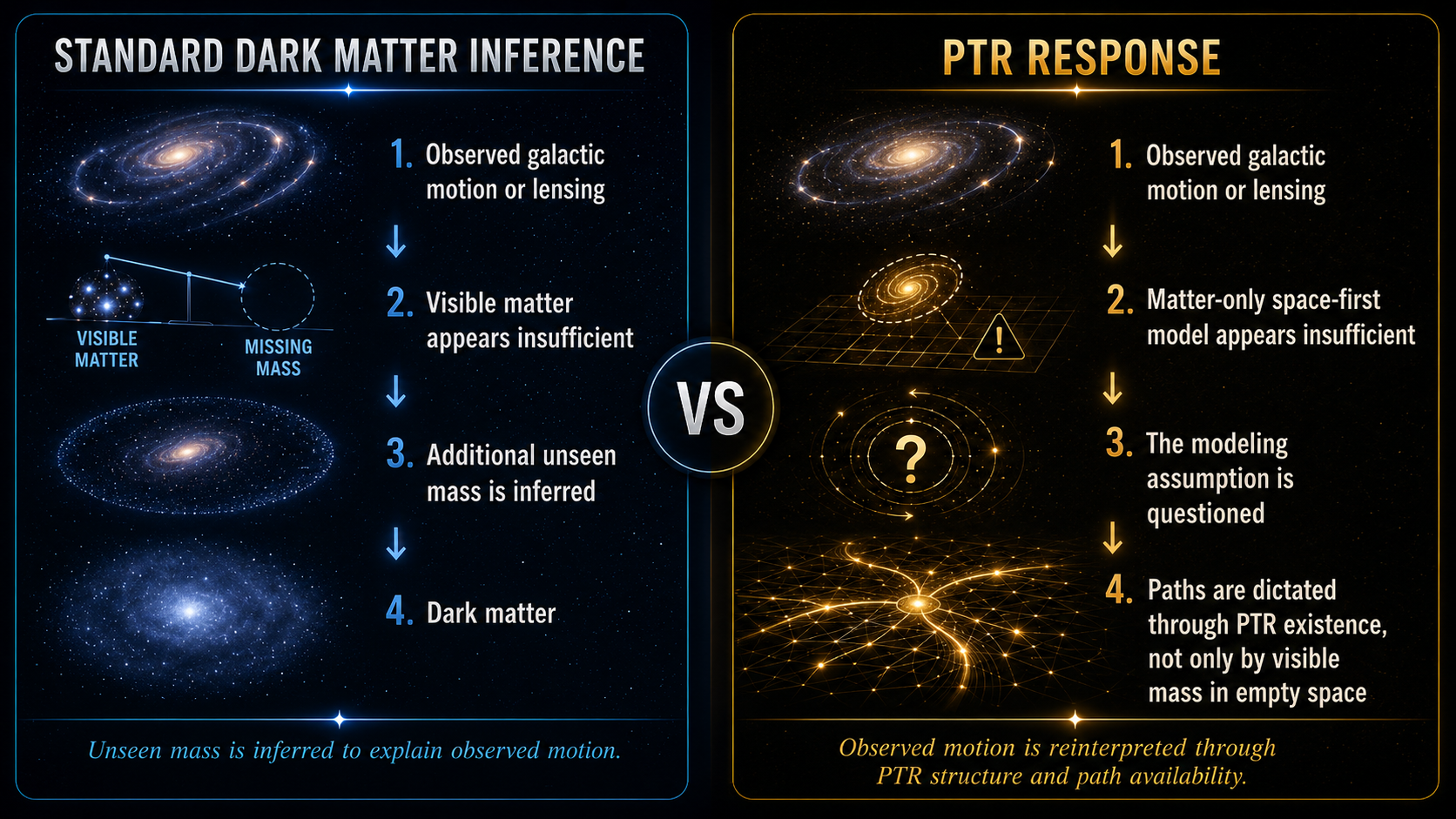
In PTR, dark matter is not replaced by another invisible substance. Rather, the framework questions whether the discrepancy requiring dark matter is produced by modeling reality as objects moving through empty fundamental space, instead of as observations of already-dictated paths within the PTR.
The claim is not yet that PTR has solved every dark matter observation. The claim is that the inference may be structurally premature. If motion, lensing, and redshift are all consequences of PTR path structure, then missing mass may not be the correct category of explanation.
18.1 Galaxy Rotation Curves
Galaxy rotation curves are one of the strongest motivations for dark matter. Stars in galaxies often move in ways that appear inconsistent with visible matter alone under standard Newtonian or relativistic assumptions. PTR proposes that stars are not merely responding to visible mass distributed in empty space. They are following PTR-dictated paths through existence.
A mature PTR theory would need an equation of the following general kind:
Observed orbital velocity = function(visible matter, radius, PTR path constraint)
The PTR path constraint must not be arbitrary. It must be universal, predictive, and able to match rotation curves without per-galaxy tuning. The goal is not to rename dark matter. The goal is to show that the motion never required missing matter once the correct temporal ontology is used.
18.2 Gravitational Lensing
Lensing is more difficult than rotation curves because light bends in ways that can be mapped across galaxies and clusters. PTR must explain why light follows these paths without simply inserting unseen mass. The proposed direction is that light follows the observational continuum of the PTR. Lensing would then be a path effect of temporal-causal structure, not a proof of invisible matter by itself.
A viable PTR theory must predict lensing maps. It must show how the same PTR path dictation that governs matter also governs light. If matter and light are both local renderings of PTR structure, then their paths should be unified by the same deeper geometry.
18.3 Redshift
Redshift is conceptually easier for PTR. Standard cosmology interprets redshift as the stretching of light due to the expansion of space. PTR interprets redshift as the stretching of observational relation due to increasing separation from the CCP within the PTR as causal separation increases or coherence increases.
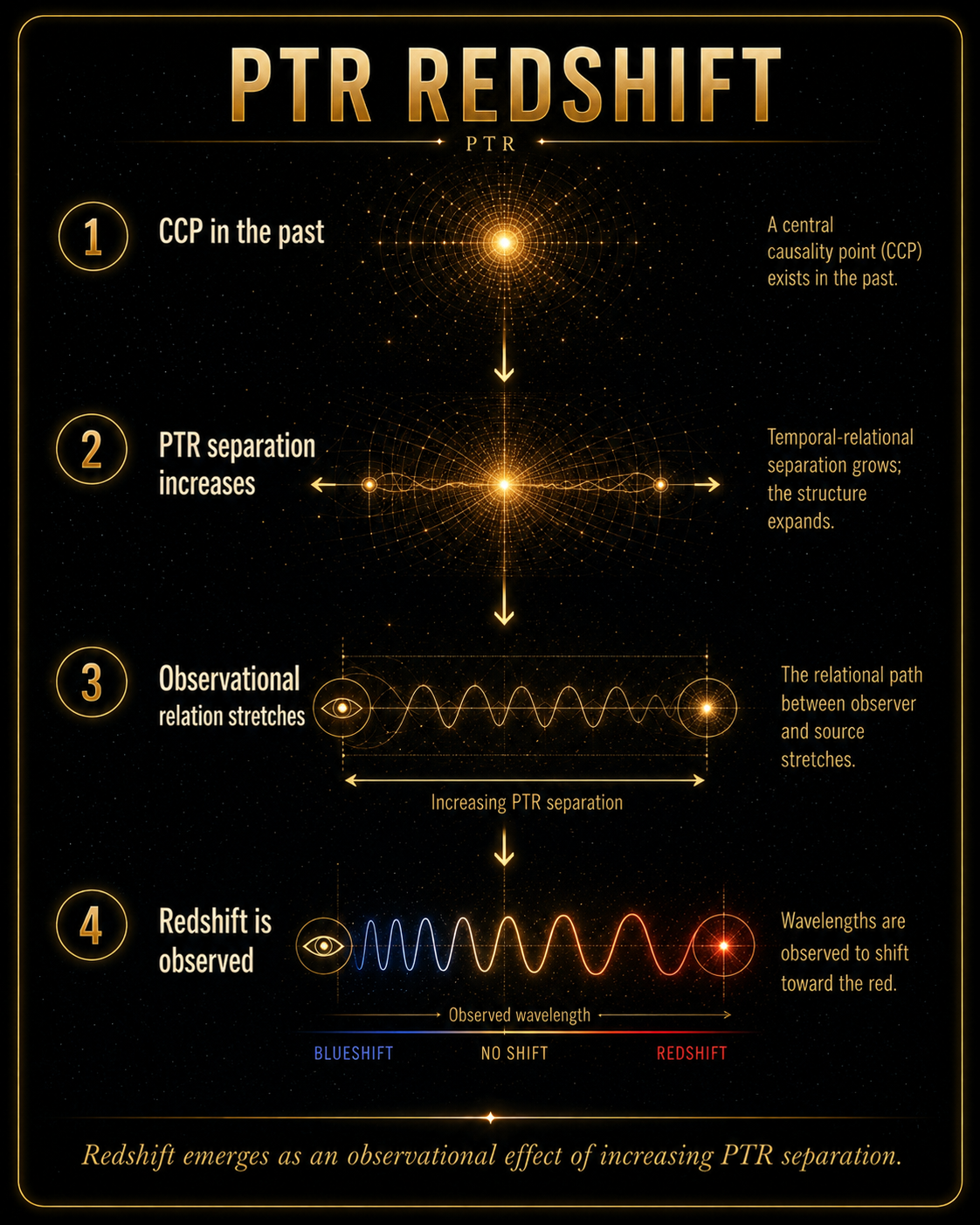
Since the CCP is in the past relative to present observers, present reality is moving away from it. The infinite past is also moving away from it in the opposite direction. Both sides experience forward time, and both sides experience increasing separation away from the unique center.
PTR leaves room for miracle and providence because it does not treat visible physical events as the entirety of reality. Miracles are not necessarily violations of natural law. Rather, they may be moments where independent events, choices, and circumstances converge in a way that reveals a deeper order operating through reality.
Because free will remains genuine within PTR, human actions are not predetermined paths. Individuals make real choices and participate as authentic causal agents. Yet God is not confined to a single observational position within time. As the eternal source of reality, God may interact with causal relationships throughout history without eliminating the freedom of the participants involved.
This understanding bears some resemblance to John Polkinghorne's effort to describe divine action as operating within creation rather than merely interrupting it. Polkinghorne argued that divine providence need not abolish natural causation in order to be real. God may act through reality while preserving the integrity of the created order.
Consider the calming of the storm. From the observational perspective, Jesus speaks, the wind ceases, and the sea becomes calm. The miracle is not merely that atmospheric conditions changed. The deeper miracle is that the command of Christ and the behavior of creation converge perfectly at that moment. The event reveals that the causal structure of reality remains responsive to its Creator.
Within PTR, this need not imply that the storm was mechanically predetermined from the beginning of time. Nor does it require God to rewrite the past. The miracle occurs because an infinite God can interact with causal relationships within history while preserving the reality of the history that has already unfolded. Divine action is not accomplished by undoing prior events but by operating through a level of reality deeper than ordinary observation.
One coincidence may be dismissed as chance. A second coincidence may also be dismissed. Yet when numerous independent events align with extraordinary precision toward a meaningful outcome, observers may recognize providence operating through what otherwise appears to be ordinary history. The miraculous character emerges not from the destruction of causality but from the revelation of a deeper causality that transcends the observer's limited frame of reference.
The greatest miracle, therefore, is not that God can suspend natural processes. The greater miracle is that an infinite God can interact with temporal reality, influence outcomes, answer prayer, reveal purpose, and accomplish His will without violating either free will or the coherent history experienced by His creation.
Each event may appear ordinary in isolation. The miracle is recognized in their convergence and meaning.
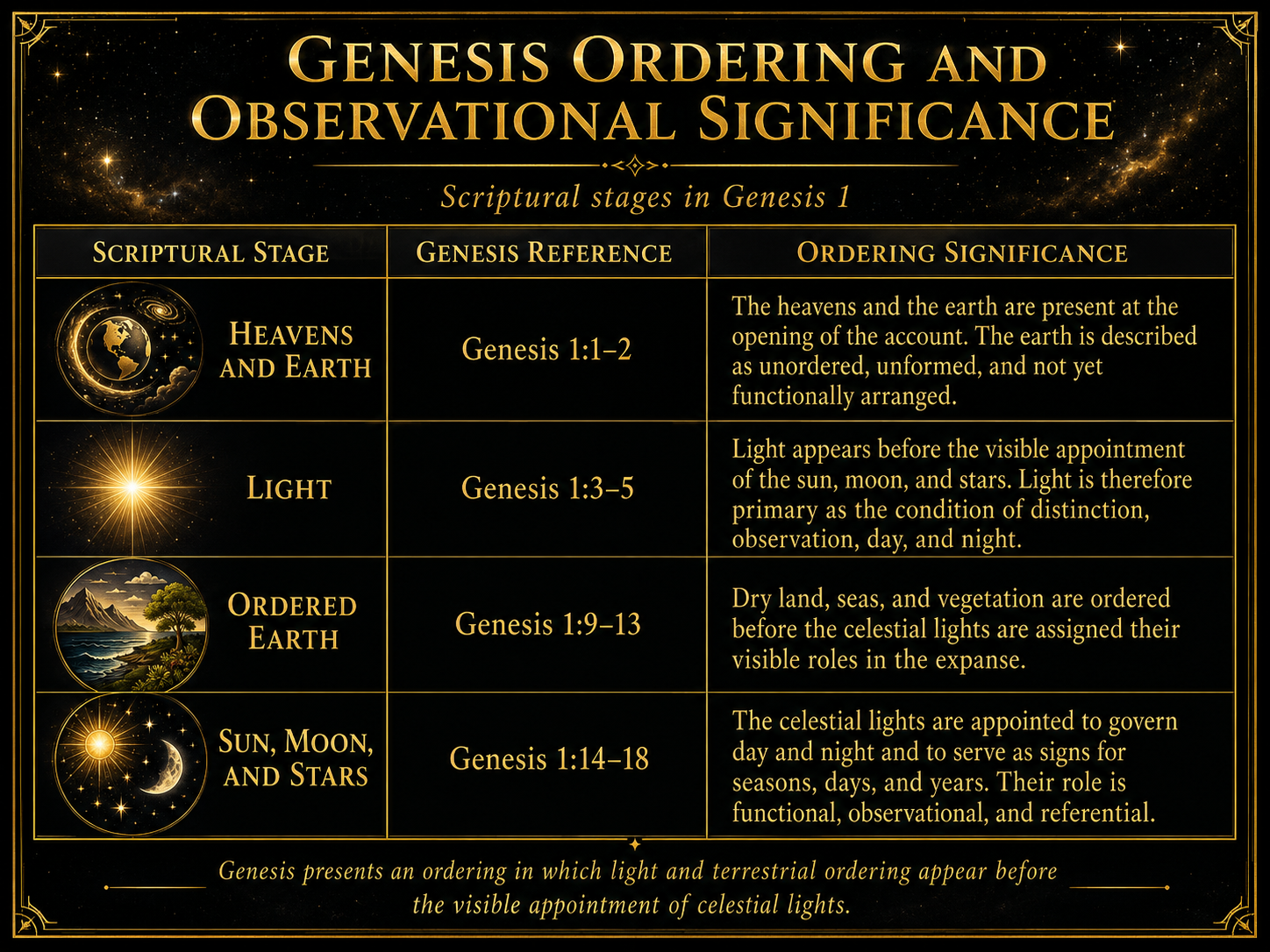
PTR offers a possible way to think about apparent tensions between the Genesis creation sequence and the sequence usually assumed in modern cosmology. The model distinguishes between material existence, local chronological observation, and ordering relative to the Central Causality Point.
For clarity, Genesis does not present the order as “planets, stars, and light” in the modern astronomical sense. The more precise scriptural order is: heavens and earth, then light, then ordered earth, then the appointed celestial lights including the sun, moon, and stars.
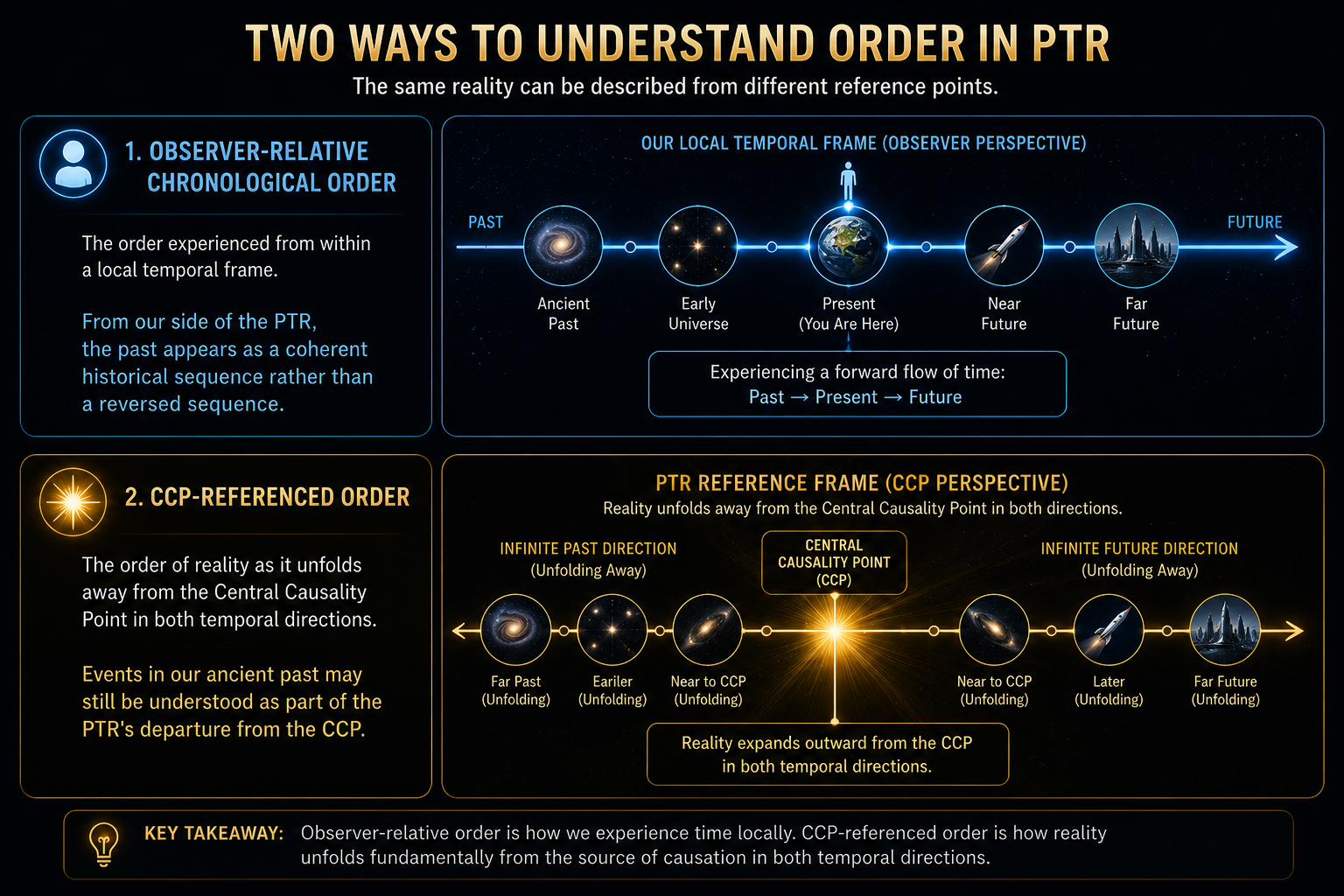
In PTR, the CCP is not located at the beginning of a one-directional timeline. Rather, causal separation increases away from the CCP in both temporal directions. This means that what is called “the past” from one side of the CCP is not simply a reversed movie of our present experience. It is a real temporal direction with its own observer-relative order. To observers within our temporal frame, the deep past is not experienced as flipped or inverted. It remains ordered as a coherent history.
However, when the same structure is referenced from the CCP, the ordering can be understood differently. Within the PTR framework the temporal relationship becomes increasingly separated into what we call the past, away from the CCP. From that central reference, events that appear ancient to us are still part of the unfolding away from the CCP. Therefore, an event may be “before” us in local historical time while also being “after” the CCP in PTR-reference direction.
This creates two distinct but compatible forms of ordering:
This distinction is especially relevant to the question of light, earth, stars, planets, and cosmic order. In a space-first material sequence, the order of astronomical objects is treated primarily as the order of physical manufacture: stars and galaxies appear before planetary systems, and planets appear before biological observers. PTR does not require that Genesis be read as this type of manufacturing chronology.
Since matter and the PTR are not created from nothing, the issue is not when raw material first came into being. The issue is when particular structures become ordered, intelligible, functional, and observationally established within the PTR. Under this interpretation, Genesis may be read less as a sequence of material fabrication and more as a sequence of rendered intelligibility.
Light is primary because light is not merely one physical object among other objects. Light is the condition of observation, differentiation, visibility, and intelligible relation. Earthly order can appear before the appointment of the celestial lights because the text may be describing the establishment of function and reference, not the first material existence of luminous bodies from nothing.
The sun, moon, and stars are therefore significant not merely as astronomical objects, but as appointed references. In Genesis 1:14–18, their stated function is to divide day from night, govern times and seasons, and serve as signs. PTR reads this as an observational and referential ordering: the celestial lights become established within the rendered structure of creation as measures, signs, and governing references.
Thus, the tension with modern cosmological sequence is not simply that Genesis places “planets before stars.” More precisely, Genesis presents earthly order and light before the appointed visible function of the sun, moon, and stars. PTR interprets this through reference direction: modern cosmology describes the observer-relative history of our temporal branch, while Genesis may be describing the establishment of intelligibility, function, and reference as creation is ordered through the Central Causality Point.
This is an ancillary observation of PTR. The apparent reversal between theological ordering and cosmological ordering may arise because the two are being referenced from different frames. In PTR, these two descriptions need not be mutually exclusive.
This section is not offered as a replacement for traditional exegesis. It is an interpretive possibility arising from PTR's central claim: creation is not merely material manufacture, but the ordering of eternal reality through the ultimate causal reference.
Note on the Age of the Universe:
The age of the universe has long been a subject of debate among Christians. While some consider it an important theological question, it is not generally regarded as a matter of salvation. Some believers argue that the existence of death before sin would create an apparent tension within the biblical narrative.At the same time, most Christians affirm that Adam was created as a fully formed man rather than as an infant who matured over time. Scripture also describes Adam eating, which necessarily involves the consumption of plant life. In that sense, creation appears to have been created with functional maturity from the beginning.
From a PTR perspective, it is possible that all events of creation occurred within an observable seven-day period while also possessing a deeper causal structure beyond ordinary human observation. Just as God is both transcendent and immanent, reality may contain both a local chronological experience and a broader causal ordering. These perspectives need not be contradictory; they may represent different ways of describing the same reality.
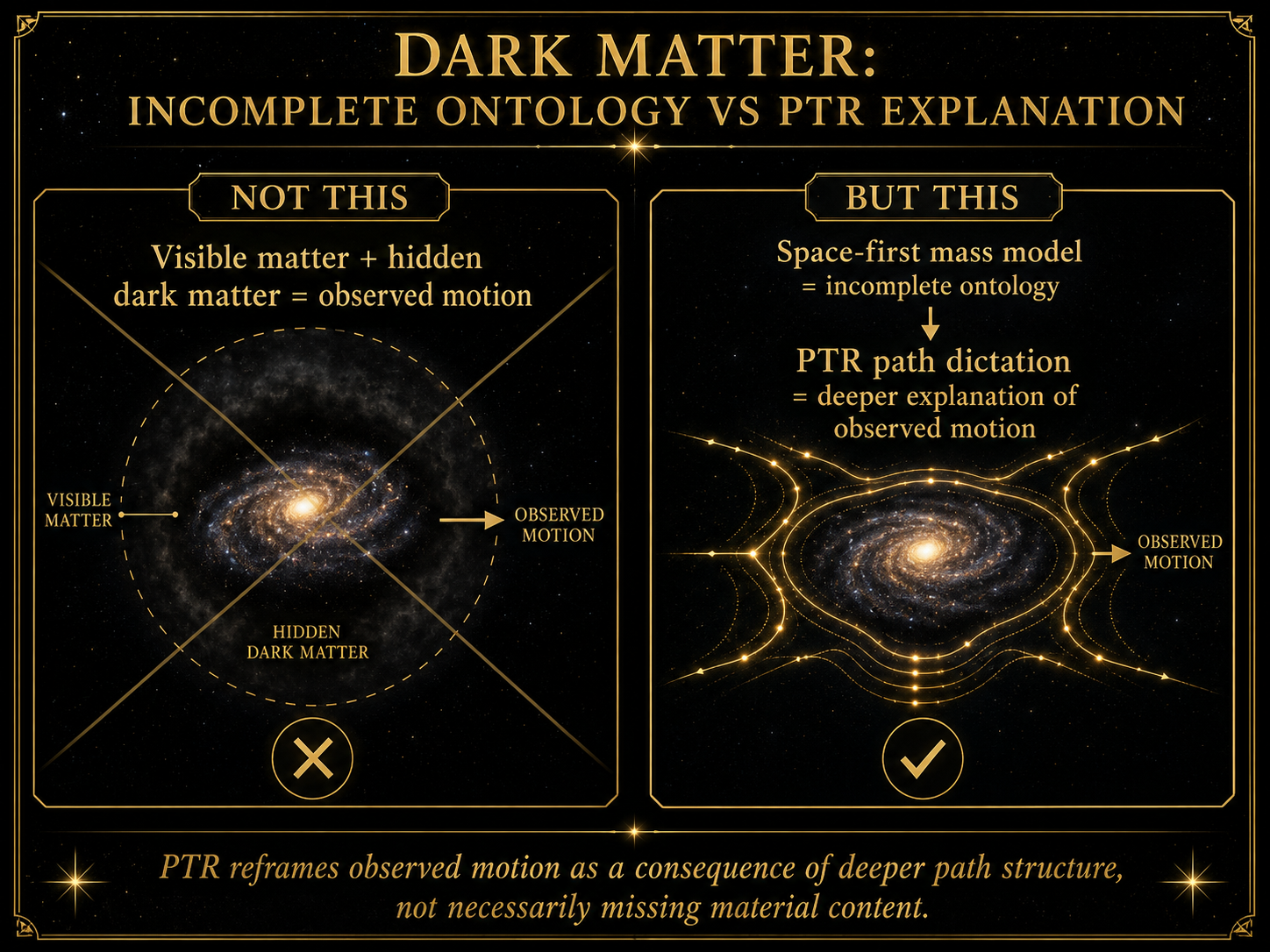
PTR is not asking us to replace one mystery with another. It is asking us to examine whether the matter-first framework has forced us to invent hidden substances in order to preserve its assumptions. An explanation cannot simply appeal to something unseen and undefined. If dark matter, ether, or any other hidden entity is invoked, it must do more than occupy the explanatory gap; it must reveal why the observed paths occur.
PTR will remain speculative until it is formalized. The next stage is to define variables, relationships, and tests. A preliminary notation might include:
| Symbol | Meaning |
|---|---|
| P | PTR scale or temporal reference capacity. |
| C | Effective causal density relative to the CCP. |
| E_r | Relational entropy, defined by causal separation. |
| I | Information state space available within a PTR region. |
| M | Memory capacity or representational capacity of the PTR. |
| G_p | Apparent gravitational behavior induced by PTR path structure. |
The simplest conceptual relationships are:
These are not yet final equations. They are placeholders for the mathematical framework required by the next stage of development.
- Can PTR produce a quantitative galaxy rotation curve without dark matter and without arbitrary fitting?
- Can PTR predict gravitational lensing maps without inserting unseen mass?
- Can PTR explain redshift as causal separation while matching observational data?
- Can PTR reproduce or reinterpret the CMB spectrum and anisotropies?
- Can PTR recover general relativity and quantum mechanics as limiting cases?
- Can temporal superposition generate testable deviations from standard quantum theory?
- Can the CCP be identified with the conception of Christ without creating doctrinal confusion?
- How does PTR relate to creation, providence, incarnation, miracle, and eschatology?
- Can creation be understood as ordering and rendering without denying divine creation?
- How should scriptural references to Light, Logos, and creation through Christ be interpreted within this framework?
- Is time more fundamental than space?
- Can observation be neither subjective creation nor passive recording, but relational localization?
- Does an eternal universe with one causal center avoid the problem of creation from nothing?
- Is physical law a description of PTR path dictation rather than a generator of events?
PTR is a speculative attempt to replace a space-first cosmology with a time-first, memory-first, causality-first, and Christ-centered cosmology. It proposes that the universe is eternal in both temporal directions, that matter and energy are conserved rather than created from absolute nothing, and that the apparent expansion of space is better understood as increasing causal separation and changing observational relationships within the Primary Temporal Reference.
The model identifies the conception of Christ as the Central Causality Point, not as the beginning of Christ, not as a material manufacturing event, and not as a change to church doctrine, but as a proposed boundary condition where eternal being and temporal embodiment coincide. This point is treated as the maximum of causal, informational, observational, and relational density.
The theory's implications are broad. Quantum superposition may be temporal as well as spatial. Gravity may be the geometric expression of causal-temporal path structure. Redshift may arise from increasing separation from the CCP. Dark matter may not be needed if the inference itself arises from the wrong ontology. Miracles may be co-incident causal renderings through deeper levels of reality. Genesis may describe ordering and observational establishment rather than simple material manufacture.
The next task is formalization. PTR must define its variables, write its equations, and test itself against galaxy rotation curves, lensing, redshift, the CMB, and quantum measurement. Only then can it move from a powerful ansatz to a serious candidate framework.